
 E-Paper



Just Like That | Witnessing Nature's Beauty in Delhi
Explore the beauty of Delhi’s trees and lamentations on the destruction of their fragrant creations through Gulzar's odes

 Prefer HTon Google


Every year, the United Nations celebrates June 5 as the World Environment Day to encourage worldwide awareness and action to protect our environment. No doubt there is greater sensitivity to preserving the environment today, but equally, far more depredations against it are also in evidence. In our normal lives, we hardly ever pause to notice the bounty of nature that improbably still survives even in our urban ghettos.
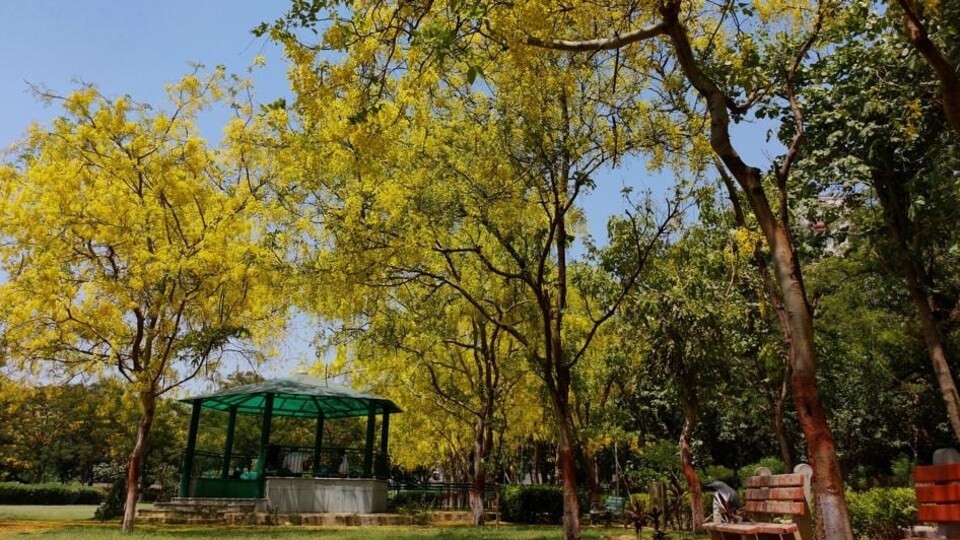
For me, it is a perennial surprise, for instance, to see how much green space exists in the haphazard concrete jungle of Delhi. The trees in the city are, in particular, something I marvel about. In fact, there is no part of the year when the beauty of a tree does not take you by surprise. In late winter or early spring, the majestic Semal or silk cotton tree blooms all over the city, its branches so laden with large red, orange or yellow flowers that sometimes the branches cannot be seen. Soon thereafter, it is the turn of the more diminutive Dhak tree with its exquisite red claw-like flowers. At one time, the Delhi Ridge and surrounding areas were full of the Dhak tree, but now many have been cut down—gone forever. As winter turns to summer, the beautiful Amaltas or Laburnum breaks into bloom, its golden shower of yellow flowers literally taking one’s breath away. The Amaltas is the national tree and flower of Thailand and the state flower of Kerala. At the height of summer, the Gulmohar bursts into a symphony of red. Originally a native of Madagascar, it now grows all over India and is called Krishnachura in West Bengal and Odisha. And, with the coming of the monsoons, it is the Jarul, with its bright pink to light purple flowers.
New Delhi was designed by Edwin Lutyens, but to my mind the real hero was the horticulturist, Sir Edwin Mustoe (1878-1942), who embellished its boulevards by slow growing but magnificent trees like the peepal, the jamun, the neem and the imli. Large parts of the capital are still a haven of green, with many lovely parks like the Lodhi Gardens, the Sundar Nagar Nursery, Buddha Jayanti Park, and the Nehru Park, resplendent not only with seasonal flowers but glorious trees.
A grand tree, standing aloof as if for eternity, can have a remarkably soothing effect on people. But its destruction can also be a cause of great pain. Here is a sample of this pain, as reflected in a poem by Gulzar, which I have translated into English for Green Poems, a book of his poetry exclusively devoted to nature published by Penguin.
The Tree at the Corner
Have you seen, at that corner, that ageing tree?
It is an acquaintance I have known for years.
When I was small, I had climbed on to its shoulders
From the adjacent wall, to steal a mango
My feet touched one of its branches that was hurting
It threw me down with a thud
Angry, I threw many stones at it.
At my wedding, I remember, it gave its branches
To warm the fire for the havan
And when Beeba was pregnant
It threw, every afternoon,
It's raw mangoes for my wife.
With time, all its leaves and flowers disappeared.
I would be jealous when Beeba told the baby:
‘You have come from that tree, you are his fruit’.
Even today I feel angry when, as I pass the turning,
he coughs
And says: ‘Hey, have you lost your hair?’
Today, since morning, the municipal authorities are
cutting it to pieces
I do not have the courage to go up to the corner.
In writing about nature, Gulzar gives it a personality of its own. He does not so much write about it as he writes through it, allowing it to speak. Green Poems is a testament to the poet’s abiding concern about what we as human beings are doing to nature. This short poem is a particular favourite of mine:
Trees
When trees pause to think, flowers bloom
Dipping their fingers in the sunshine
They write their thoughts on swaying branches
Picking their words in different hues of colour
They converse with fragrances and call us to them.
Look at what our wont is:
The moment anything emerges which is fragrant,
We chop off its neck.
Ultimately, people will begin to care about nature when they personally become conscious of its presence and value. Our ancient sages had that sensitivity. The Shanti Mantra of the Upanishads says:
“May the heavens be at peace; peace to the water; peace to the trees and nature; may the Gods be at peace”.
Pavan K Varma is author, diplomat, and former Member of Parliament (Rajya Sabha).
Just Like That is a weekly column where Varma shares nuggets from the world of history, culture, literature, and personal reminiscences with HT Premium readers
The views expressed are personal


