E-Paper



Metro Matters | The need to declutter Delhi
Time agencies and communities came together to enforce parking rules and declutter Delhi

 Prefer HTon Google


Already suffering from chronic air pollution and road congestion, Delhi desperately needs to find a solution for the clutter caused by its private vehicles. It is therefore surprising that despite legally enforceable parking rules in place since September 2019, the capital of India has made little headway in addressing this critical quality-of-life concern.
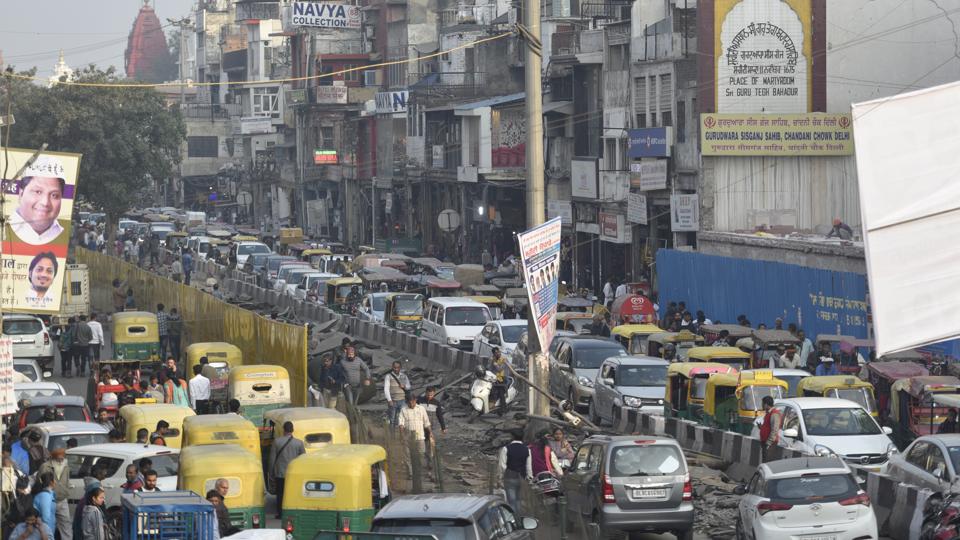
While most other Indian cities would struggle with where to start, Delhi already has a roadmap in place. The Delhi Maintenance and Management of Parking Places Rules, prioritise the rights of pedestrians and cyclists, call for securing footpaths, green spaces, intersections, access for emergency vehicles, the differently-abled and vendors from haphazardly parked vehicles.
It also provides for mapping and inventorying all kinds of existing parking spots, demarcating on-street slots in both residential neighbourhoods and commercial areas, creating new lots, and introducing a dynamic pricing mechanism for demand-side management.
The rules also offer timelines. But stakeholder agencies tasked with the execution of the plan have so far made little progress. Municipal officials cite financial and space constraints and resistance from traders and residents as the main hurdles. The residents and traders' associations complain of a lack of consultation in the planning process. With civic polls due in the next few months, harsher decisions such as hiking the parking fee have already been deferred.
Rational pricing
Urban mobility experts have for long maintained that it is unfair to subsidise motor vehicle owners by offering public land for free or charging a pittance for parking. Back in 2006, even the National Urban Transportation Policy advocated levying a high parking fee that truly represents the value of the land occupied to be used as a means to make public transportation options more attractive.
Challenging Delhi’s free parking culture, the draft parking rules had also recommended a fee for using public land for parking a vehicle in a residential neighbourhood. But deleting the clause later, the government argued that levying the fee would not guarantee the safety of cars, would overburden the civic agencies and the money collected in such colonies would go unspent.
In the more competitive market of the National Capital Region, many private builders charge as much as ₹2-3 lakh for an additional parking space within the gated communities. But in Delhi, even the proposal to increase the one-time parking fee — a small amount charged at the time of registration — was withdrawn by the government in 2018, which stated that the proposal was “irregular for many reasons” and didn’t include all municipal zones.
The notified parking rules retained the provision of fixing a base parking fee by factoring in the category of spot (on-street parking to be more expensive than that off-street), duration, peak and off-peak hours. Right now, barring a few markets that have a higher fee, the three municipal corporations charge ₹20 for the first hour and ₹100 for five hours and above. This, a municipal official said, could have gone up to a maximum of ₹700-800 depending on determining factors mentioned in the new parking rules. But the hike was recently deferred by the government that cited people’s inability to pay more because of financial hardships caused by the pandemic. Anticipating pushback from residents and retailers, it was unlikely that the political class would have taken a chance with this unpopular reform right before the municipal elections.
The real barrier to charging for curb (on-street) parking is always political and not technological, says Donald Shoup, a transportation professor at the University of California, Los Angeles, in his book “The high cost of free parking”. The cities can overcome this political barrier, he suggests, by returning all parking revenue to the neighbourhoods that generate it.
Delhi’s parking rules, in fact, call for utilisation of parking revenue for local development work related to the safety of pedestrians, maintaining non-motorised vehicles lanes, and developing parking spaces. But to generate this revenue, authorities have to initiate concrete action with utmost transparency.
Streamline and regulate
The existing parking rules, in fact, give enough scope to organise legal parking, penalise illegal parking, manage demand and even make a case for paid parking.
Anumita Roy Chowdhury, executive director at Centre for Science and Environment, who was a member of the committee that drafted the parking rules, says the framework allows the introduction of parking permits in residential areas. But to get there, the municipalities have to start framing and implementing the parking management area plans that are provisioned in the parking rules and were to be in place within the first four months of the notification in September 2019.
These plans, which have been adapted from the parking management district plans provisioned in the Delhi Master Plan-2021, are to be created mandatorily by municipalities in consultation with local stakeholders, transport planners and urban designers by assessing the parking requirements of a neighbourhood, demarcating all types of parking as well as essential street amenities and making sure that the parking slots, which are numbered and have signage, leave space for pedestrians, cyclists, emergency vehicles and vending zones.
Residents can apply for stickers or passes for use of designated public parking spaces, and the second car can be permitted within the neighbourhood depending on the space available, the municipal official explained. To park extra cars, the rules stipulate the use of open areas, other than parks and green zones, against a fee and a paid shuttle service for pick and drop. Similarly, empty and under-utilised lots, as well as plots of land, community halls, and parking in government offices, need to be identified to accommodate stack/multi-level parking facilities if required, the guidance framework for the PAMP states.
But solutions have to be local, ingenious and not capital intensive. The rules dissuade municipalities from building new standalone multi-level parking lots because the land is valuable and should be put to important public use. Instead, it suggests stack/portable parking, which is less expensive and can be used in different locations with changing needs.
The rules direct communities to explore shared off-street paid parking between neighbourhoods, which may have different peak hours of demand. An office facility, the rules say, could be used by cinema halls, restaurants or residents living in the neighbourhood as paid evening/night parking.
Public support
The South Delhi Municipal Corporation has made 16 plans and uploaded them on its website for feedback from stakeholders, but the response has been tepid. The plans now await approval and notification from the government. North Delhi Municipal Corporation has seven and its counterpart in East Delhi has two plans in the works.
The parking rules call for the involvement of local stakeholders in micro-planning and enforcement mechanisms but resident bodies were not consulted in the preparation of the PAMP, says Atul Goyal president of United Residents Joint Action (URJA). “We are not against the idea of streamlining parking or even paying for it. But going by the past record of the municipalities, there is huge mistrust among the residents,” he says.
Rajiv Kakria, the convener of the Save Our City campaign, concurs. “The municipalities in Delhi had already collected huge sums in development and parking and conversion charges from residential and commercial areas but never delivered facilities that they promised. Providing adequate parking was one such promise.”
Since 2006, over 2,500 streets in residential areas have been declared under the categories of commercial, mixed land use and pedestrian streets in the city. The municipal corporations were responsible for providing parking space in these areas for which they even collected parking and conversion charges from each commercial unit. But only a few multilevel parking lots were built. With parking a mess, these stretches are some of the most congested spaces in the city today.
Even residential neighbourhoods – from the most affluent to the working class -- are choc a bloc with vehicles. Stilt parking spaces, which were made mandatory for all developments since 2011, either don’t have the capacity to park multiple cars that each household in the building owns, or are used for non-parking purposes, taking the spillover back on pavements and streets.
As a result, too many cars are cluttering public land that is essentially meant for use by pedestrians and cyclists. Cars encroach on the space for children to play and the elderly to take a stroll in the neighbourhood streets. They restrict the right of way for ambulances and fire-tenders and access to bus stops and Metro stations.
Goyal says to convince residents about the efficacy of the parking area management plan, municipalities should have demonstrated some success models. “They did start pilot projects in Lajpat Nagar, Kamala Nagar and Karol Bagh but after some initial work, they just left them halfway. Neither the traders nor the residents could gauge the full benefits of these experiments,” he says.
The exercise has to be conducted more convincingly, adds Roy Chowdhury. “If you demarcate areas for parking and grant parking permits to residents and for that even if residents pay a small amount, it brings down the chaos in the neighbourhood. They will understand the benefit of this because the moment this system is in place, it stops people from other areas coming and crowding these neighbourhoods,” she says.
Limit demand
While car owners should pay for using public space for parking, such a fee in itself may not deter multiple car ownership. But if rationing of parking space outside one’s home allows only one slot, residents who will have to look to park in paid parking elsewhere in the neighbourhood may change their mind.
“While taking care of existing demand, the parking area plans also limit demand for the future. It should reduce the excessive purchase of multiple cars because if people know that there’s no parking space for the second car outside their homes, they will think twice before buying it,” says Roy Chowdhury.
In 1962, Japan passed the Garage Act, making it mandatory for car owners to get a garage certificate — shako shomei sho — from the local police. This certificate was to serve as proof of off-street parking space, owned or leased, for vehicle registration.
The policy has worked well in Japan because it is coupled with the ban on overnight on-street parking. However, the policy could still be successful if combined with a robust on-street parking permit system, suggests Reinventing Parking, an online blog run by transport expert Paul Barter.
Although it was not the stated aim of the garage rule, it probably did slow down the growth of car ownership in Japanese cities, the blog states, adding that it is most impactful in neighbourhoods that have high property prices and where leased parking spaces are also expensive. "It deters car ownership in precisely the highly accessible, densely developed, transit-rich contexts where car ownership is least necessary.”
Under the parking rules in Delhi, permits for transport vehicles like taxis will be given on the basis of parking proof. The same rules should apply to the purchase of a second car by private citizens as well.
Never enough parking
Delhi already has 10 million two-wheelers and cars registered on its rolls and a large part of this massive fleet does not even need to ply to occupy road space. Worse, it sees at least 500 new cars being registered every day.
No city authority can be obligated to accommodate the ever-expanding private car fleet. Even multi-level parking spaces, much popular with municipalities in Delhi, will eventually hit their vertical limit. That is why progressive cities around the world are trying to reduce parking spaces to discourage people from buying cars.
Delhi too has taken baby steps in this direction. In September last year, the Union ministry of housing and urban affairs gave the final go-ahead for the implementation of the dynamic parking norms that cut parking space by 10-30% in new buildings (barring residential) to be built near the metro stations and multilevel parking. It could be extended to residential areas too, but only after we have graded these areas on the basis of public transport accessibility, says Roy Chowdhury.
Any move to restrict car use will meet with some amount of public resistance but as experiments from Beijing (car purchasing restrictions) and London and Singapore (congestion pricing) have shown, none of these measures works in the absence of an efficient alternative to private vehicles. Delhi is already paying a heavy price having failed to fix its rag-tag bus service and the last-mile connectivity gaps in the Metro commutes. For a clogging, gasping Delhi to reclaim mobility and breathe easy, there is no time to dither.