
 E-Paper



Pakistan-China bonhomie reaffirms India’s rise
Beijing watchers believe there is a split between Chinese intelligence and PLA over Pakistan’s role in exporting terror to India but that the generals prevail when it comes to Islamabad’s use for containment of India.

 Prefer HTon Google


The joint statement issued after Pakistan Prime Minister Imran Khan’s four-day visit to meet his “Iron Brothers” in Beijing is most instructive as it inadvertently acknowledges the rise of India as a global power and willy-nilly reduces Islamabad to, at best, a client state.
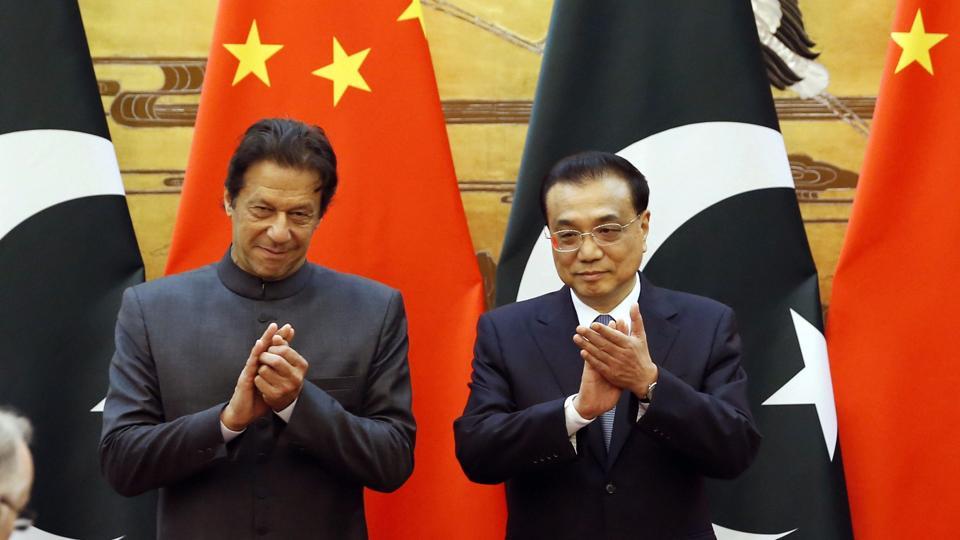
The line — “both sides dismissed the growing negative propaganda against China Pakistan Economic Corridor (CPEC) and expressed determination to safeguard the CPEC projects from all threats” — is directly pointed at India and so is big brother’s support for “Pakistan’s efforts for improvement of Pakistan-India relations and for settlement of outstanding disputes — read Kashmir — between two countries”.
On its part, Pakistan, which is self-proclaimed leader of Muslims, in the statement has upheld “one-China policy and supports all efforts made by Chinese government to realise national reunification”, a euphemism for turning a blind eye towards Beijing’s decades-long repression in Xinjiang and Tibet. All this leads us to examine the relationship between these two all weather iron brothers, where Beijing goes to the extent of vetoing UN designation of a global jihadist like Jaish-e-Mohammed (JeM) chief Masood Azhar and blocks India’s legitimate entry into Nuclear Suppliers Group with a Pakistan entry condition.
Fact is that Islamabad’s supping with Islamists targeting India and Afghanistan is not hidden from Chinese intelligence but the Peoples Liberation Army (PLA) sees Pakistan as a low-cost weapon to checkmate India with Afghanistan as a bonus.
Beijing watchers believe there is a split between Chinese intelligence and PLA over Pakistan’s role in exporting terror to India but that the generals prevail when it comes to Islamabad’s use for containment of India.
Time and again Chinese officials have privately shared with their Indian counterparts, their knowledge about the existence of terror training camps in Pakistan occupied Kashmir (PoK).
But this fact is glossed over by Beijing as its gets relief in Xinjiang with Pakistan blocking jihadist movement across the Wakhan corridor and preventing them from joining hands with their militant Uighur brothers fighting against Chinese repression.
Repression in Xinjiang virtually coincides with the rise of militancy in Kashmir in 1991 but finds little global attention as rampaging Communist party cadre backed by PLA subsume local culture and religion in both Xinjiang and Tibet through what is euphemistically called re-education of the masses.
Militancy in Xinjiang, however, cannot be swept under the carpet as a few hundreds to a few thousands from there joined the so called Islamic State in Syria in support of ultra conservative Wahabbi Islam.
The reason why China allows Pakistan to take the lead in Afghanistan affairs despite knowing all the brutal facts of Islamabad nurturing Taliban, is to buffer the militancy in Xinjiang.
While Pakistan may think its relationship with China is all milk and honey, Beijing clearly sees Islamabad as a weapon to degrade India and a mere portal to access the Arabian Sea through Gwadar just as it uses Myanmar to access the Indian Ocean through Kyaukpyu port and possibly make India vulnerable in its rapid growing North-Eastern states.
Containment of India through a pincer move is understandable as China’s worst case scenario is India and the US joining hands to counter PLA aggression South China Sea and Indo-Pacific region with the choking of the Malacca Straits as a potential flash point.
After the 73-day Indian Army-PLA standoff at Doklam, the Chinese leadership has started looking at India with respect with its paramount leader Xi Jinping taking the final call on decisions in respect of New Delhi rather than leaving this to the mandarins in the foreign ministry or PLA headquarters.
Prime Minister Narendra Modi has also made it clear to President Xi Jinping that while India will not do anything to destabilise Beijing, it will not play second fiddle to anyone in the world when it comes to protecting national interests.
While India’s ties with the US are ever growing with a bipartisan consensus, they are not at the cost of Russia even though PM Modi knows the growing synergy between Moscow and Beijing. Fact is that Indian and US interests converge in Afghanistan, Indian Ocean, Middle-East and the Far East much to the chagrin of China, which despite all aggression has a constant two-front hostility nightmare.
Beijing revised its attitude towards India after the latter stood up on Beijing’s imperialistic Belt Road Initiative and supported the freedom of navigation in South China Sea, with the US, Japan, South Korea, Singapore and Australia joining hands. China has always treated India as a civilization power with no history of animosity towards the middle kingdom. The problem is that India under Modi is a global player, not the regional supplicant China wants.


