Nature holds great promise in improving human health, if we know where to look. The first ACE inhibitor used to treat high blood pressure was derived from snake venom. Long-lived small animals like naked mole rats might hold the key to healthy ageing while larger ones like elephants are being studied for unlocking cancer treatments. Now, a group of dozens of researchers have found that hibernating bears could help prevent blood clots – a condition afflicting over 600,000 Indians each year.
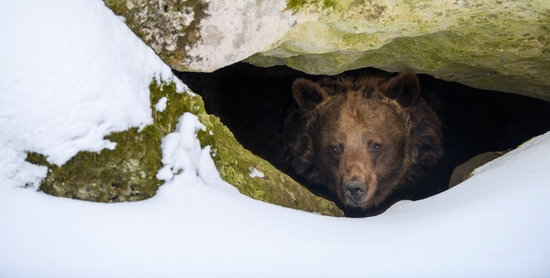
During hibernation, brown bears are able to reduce their metabolism to rates so slow that would kill healthy humans. How they achieve this feat is still mostly a mystery. (Shutterstock)
Perhaps, like me you’ve seen the warning printed on the safety card of an airline too, advising passengers that they need to move around to prevent a condition known as deep vein thrombosis.
The ability to form blood clots is essential to good health. But it’s when these clots occur inside the body that we need to worry. Untreated blood clots that can form in some people when they’re immobilised can get dislodged and migrate to the lungs, causing potentially serious conditions.
And they don’t just occur from remaining inactive during long flights. Being immobilised for days or weeks due to medical conditions or surgery also results in a heightened risk of blood clots.
Now, a team of scientists led by Ole Frøbert, a cardiologist and professor at Örebro University in Sweden and Aarhus University in Denmark and Tobias Petzold, a cardiologist at the University Hospital at Ludwig-Maximilians University in Germany have made an outstanding discovery in brown bears that opens a completely new avenue of research on blood clot prevention in people. Last week, the results of their experiments spanning multiple years were published in the prestigious journal, Science.
During hibernation, brown bears are able to reduce their metabolism to rates so slow that would kill healthy humans. How they achieve this feat is still mostly a mystery but an active area of research for many scientists including those at space agencies. After all, if humans could be induced to survive hibernation like brown bears, we could traverse the long distances of space with greater ease.
But it’s also been known for a while that brown bears don’t usually suffer from blood clots despite being in an immobilised state during hibernation for around six months. And how bears achieve this is what the researchers set out to explain in the current study.
The researchers turned to thirteen teenage brown bears roaming in the wild. Each bear was fitted with a radio collar to be able to track it down. Bears were tranquillised and blood samples were taken during their period of hibernation in winter. They were also tracked by helicopter in summer and similar blood samples were taken. Then, these two sets of blood samples were compared to see if there were any significant differences in composition that might account for protection from blood clots during winter.
The researchers found that the specific cells involved in blood clots known as platelets were less sticky in winter than they were in summer. And the researchers wanted to know the secret behind this stickiness.
The researchers identified a protein called Heat Shock Protein 47 (or HSP47, for short) which acts as a kind of glue. HSP47 was implicated in normal blood clotting but was reduced significantly in the blood of hibernating bears in the winter. Because hibernating bears had less of this glue in winter, they were less likely to get blood clots, even though they weren’t moving.
But the study didn’t just end with bears. The researchers found the same anticlotting hallmarks from the lack of the HSP47 glue in mice, pigs, and humans in specific circumstances.
It turns out that humans don’t uniformly run the risk of blood clots either. Patients with spinal cord injuries seem to be less prone to blood clots after 4 to 6 weeks of being immobilized. The researchers found that the same glue, HSP47, that was absent in hibernating bears was also severely reduced in permanently immobile people.
The researchers also looked at the blood of healthy volunteers undergoing trials on immobilisation for weeks at a stretch for research on the effects of space travel in zero gravity. They saw the exact same phenomenon. There was a reduction of HSP47 after some time.
How the body regulates the production HSP47 in people who are moving, immobilised, or permanently immobile remains a huge mystery. But with the major discovery last week, HSP47 could one day be tested as a target for new drugs. The idea would be that a drug would reduce HSP47 and lower the risk of blood clots in high-risk individuals. All of this, from hibernating bears.
Anirban Mahapatra is a scientist by training and the author of a book on COVID-19

 E-Paper