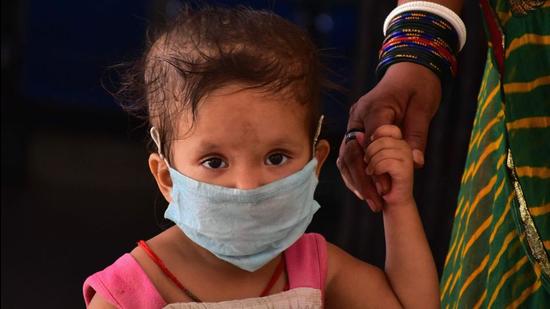
The government must study best practices on the issue of grief counselling from across the world, initiate projects using available resources, and build on this in partnership with experts and civil society organisations
Covid-19 has caused enormous suffering among all segments, but particularly vulnerable have been children who have lost a parent. The surviving parent is often so preoccupied with basic issues of survival that the child’s emotional trauma goes unattended.
The surviving parent is often so preoccupied with basic issues of survival that the child’s emotional trauma goes unattended (AFP)
The transition to schools from online classes will bring with it more pressure for the child. In all of this, grief counselling can play a very major role.
When they see a surviving parent struggle, children try to suppress their emotions to avoid create any trouble. They get little or no space to either understand their own loss or how to deal with their feelings. They experience feelings of loneliness, anxiety, anger and depression, most of which they are unable to articulate.
Namrata Joshi, therapist and manager, healing services, with a Maharastra-based non-governmental organisation (NGO), Arpan, told me of the organisation’s effort — in collaboration with the state’s women and child development ministry — to initiate grief counselling in three districts for children who have lost a single parent due to Covid.
“We realised that the biggest obstacle was lack of awareness that grief counselling is vital to help children understand and cope with the loss and bring about a sense of normalcy, safety and security. Families often struggle with basic needs and counselling is not a priority. However, it’s important to note that unresolved feelings related to grief can manifest in various behavioural, emotional and psychological issues.”
Her colleague Nehal Parekh, director of prevention and healing services, added, “Every child responds differently to grief. It is important that the children feel they can reach out to seek help and that there is someone there to listen. Adolescents often hesitate to share their feelings as they worry about the surviving parent and do not want to increase stress within the family. It is, therefore, important to help these children express their emotions through therapy.”
Schools are a prominent space where teachers, who play a major role in the child’s life, can be sensitised as Arpan is doing in Maharashtra.
In rural areas, experts feel that accredited social health activist (ASHA) and anganwadi workers can be given sensitisation courses through a NGO-government partnership to enable them to impart grief counselling.
Vipul Rastogi, consultant psychiatrist in Medanta hospital, says that children find it easier to open up to a grief counsellor who they perceive as more non-judgmental than, say a friend or a family member.
It is also important to not try and shield children from reality for too long, but to make them understand that though a particular person who played a huge role in their lives has gone, they have support structures to help normalise their lives.
The government must study best practices on the issue of grief counselling from across the world, initiate projects using available resources, and build on this in partnership with experts and civil society organisations.
This is the least that can be done to stabilise the lives of the many children who have suffered unimaginable loss and grief as a result of the Covid-19 pandemic.
Lalita Panicker leads the opinion section at Hindustan Times. Over a 33-year career, she has specialised in gender issues, reproductive health, child rights, politics and social engineering.

 E-Paper