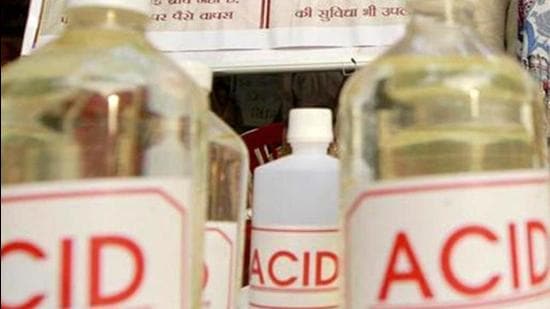
Many of the survivors suffer from severe mental trauma as they are shunned due to their disfigurement. Jobs are not easy to get as appearances matter to many employers. Even homes on rent are denied to survivors
The acid attack earlier this month on a young woman by a stalker who wanted to marry her and couldn’t take no for an answer shows how imperfectly the sale of acid is regulated in India.
Rehabilitation of the victims and providing them education and life skills are crucial to their being able to reclaim their lives (Sanjeev Verma//HT)
She lost her vision in the vicious attack, and after battling for life for several days, died of her injuries. The accused bought acid under the guise of needing it to clean a toilet, despite the Supreme Court ban on the sale of acid over the counter. According to the National Crime Records Bureau (NCRB), in 2020, there were 182 reported acid attacks. However, the conviction rate is poor — just 19 in 2018 of a total of 523 cases that went to trial.
I spoke to Daulat Bi Khan, an acid attack survivor who told me that this crime wipes out your future and health in an instant. In her case, her brother-in-law, enraged by her rejection of his marriage proposal, attacked her, her two sisters, and her baby niece with acid. She suffered 46% burns while the baby suffered 70% burns. Her ordeal involved running around for money for the 17 surgeries that she had to undergo. She sold her home to pay for these and lawyers, all the while in immense pain and having totally lost vision in one eye.
Undaunted and determined that some good had to come out of her pain, she set up Saahas Foundation for acid survivors and a few years ago set up a set up a supermarket for survivors, and a few years ago set up a supermarket for survivors, where they can get free rations.
Many of the survivors suffer from severe mental trauma as they are shunned due to their disfigurement. Jobs are not easy to get as appearances matter to many employers. Even homes on rent are denied to survivors on the grounds that their disfigurement invokes fear in the locality.
Aanchan Narang, a Mumbai-based therapist who has counselled several acid survivors, says that they suffer from guilt that they invited this on themselves and shame that they no longer fit into society. “We need to create awareness among men that a single rash decision can ruin someone’s life forever.” She says that the predominant emotions in victims are also fear and anger. “We simply have to have stricter rules regulating the sale of acid. Shops found selling this substance must be slapped with hefty fines. Above all, we must have empathy for victims who are condemned to a life of suffering and deprivation for no fault of theirs other than standing up to an entitled patriarchal set-up.”
For Shaheen Malik, her dreams of pursuing a post-graduate degree in business management ended when she was attacked by a man she mistook for a passerby. Twenty five surgeries later, she is still in pain, but has decided to do something for others like herself. It is this indomitable spirit that sees people like her through.
Today, her Brave Souls Foundation helps victims with medical treatment, legal advice, compensation and civil cases. It also provides psychological counselling as many of the survivors suffer from depression often spilling over into suicidal thoughts. “The courts have to monitor the sale of acid, passing laws alone is not enough,” she says.
Rehabilitation of the victims and providing them education and life skills are crucial to their being able to reclaim their lives. The government must look into increasing compensation; bearing the costs of medical treatment; provide counselling and job opportunities.
This would help them bear their loss to some extent and ease their pain and feelings of rejection and depression.
Lalita Panicker leads the opinion section at Hindustan Times. Over a 33-year career, she has specialised in gender issues, reproductive health, child rights, politics and social engineering.

 E-Paper