
 E-Paper



View: Modi’s ‘White Paper' shows a mirror to UPA’s misgovernance and corruption
The white paper adds weight to the BJP’s argument during the UPA regime that there should be only one centre of power like the Modi government.

 Prefer HTon Google


New Delhi: The ‘White Paper on the Indian Economy’ tabled by the Narendra Modi government in Parliament on Thursday shows a mirror to economist turned Prime Minister Manmohan Singh for the fiscal mismanagement and corruption done during his 10-year UPA regime. It is virtually an authentic indictment of the leader once hailed as the father of economic reforms in India and how due to political interference and the banking crisis, the country lost economic momentum.
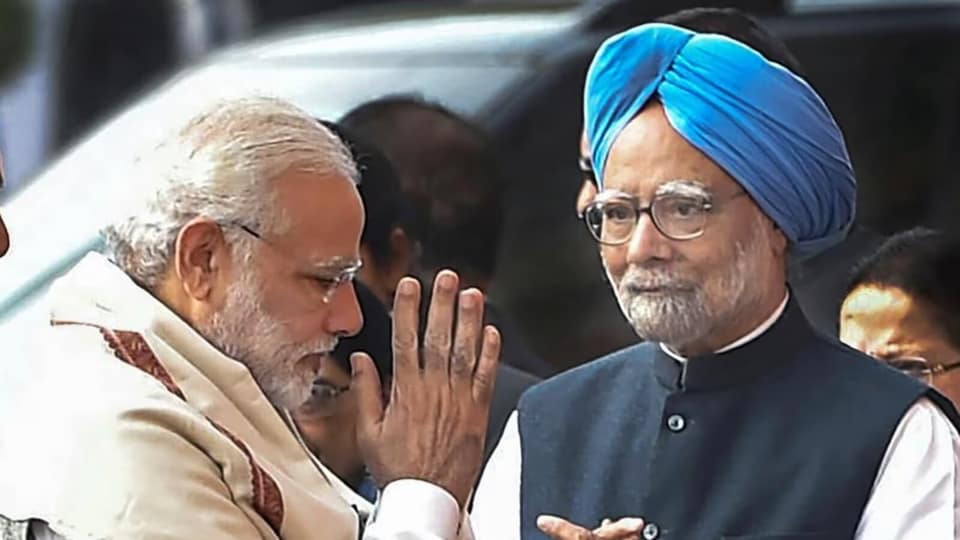
By comparing about 10 years (2014-24) of the Modi government with the preceding decade (2004-24) of the UPA regime led by Manmohan Singh, the document details how India turned from a 'fragile five’ economy to the fifth largest economy in the world. Perhaps, the milestone could have been achieved earlier if an unprecedented global devastation would not have been caused by Covid-19 pandemic.
Tabled on the day when Manmohan Singh bid adieu to public life after decades in Rajya Sabha, the document adds weight to the BJP’s argument during the UPA regime that there should be only one centre of power like the Modi government and not two like in the Manmohan Singh regime with all political clout vested in UPA Chairperson Sonia Gandhi.
The paper also underscores the downsides of a minority government pulled from all sides by alliance partners with contrary agendas with no thought to the country and the spiral down. The document is a proof that Bharat can only be run with a strong majority government at the centre as alliances stitched with regional parties cannot deliver on the economic as well as administrative front. The multiple scams and fiscal profligacy during the Manmohan regime was a fall-out of government that is pulled from all directions due to political interference with the basic aim being the survival of the government, not economic progress.
Albeit authentic and full of facts, the ‘White Paper’ is also political as it was tabled on the eve of the 2024 General Elections and pushes BJP’s main rival Congress and its erstwhile UPA allies into a dock as it will have to answer for the economic mismanagement and corruption during the forthcoming campaign. The document also provides ready-made ammunition to the NDA candidates to fire at their rivals during the forthcoming elections with the promise of developed India by 2047 using ‘Modinomics.’
While the Opposition parties are scurrying for ammunition against the Modi government, the latter is actually guaranteeing to fulfil the dream of aspiring youth of a strong, developed and inclusive India. Rather than throw stones at the Modi government, the Opposition will have to come up with an alternative vision to attract the voters on its side. Dividing the voters on lines of religion, caste and economic disparity may not fetch the same electoral dividends as in the past as the people are convinced that Bharat can achieve a larger goal of a powerful India.
In the past decade, Prime Minister Narendra Modi has been successful in reviving the Indian civilizational past with ‘Ram Lalla Mandir’ being the prime example. He has also simultaneously delivered on the future by taking the Indian economy on a rapid growth trajectory while standing resolute on internal and external security issues. The abrogation of Article 370 in Kashmir and the decision to meet the armed challenge posed by the Chinese Communist regime both resonate with the Indian public as well as charting a strategically autonomous course on the Ukraine and Gaza war without any compromise on terrorism.
The Paper is not merely a record of economic history, it reflects the resolve of the Modi government to move ahead against any odd, set ambitious goals and achieve them as per schedule. It also highlights the Modi government’s intolerance to corruption and the PM’s intentions to bring the guilty to book at any cost. The document is also a prescription for future governments on how political interference without accountability plays havoc with governance and why a strong political leader, not an economist is needed to run India.


