
 E-Paper



Photos: Antigen tests help detect nearly a third of Delhi’s Covid-19 cases
A review of data collated by the Delhi Disaster Management Authority (DDMA) shows that in the period between June 14 and July 12 almost a third of the capital’s Covid-19 tests were diagnosed using rapid antigen tests. Rapid antigen tests were earlier being used in containment zones and had been allowed for use in hospitals, dispensaries and testing centres since July 3. This is the first time data on the number of people diagnosed positive using these tests is being publicised and sheds light on the importance of rapid antigen tests in identifying infections.
Updated on: Jul 20, 2020 10:44 AM IST


Share via


Copy link

1/9

 View Photos in a new improved layout
Updated on Jul 20, 2020 10:44 AM
A health worker collects a swab sample for Covid-19 rapid antigen testing at a government dispensary in Mehrauli, New Delhi on July 17. Around 30% of the 65,810 Covid-19 cases diagnosed in Delhi between June 14 and July 12 were done using rapid antigen tests, data collated by the Delhi Disaster Management Authority (DDMA ) and reviewed by HT shows. (Sanchit Khanna / HT Photo)
2/9
 View Photos in a new improved layout
Updated on Jul 20, 2020 10:44 AM
People wait for their turn to give samples for coronavirus tests in Khajuri Khas, New Delhi on July 17. The Delhi government started using rapid antigen tests in mid-June. Initially these were used only in containment zones. From July 3, the government started rapid antigen tests in hospitals, dispensaries and centres set up in several parts of the city. (Vipin Kumar / HT Photo)
3/9
 View Photos in a new improved layout
Updated on Jul 20, 2020 10:44 AM
A health worker puts on PPE coveralls before a sample collection drive in New Delhi on July 17. 201,950 individuals went through RT-PCR tests in the June 14 - July 12 period, and of this, 151,690 test results were received, the data showed. The results of 50,260 tests were awaited as on 8 pm July 12 --the cut off for the data. The 46,320 individuals who tested positive through RT-PCR tests account for 70.38% of the total caseload. (Sanchit Khanna / HT Photo)
4/9
 View Photos in a new improved layout
Updated on Jul 20, 2020 10:44 AM
A health worker standing behind a partition collects a swab sample for a coronavirus test in Khajuri Khas, New Delhi on July 17. While RT-PCR tests are considered to be more accurate, it may take anything between 4 to 6 hours to show results. Rapid antigen tests, though less accurate, can show results between 30 to 45 minutes. (Vipin Kumar / HT Photo)
5/9
 View Photos in a new improved layout
Updated on Jul 20, 2020 10:44 AM
A health worker prepares testing and storage equipment during a Covid-19 test camp in Mehrauli, New Delhi on July 17. At present, antigen tests are carried out by the sole kit approved by the Indian Council of Medical Research (ICMR). In evaluations by ICMR, the test kit was found to have moderate sensitivity at 50.6-84%, and high specificity of 99.3-100%. (Sanchit Khanna / HT Photo)
6/9
 View Photos in a new improved layout
Updated on Jul 20, 2020 10:44 AM
A woman waits while a health worker prepares to collect a swab sample in Mehrauli, New Delhi on July 17. A highly sensitive test will detect all positive cases but will also throw up several false positives. A highly specific test means that there are few false positive results, which is why any test that shows positive in the kit is regarded as a positive infection. (Sanchit Khanna / HT Photo)
7/9
 View Photos in a new improved layout
Updated on Jul 20, 2020 10:44 AM
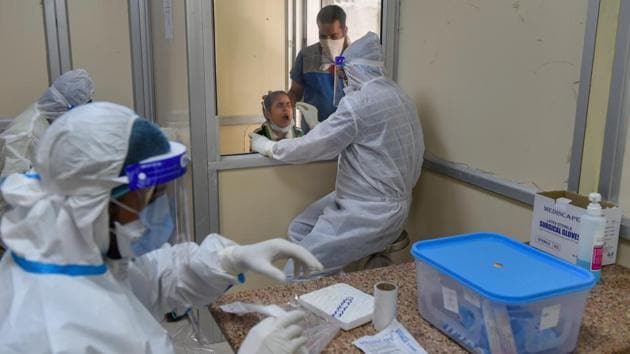
Health workers working at a COVID-19 rapid antigen testing booth in New Delhi on July 18. As per ICMR guidelines, symptomatic persons who test negative in the rapid antigen tests should be followed up with an RT-PCR test. (Kamal Kishore / PTI)
8/9
 View Photos in a new improved layout
Updated on Jul 20, 2020 10:44 AM
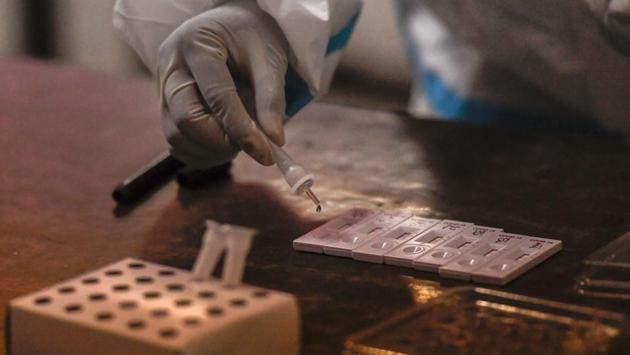
A health worker with COVID-19 test kits in New Delhi on July 17. “The number suggests that around 20,000 people were quickly tested positive with much less efforts in a period of around four weeks through rapid antigen tests. The government did not have to invest RT-PCR kits on them… This also helped reduce burden on the laboratories,” Dr T Jacob John, virologist and former professor at Christian Medical College in Vellore, told HT. (Ravi Choudhary / PTI)
9/9
 View Photos in a new improved layout
Updated on Jul 20, 2020 10:44 AM


