
 E-Paper



Photos: Balancing fear and exhilaration on Italy’s Covid-19 frontline
Over 28,000 people have died since the coronavirus pandemic gripped Italy two months ago, including 150 doctors. At the frontlines of this battle are health workers like Marino De Rosa is an anaesthesiologist in the COVID unit of a hospital in Rome. Each day they soldier on, despite the difficulty of wearing long sterile coveralls that suffocate for hours, the risk of contamination, the fear for personal safety and for those close to them, but also the feeling of being useful.
Updated on: May 2, 2020 7:31 PM IST


Share via


Copy link

1/9

 View Photos in a new improved layout
Updated on May 2, 2020 7:31 PM
Anaesthesiologist Marino De Rosa gets ready at the ICU division of the Covid unit where he works at the San Filippo Neri hospital in Rome on April 29. Weeks of fighting the coronavirus has taught De Rosa to suppress his fear of infection, but no amount of mental discipline can help him cope with more than five hours in suffocating protective gear. (Alberto Pizzoli / AFP)
2/9
 View Photos in a new improved layout
Updated on May 2, 2020 7:31 PM
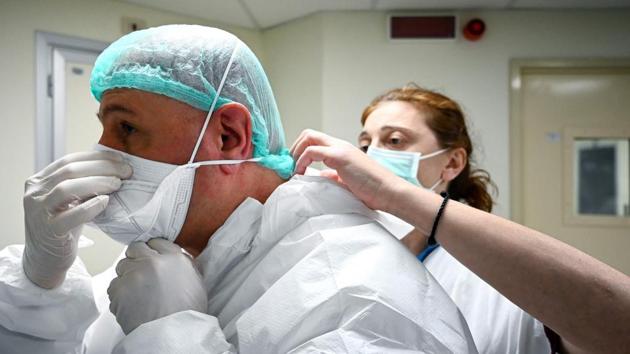
Marino De Rosa pinches his mask tight over the bridge of his nose as a nurse helps him put on his Personal Protective Equipment (PPE) before an afternoon shift in a COVID-19 unit in Rome. The 54-year old has a gruelling six hours ahead of him. Night shifts last 12 hours, though they are shared with another anaesthetist. (Alberto Pizzoli / AFP)
3/9
 View Photos in a new improved layout
Updated on May 2, 2020 7:31 PM
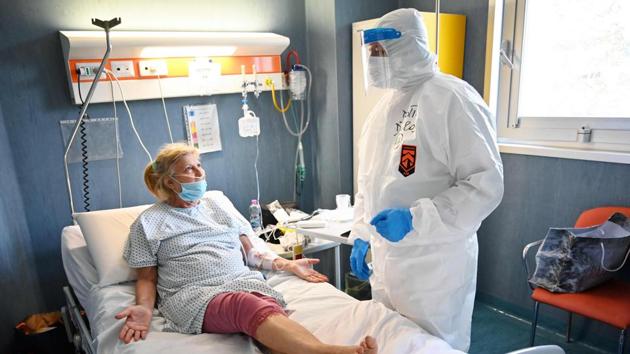
Anaesthesiologist Marino De Rosa speaks with a patient in the ICU of the Covid unit of the San Filippo Neri hospital, in Rome. “Patient contact is visual. We talk to them, they describe their symptoms. We have a tool that allows us to measure blood oxygen levels, which gives us an idea of the level of respiratory insufficiency,” De Rosa told AFP. (Alberto Pizzoli / AFP)
4/9
 View Photos in a new improved layout
Updated on May 2, 2020 7:31 PM
De Rosa in his Personal Protective Equipment (PPE) with his name written on the back. “Working 12 hours in a row in these conditions is impossible,” he said. “The gear is oppressive; you can’t breathe properly in the masks, the glasses fog up, it’s difficult to read and write. The longest I’ve lasted is five hours, and I came out utterly frazzled.” (Alberto Pizzoli / AFP)
5/9
 View Photos in a new improved layout
Updated on May 2, 2020 7:31 PM
De Rosa and his colleagues have been relying on chest ultrasounds to get as clear an idea of the situation as possible.The doctors avoid contact with the patients in their care. It’s difficult, if not impossible, to use their fundamental tool: the stethoscope. (Alberto Pizzoli / AFP)
6/9
 View Photos in a new improved layout
Updated on May 2, 2020 7:31 PM
Marino De Rosa (R) speaks with colleagues at the Covid unit where he works at the San Filippo Neri hospital, in Rome, on April 29. The doctors and nurses looking after patients in the 20-bed unit try not to do more than four hours in the gear at a time. This past Wednesday, 14 of the beds were occupied, some by patients on mechanical ventilation. (Alberto Pizzoli / AFP)
7/9
 View Photos in a new improved layout
Updated on May 2, 2020 7:31 PM
Marino De Rosa rests in a room of the Covid unit between his shift. As the weeks have passed, De Rosa has learnt to “put aside” his fear of being infected. He sees his wife and teenage children daily, but wears a mask and gloves at all times and sleeps in a separate apartment to limit the chance of passing an infection. (Alberto Pizzoli / AFP)
8/9
 View Photos in a new improved layout
Updated on May 2, 2020 7:31 PM
Anaesthesiologist Doctor Marino De Rosa (L) speaks with a colleague. De Rosa said his anxiety is counterbalanced by a chance to work on the frontlines of a new illness and help those who are fighting for their lives. “The idea of being one of those people who are really useful to others exhilarates me,” he told AFP. (Alberto Pizzoli / AFP)
9/9
 View Photos in a new improved layout
Updated on May 2, 2020 7:31 PM


