
 E-Paper



Photos: Egypt unearths over 40 Ptolemaic era mummies
In its first archaeological finding of 2019, Egypt has uncovered more than 40 mummies dating back to the kingdom founded by Ptolemy, a successor to Alexander the Great, which lasted from 323 BC to 30 BC. The mummies, wrapped in linen or placed in stone coffins, were found in a burial chamber in Minya, south of Cairo. From the mummification method, it is clear that the individuals whose remains were found held important or prestigious positions.
Updated on: Feb 04, 2019 1:56 PM IST

Share via


Copy link

1/8
 View Photos in a new improved layout
Updated on Feb 04, 2019 1:56 PM
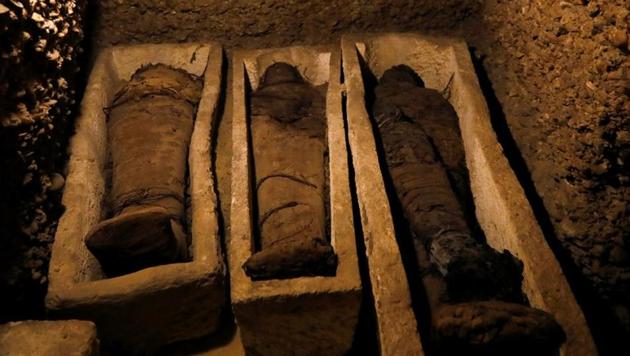
Egypt has unveiled over 40 mummies dating back to the Ptolemaic era at a communal burial site in Minya, 260 kilometres south of Cairo. The remains were found laid on the floor or in open clay coffins in the crumbling chamber. (Amr Abdallah Dalsh / REUTERS)
2/8
 View Photos in a new improved layout
Updated on Feb 04, 2019 1:56 PM
The Minya graves, discovered during an excavation that started in February last year, are in a communal tomb “probably belonging to a petty bourgeois family”, the antiquities ministry said. Archaeologist Mohamed Ragab said two tombs were discovered nine metres underground and contained more than six rooms. (Mohamed El-Shahed / AFP)
3/8
 View Photos in a new improved layout
Updated on Feb 04, 2019 1:56 PM
12 children and six animals were among the more than 40 mummies, while the rest were adult men and women. The presence of mummified pets -- mostly dogs -- showed how important they were for the dead. “These animals were so dear to their owners that they buried them... in their tomb,” archaeologist Mohamed Ragab said. (Mohamed El-Shahed / AFP)
4/8
 View Photos in a new improved layout
Updated on Feb 04, 2019 1:56 PM
An archaeologist points at the newly-discovered mummies at the site. While mummification is mostly associated with ancient Egypt, the practice continued under the kingdom founded by Ptolemy, a successor to Alexander the Great, which lasted from 323 BC to 30 BC. (Mohamed El-Shahed / AFP)
5/8
 View Photos in a new improved layout
Updated on Feb 04, 2019 1:56 PM
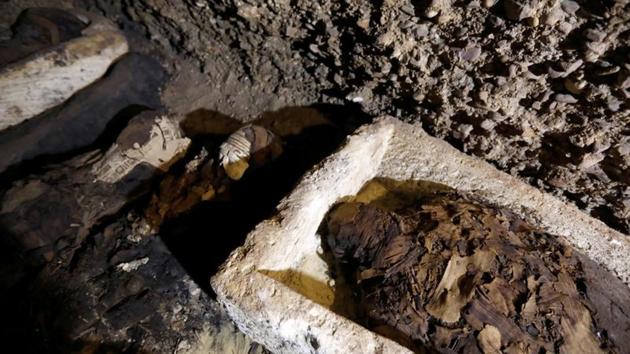
Some of the mummies were found wrapped in linen while others were placed in stone coffins or wooden sarcophagi. (Amr Abdallah Dalsh / REUTERS)
6/8
 View Photos in a new improved layout
Updated on Feb 04, 2019 1:56 PM
The identities of the mummies were still unknown, said Mostafa Waziri, secretary-general of the Supreme Council of Antiquities. “We have not found names written in hieroglyphics,” he said. (Mohamed El-Shahed / AFP)
7/8
 View Photos in a new improved layout
Updated on Feb 04, 2019 1:56 PM
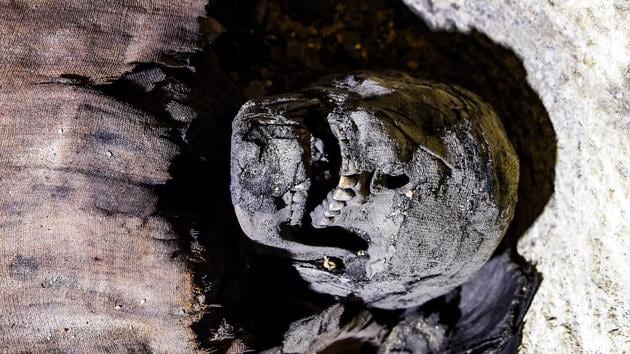
Shards of pottery and pieces of papyrus found at the site helped researchers to determine its date, Waziri further added. (Mohamed El-Shahed / AFP)
8/8
 View Photos in a new improved layout
Updated on Feb 04, 2019 1:56 PM


