
 E-Paper



Photos: Israeli farmer turns perfumer, recreates biblical fragrances
At his farm near the Dead Sea in occupied Palestinian territory, Israeli farmer Guy Erlich remixes blends of perfume and incense that he believes were used by royalty in the biblical era. He claims to have re-created a scent that Cleopatra may have dabbed on her skin and oils that anointed ancient Jewish kings. With a passion for ancient plants, Erlich set out in 2008 to try to grow them himself to turn into fragrances and other products, on a small hill in the West Bank, near the Israeli settlement of Almog.
Updated on: Aug 27, 2019 12:15 PM IST

Share via


Copy link

1/7
 View Photos in a new improved layout
Updated on Aug 27, 2019 12:15 PM
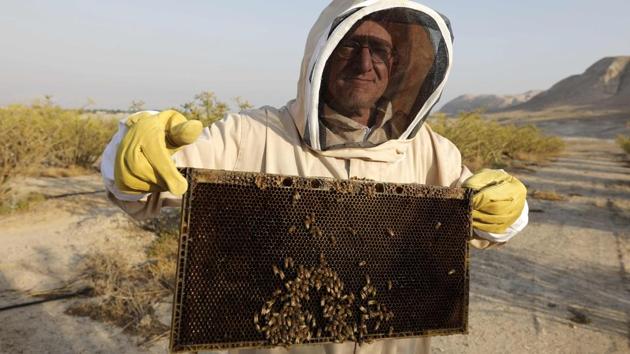
Israeli farmer Guy Erlich shows a beehive frame in front of Boswellia trees that he has planted to make honey at a farm on a small hill near the settlement of Almog in the Israeli-occupied West Bank. Erlich believes he has remixed blends of perfume and incense used by royalty during the biblical era and claims to have recreated a scent that may have been used by Cleopatra and oils that anointed ancient Jewish kings. (Menahem Kahana / AFP)
2/7
 View Photos in a new improved layout
Updated on Aug 27, 2019 12:15 PM
Erlich is seen with Boswellia trees that he has planted to make honey at his farm. With a passion for ancient plants, Erlich set out in 2008 to try to grow them himself to turn into fragrances and other products. He now cultivates around 60 biblical plants, from which he creates creams, perfumes, soap and honey, and attracts tourists who come to learn about the rare plants and take in their scents. (Menahem Kahana / AFP)
3/7
 View Photos in a new improved layout
Updated on Aug 27, 2019 12:15 PM
Erlich works on his beehives in front of Boswellia trees. He dreams of bringing back into widespread circulation the balm of Gilead, used medicinally during the ancient Roman era and referenced in the Bible. He’s even named his farm after it. The balm is thought to have been used by the ancient Greek physician, Galen, to heal infections and wounds. He mentioned Jewish teachings from the Talmud and Christian sources that name it. (Menahem Kahana / AFP)
4/7
 View Photos in a new improved layout
Updated on Aug 27, 2019 12:15 PM
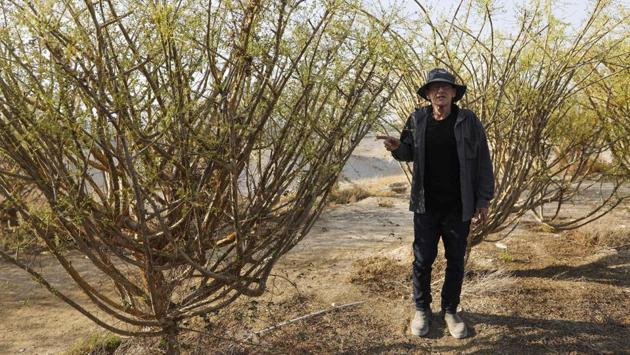
A farmer before making a job out of his fascination for biblical agriculture -- some of which has long disappeared, Erlich says he has read everything he can find on the subject. Elaine Solowey, a desert agriculture specialist at Israel’s Arava Institute for Environmental Studies, helped him to identify some of his plants. “The species produced by Mr Erlich are probably those cultivated in the region during antiquity, but we can’t be certain,” Solowey said. (Menahem Kahana / AFP)
5/7
 View Photos in a new improved layout
Updated on Aug 27, 2019 12:15 PM
Israeli farmer Guy Erlich inspects a branch from his Persimmon (balsam) plants. For now, the small leafed species takes up only a limited part of his farm, but the honey he produces sells at a premium price: $1,000 (900 euros) per kilogram. The farm is currently quite spartan and he hopes in time to be able to develop his tourist centre, a simple, wooden structure that shields visitors from the sun next to his fields. (Menahem Kahana / AFP)
6/7
 View Photos in a new improved layout
Updated on Aug 27, 2019 12:15 PM
Erlich is seeking to attract investors but says it is difficult since his farm is in occupied territory. Abdallah Abu Rahma, a Palestinian Authority official who monitors Israeli settlements, was unequivocal when asked about the project. “Everything produced in the settlements is illegal,” he said. “That’s why we call for a boycott of such products.” But Erlich is undeterred. (Menahem Kahana / AFP)
7/7
 View Photos in a new improved layout
Updated on Aug 27, 2019 12:15 PM


