
 E-Paper



Photos: German wranglers round up wild Dulmener stallions
A reserve about 40 kilometers north of Germany's industrial heartland of Ruhr is home to what locals claim is the last reserve for wild horses on the European continent. Here, Dulmener horses are left to cope with nature all year round except for the last Saturday of May, when wranglers come in to catch the young. Spared human intervention and handling illness and death on their own, only the best among these wild horses, mentioned in chronicles as far as 700 years ago, make it to the following year.
Updated on: May 29, 2018 9:30 AM IST

Share via


Copy link

1/7

 View Photos in a new improved layout
Updated on May 29, 2018 9:30 AM
Horses are seen during a wild horse show event in Duelmen, Germany. The Merfelder Bruch reserve at Duelmen, about 40 kilometers north of Germany’s industrial heartland is home to a herd of wild horses which are left to their own devices all year — except when wranglers come in late May to catch the young stallions. (Leon Kuegeler / REUTERS)
2/7
 View Photos in a new improved layout
Updated on May 29, 2018 9:30 AM
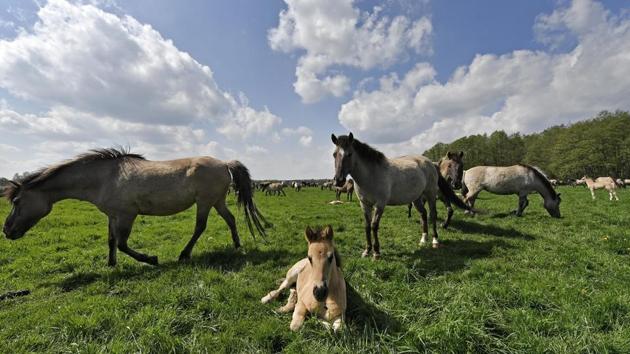
A foal sits in the grass in Duelmen. North of the Ruhr industrial region, this is the last of many areas where wild horses once roamed. The horses here are mentioned as far back as 1316, and the dukes of Croy set aside this reserve for them in the mid-19th century. According to local authorities, it is the only one on the European continent. (Martin Meissner / AP)
3/7
 View Photos in a new improved layout
Updated on May 29, 2018 9:30 AM
Today, around 400 horses live in a roughly 3.5-square kilometer area. They’re left to fend for themselves with only trees and bushes for shelter -- living conditions that have made the Duelmen horses particularly robust. (Martin Meissner / AP)
4/7
 View Photos in a new improved layout
Updated on May 29, 2018 9:30 AM
A wrangler tries to tame a foal during the wild horse show event. Only when there’s heavy frost or snow is hay provided for them. Otherwise, as a rule, humans intervene only once a year: when wranglers come to catch the young stallions by hand on the last Saturday in May. (Leon Kuegeler / REUTERS)
5/7
 View Photos in a new improved layout
Updated on May 29, 2018 9:30 AM
The sight drew about 15,000 spectators this year to the arena where the event is held. During the event, one-year-old stallions are rounded up and separated from the herd. (Leon Kuegeler / REUTERS)
6/7
 View Photos in a new improved layout
Updated on May 29, 2018 9:30 AM
The aim is to preserve the herd for the future by keeping it to a sustainable size and warding off the danger of inbreeding and territorial fighting. Once they’re rounded up, the young stallions are auctioned off. (Leon Kuegeler / REUTERS)
7/7
 View Photos in a new improved layout
Updated on May 29, 2018 9:30 AM


