
 E-Paper



Photos: Going back in time to restore The Great Wall of China
After criticism over restoration methods that left portions of the Great Wall of China resembling any modern paved walkway, workers have been busy painstakingly reinstalling large stones that had fallen off the Great Wall over millennia, as mules bring them sacks of building material up a steep mountainside on the outskirts of China's capital. This old school method was implemented in January to preserve the original look of China's famous landmark in contrast to shoddy restoration work in the past that had evoked cries of disfigurement.
Updated on: Jul 01, 2019 4:14 PM IST

Share via


Copy link

1/9

 View Photos in a new improved layout
Updated on Jul 01, 2019 4:14 PM
A worker inspects a restored part of the Great Wall at Xiangshuihu in Huairou District, on the outskirts of Beijing. Nature, time, neglect and millions of footsteps have taken their toll on the Great Wall of China leaving much of it crumbling, but repairing it can be painstaking and controversial work. (Fred Dufor / AFP)
2/9
 View Photos in a new improved layout
Updated on Jul 01, 2019 4:14 PM
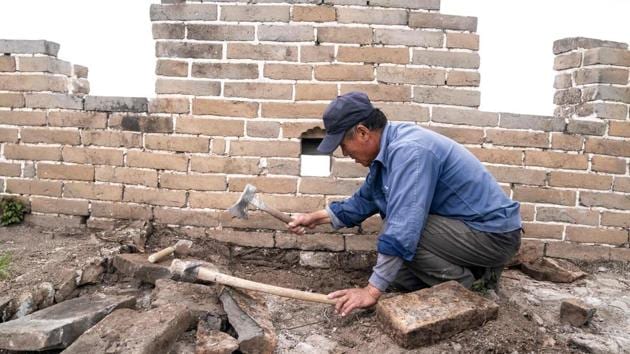
“They are all the bricks that collapsed from the original wall. The bricks are used to mend these places,” said Li Jingdong, one of the workers restoring the Jiankou section. Construction of the Great Wall first began in the third century BC and continued for centuries. Nearly 6,300 kilometres, including the Jiankou section, were built in the Ming Dynasty of 1368-1644. (Fred Dufor / AFP)
3/9
 View Photos in a new improved layout
Updated on Jul 01, 2019 4:14 PM
The Great Wall attracts around 10 million tourists per year but the swell of visitors, combined with age and weathering, has left swathes of it in ruins. In places it is so dilapidated that estimates of its total length vary from 9,000 to 21,000 kilometres, depending on whether missing sections are included. To protect the relic, authorities in the heavily visited Badaling section decided to cap visits to 65,000 per day from June 1. (Fred Dufor / AFP)
4/9
 View Photos in a new improved layout
Updated on Jul 01, 2019 4:14 PM
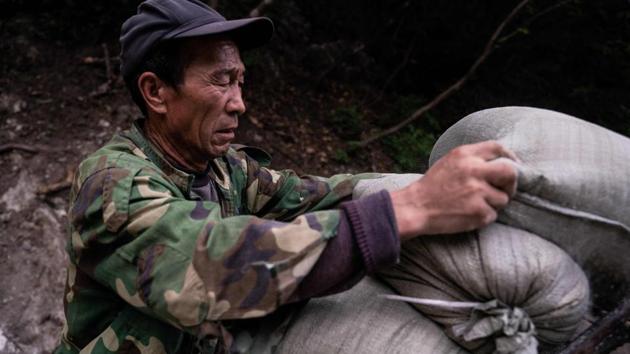
A worker loads bags on mules as he prepares to go to a restored part of the Great Wall. (Fred Dufor / AFP)
5/9
 View Photos in a new improved layout
Updated on Jul 01, 2019 4:14 PM
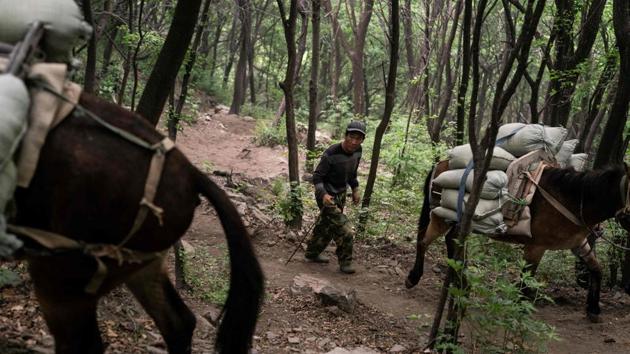
A worker leads mules to the Great Wall. The mules carry sacks of building material up a steep mountainside on the outskirts of China’s capital so that workers can reinstall large stones that had fallen off the Great Wall. (Fred Dufor / AFP)
6/9
 View Photos in a new improved layout
Updated on Jul 01, 2019 4:14 PM
In 2016, a section of the Great Wall in northeast Liaoning province was covered in cement, turning the uneven path originally built in 1381 into a flat surface which some compared to an ordinary pavement. After public outcry when a nearly 700-year-old section of the monument was ‘fixed’ by covering it with cement, authorities insisted on more authentic restoration using traditional methods. (Fred Dufor / AFP)
7/9
 View Photos in a new improved layout
Updated on Jul 01, 2019 4:14 PM
Workers painstakingly reinstall large stones that had fallen off the Great Wall while mules traverse the steep mountainside bringing water and lime mortar to mix and bind the stones with. (Fred Dufor / AFP)
8/9
 View Photos in a new improved layout
Updated on Jul 01, 2019 4:14 PM
The plan to use traditional methods was implemented earlier this year in a bid to preserve the original look of China’s famous landmark, which is split into sections that altogether stretch for thousands of kilometres from China’s east coast to the edge of the Gobi Desert. (Fred Dufor / AFP)
9/9
 View Photos in a new improved layout
Updated on Jul 01, 2019 4:14 PM


