
 E-Paper



Photos: At 100, Russia’s historic October Revolution
On the centenary of the October Revolution of 1917 in Russia, archive photos show the turmoil of a year that changed not just Russia but also the balance of power around the world for the entirety of the 20th century.
Updated on: Nov 07, 2017 3:12 PM IST

Share via


Copy link

1/12
 View Photos in a new improved layout
Updated on Nov 07, 2017 3:12 PM
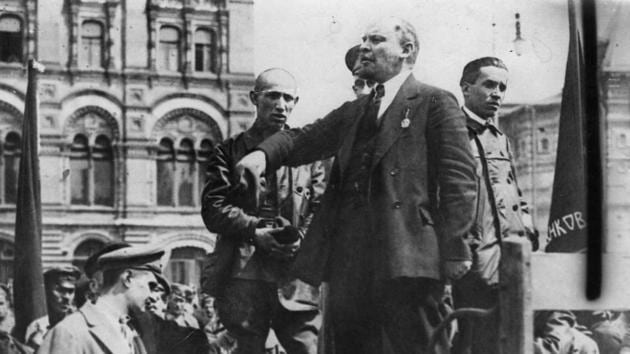
Vladimir Ilyich Lenin gives a speech from the back of a vehicle in a Russian street. A century to this week, Russia saw the culmination of the Bolshevik and Lenin led October Revolution –one of two events part of the larger Russian Revolution of 1917-- which changed the world’s political allegiances and ushered in the dawn of the first Communist state in history. On its centenary, a look at how the revolution unfolded. (Hulton Archive / Getty Images)
2/12
 View Photos in a new improved layout
Updated on Nov 07, 2017 3:12 PM
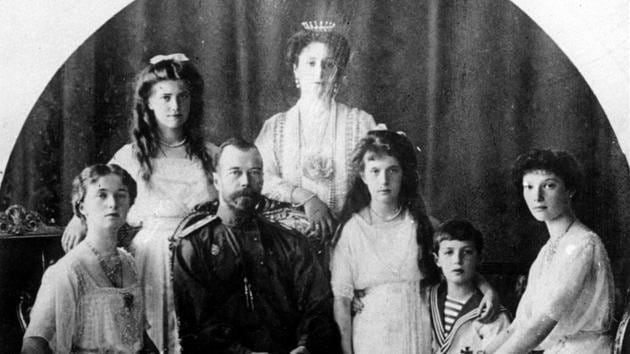
Russia’s last Czar Nicholas II (second from left), and family in an undated photo. The Bolshevik revolution’s success would not have been possible had the monarchy not been toppled just months before in the outcome of the February Revolution. The downfall of the 300-year old Romanov dynasty in 1917 coupled with the burdens of World War I set in motion a series of events that brought Lenin and the Bolsheviks into power. (AP)
3/12
 View Photos in a new improved layout
Updated on Nov 07, 2017 3:12 PM
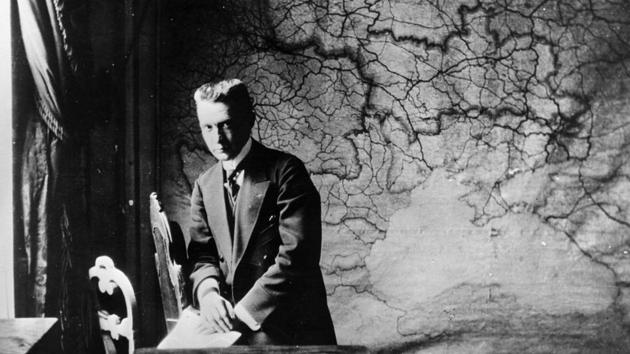
Aleksandr Fyodorovich Kerensky, leader of the Russian Provisional Government, at his desk during the Revolution. Kerensky led the government that replaced the Czar, with the intention of organizing swift elections to the Russian Constituent assembly. His government lasted a tumultuous 8 months, rife with inaction caused by a lack on enforcement ability and political factionalism. (Keystone / Getty Images)
4/12
 View Photos in a new improved layout
Updated on Nov 07, 2017 3:12 PM
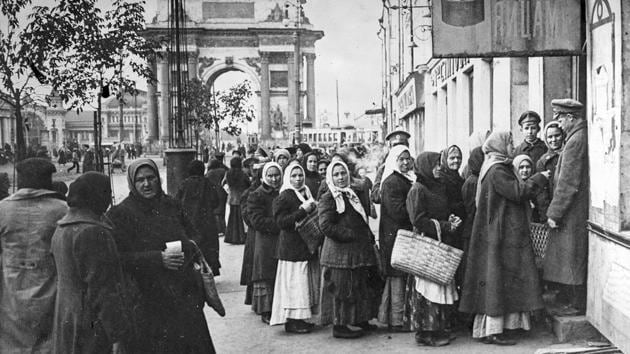
People line up to for rations at Tverskaya Zastava, in Moscow, 1917. The state in 1917 reeled under the weight of World War I. Industrial production was down over a third from the war’s onset. Unemployment was rampant as enterprises in production centres shut down and the cost of living spiked as the buying power of wages halved from pre-war levels. Russia faced the threat of bankruptcy due to massive foreign debts. (Russian State Documentary Film and Photo Archive via AP)
5/12
 View Photos in a new improved layout
Updated on Nov 07, 2017 3:12 PM
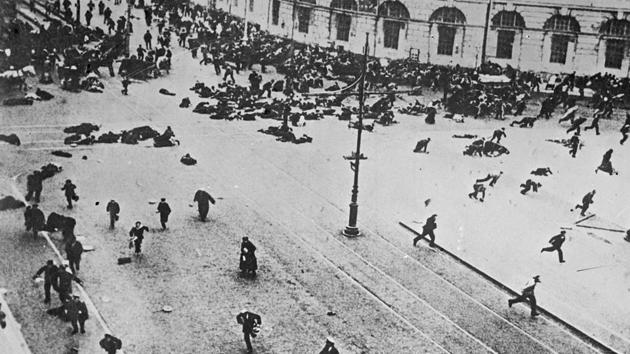
Russian troops fire on demonstrators with machine guns, on the corner of Nevsky Prospect and Sadovaya Street, in St.Petersburg on July 4, 1917. In the strife of this environment, soldiers and industrial workers of the Petrograd Soviet, a centre of opposition to the Provisional Government and backed by the Bolsheviks emerged in spontaneous demonstrations over what came to be known as the July Days. (Karl Bulla Historical Foundation via AP)
6/12
 View Photos in a new improved layout
Updated on Nov 07, 2017 3:12 PM
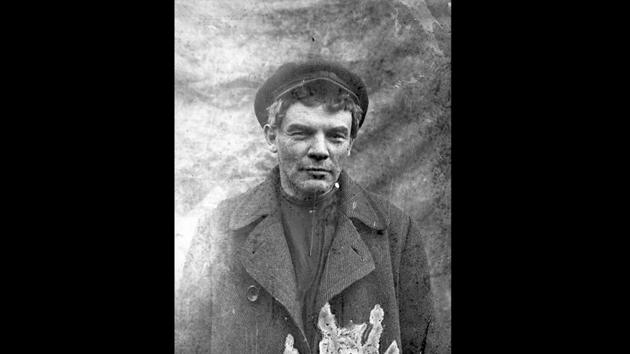
A clean-shaven Vladimir Lenin seen in disguise as he hid in a village north-west of St. Petersburg, Russia in August 1917. With crackdowns on Bolshevik support after the July Days encounters, Vladimir Lenin also went into hiding with orders for his arrest and trial put out. Bolshevik supporters were disarmed and their armed units in Petrograd were sent to the war front. (Russian State Archive of Social and Political History via AP)
7/12
 View Photos in a new improved layout
Updated on Nov 07, 2017 3:12 PM
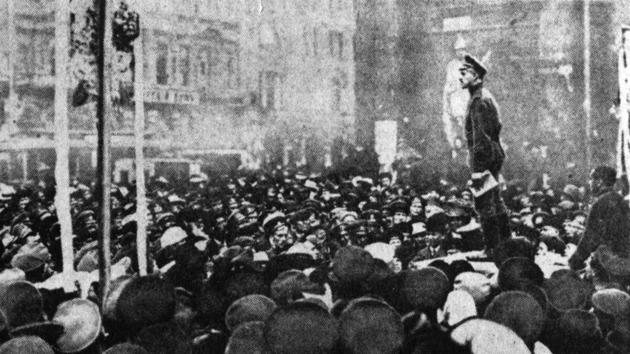
A huge crowd convenes at a revolutionary meeting in St Petersburg during the Russian Revolution in 1917. Anti-war and anti Provisional Government rallies across the state gained momentum in this period. (Hulton Archive / Getty Images)
8/12
 View Photos in a new improved layout
Updated on Nov 07, 2017 3:12 PM
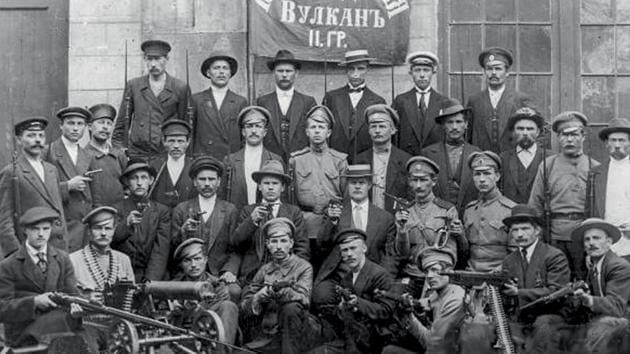
Armed workers of Vulcan plant, calling themselves the Red Guard pose for a photo in St.Petersburg. The Petrograd Bolsheviks openly created a revolutionary military committee led by Leon Trotsky, the soviet’s president. It comprised armed workers, members of the army and navy, methodically planning to occupy strategic locations through the city despite the knowledge of the Kerensky government. (Karl Bulla Historical Foundation via AP)
9/12
 View Photos in a new improved layout
Updated on Nov 07, 2017 3:12 PM
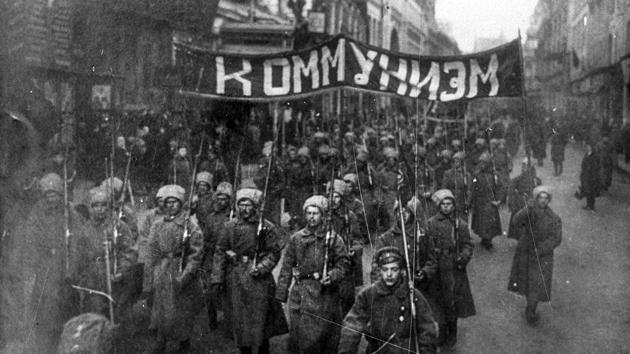
Armed soldiers carry a banner reading ‘Communism’ as they march along Nikolskaya Street towards to the Kremlin Wall in Moscow, Russia. In a counter to Bolshevik appeals, Commander-in Chief General Lavr Kornilov marched with troops to restore order in Petrograd but the movement was halted by the Bolshevik influence on railroad and telegraph workers. (Russian State Documentary Film and Photo Archive via AP)
10/12
 View Photos in a new improved layout
Updated on Nov 07, 2017 3:12 PM
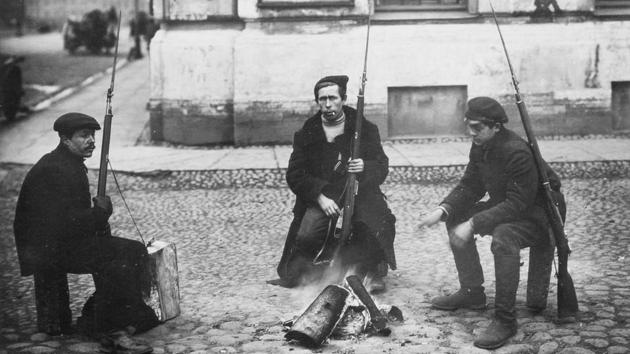
Armed revolution workers Ivanov, Yarosh and Gribovsky (L-R) warm themselves at a bonfire in St.Petersburg, Russia in October 1917. On October 25 1917 (November 07, Gregorian calendar) the Red Guard under the authority of the Bolshevik Central Committee launched an armed uprising in Petrograd to seize government facilities, communication and vantage locations, to little opposition. (Russian State Archive of Social and Political History via AP)
11/12
 View Photos in a new improved layout
Updated on Nov 07, 2017 3:12 PM
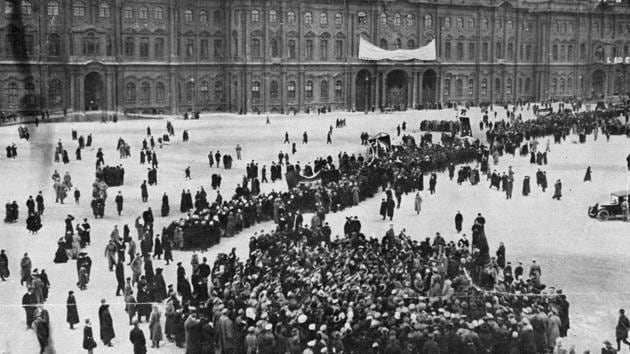
Demonstrators gather in front of the Winter Palace in Petrograd, formerly St Petersburg and later re-named Leningrad, during the Russian Revolution. Armed Bolsheviks gathered at the Winter Palace with the provisional government holed up inside. The insurrection faced little opposition as the artillery guarding the site abandoned their posts and Bolshevik forces entered the building post midnight. (Hulton Archive / Getty Images)
12/12
 View Photos in a new improved layout
Updated on Nov 07, 2017 3:12 PM


