
 E-Paper



Photos: The NHS, Britain’s free health service turns 70
Free, good quality healthcare for everyone, from cradle to grave. That was the mission of Britain’s National Health Service when it was founded in 1948. Ask any patient, nurse or doctor how they feel about the NHS now, and you will find that those core values are just as important today as they were 70 years ago. But as much as Britons love the NHS, they also fret about it. Can it survive in its present form, delivering care for free to anyone who needs it, in the face of ever-increasing pressures from an ageing population?
Updated on: Jun 27, 2018 9:51 AM IST

Share via


Copy link

1/11

 View Photos in a new improved layout
Updated on Jun 27, 2018 9:51 AM
“I’ve had so many things go wrong with my body in the last four-and-a-half years that it’s just incredible that one organisation can cure so many things and treat me so kindly, efficiently, and for free. It’s just astonishing,” said 83-year-old Donald Ritson, who was receiving treatment in Milton Keynes University Hospital’s Ward 24, in central England. (Hannah McKay / REUTERS)
2/11
 View Photos in a new improved layout
Updated on Jun 27, 2018 9:51 AM
Ritson remembers what it was like before the state-funded NHS, when healthcare was beyond the reach of many people because they could not afford to pay doctors’ fees. “I can remember my brother being ill and my parents being unable to afford to go to a doctor, so they tried to treat it themselves,” he recalled. (Hannah McKay / REUTERS)
3/11
 View Photos in a new improved layout
Updated on Jun 27, 2018 9:51 AM
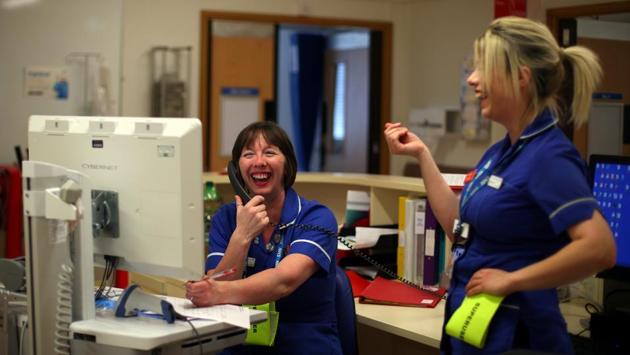
Free, good quality healthcare for everyone, from cradle to grave. That was the mission of Britain’s National Health Service when it was founded on July 5, 1948. Ask any patient, nurse or doctor at this sprawling hospital how they feel about the NHS now, and you will find that those core values are just as important today as they were 70 years ago. (Hannah McKay / REUTERS)
4/11
 View Photos in a new improved layout
Updated on Jun 27, 2018 9:51 AM
“We could never go back to that sort of system. Cradle to grave, it’s not a bad idea,” Ritson said. A former minister once wrote that the NHS is the closest thing the English have to a religion, and that often-repeated quote still rings true. It is a political sacred cow, with rival parties competing to show their support for it and to try to convince the public it is safe in their hands. (Hannah McKay / REUTERS)
5/11
 View Photos in a new improved layout
Updated on Jun 27, 2018 9:51 AM
Patients participate in a physiotherapy class in the hydrotherapy pool in the Physiotherapy department at Milton Keynes University Hospital. But as much as Britons love the NHS, they also fret about it. Can it survive in its present form, delivering care for free to anyone who needs it, in the face of pressures from an ageing population? That is a perennial topic of debate. (Hannah McKay / REUTERS)
6/11
 View Photos in a new improved layout
Updated on Jun 27, 2018 9:51 AM
“Yes, I do worry about it. There’s not enough funding and staffing to go around already, and people are having more and more care and they’re living longer,” said 29-year-old Sarah Plant (R), who was in the hospital’s Accident and Emergency Department, accompanying her elderly grandmother Barbara Lant who had been taken ill. (Hannah McKay / REUTERS)
7/11
 View Photos in a new improved layout
Updated on Jun 27, 2018 9:51 AM
Inpatient Annette Evans is cared for by a nurse. For patients like Plant, who has the rare and debilitating Ehlers-Danlos syndrome, the pressures on the NHS have gotten worse over the years. But she is in no doubt about what she and her family owe to the NHS. “It’s kept a lot of us alive,” she said. “They’ve brought me back twice. I wouldn’t be here without them.” (Hannah McKay / REUTERS)
8/11
 View Photos in a new improved layout
Updated on Jun 27, 2018 9:51 AM
Wayne Vassell, a junior doctor specialising in orthopaedics, said the ideals underpinning the NHS were important to him as someone from a modest background, the first in his family to go to university. “For me the NHS means a lot because it’s a unique model that provides care to people irrespective of background and income,” he said, answering questions during a break in the junior doctors’ mess. (Hannah McKay / REUTERS)
9/11
 View Photos in a new improved layout
Updated on Jun 27, 2018 9:51 AM
Hospital staff deliver patients their lunchtime meals. Vassell said he did not expect the pressures on the NHS to ease off anytime soon. He saw the service as “structurally more pressured” than in the past, because of the ageing population and the competing demands on state funding, at a time when other public services had been hit hard by austerity policies. (Hannah McKay / REUTERS)
10/11
 View Photos in a new improved layout
Updated on Jun 27, 2018 9:51 AM
Elizabeth Nomhwange observes her son, Moses Aloho, having a hearing test during an appointment at the Audiology department. Far from being put off by those pressures, he said he regarded them as a challenge worth rising to. “The best reward is when you’ve been treating a patient and you have a happy family and they say thank you,” he said. (Hannah McKay / REUTERS)
11/11
 View Photos in a new improved layout
Updated on Jun 27, 2018 9:51 AM


