
 E-Paper



Ground water levels: 252 Maharashtra tehsils report alarming drop
The groundwater depletion was recorded highest in the Marathwada and north Maharashtra regions, according to the survey. According to the India Meteorological Department (IMD) office, Marathwada received 22 per cent less than average rainfall this monsoon season. GSDA report states that 4,572 villages from Marathwada region and 3,117 villages from north Maharashtra region reported decline in groundwater level.


This year Maharashtra has received less than average rainfall which has resulted in many villages from 252 tehsils reporting a drop of more than a metre in the groundwater levels, according to the findings of groundwater surveys and development agency (GSDA).The GSDA findings were based on the agency’s survey conducted in September this year.The situation will worsen as the groundwater level will drop further as summer approaches.
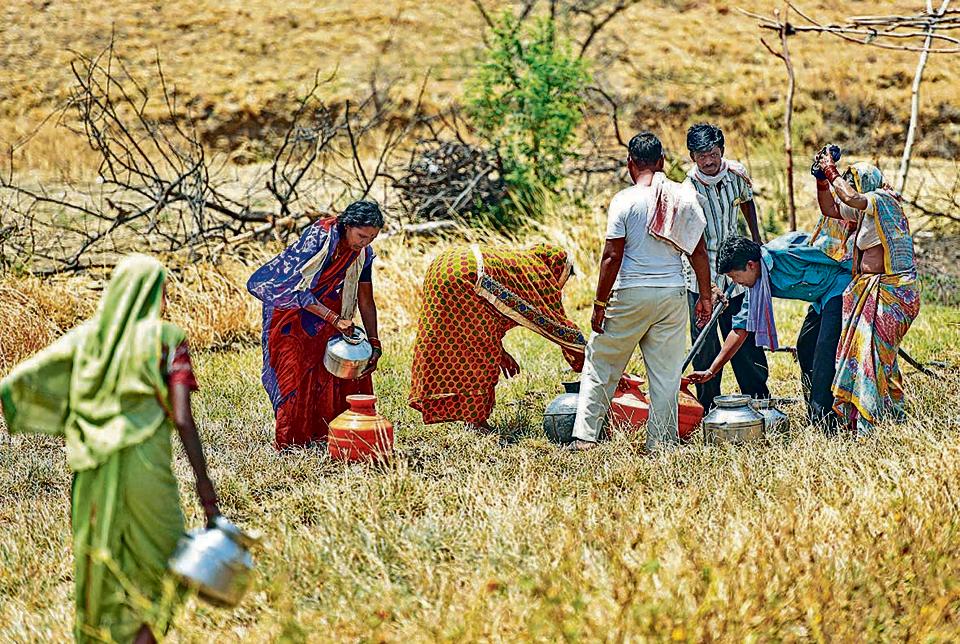
The groundwater depletion was recorded highest in the Marathwada and north Maharashtra regions, according to the survey. According to the India Meteorological Department (IMD) office, Marathwada received 22 per cent less than average rainfall this monsoon season. GSDA report states that 4,572 villages from Marathwada region and 3,117 villages from north Maharashtra region reported decline in groundwater level.
The GSDA survey also found that the groundwater level had fallen by more than a metre in 11,487 villages and by 1-2 metres in 5,556 villages. Groundwater level had declined by 2-3 metres in 2,990 and more than 3 metres in 2,941 villages of Maharashtra.
During an interview with Hindustan Times, II Shah, additional director, GSDA, said, “After the 2012 drought, this is the worst hit the state has taken. And since Maharashtra has high percentage of basalt rock (82 per cent), water percolation becomes difficult leading to low groundwater levels.” Shah said there are other main reasons responsible for depletion of water level.
“This year we witnessed long dry spell during monsoon season. Farmers pumped a lot more water during the dry spell , which is also a major cause of depletion in ground water level,” said Shah. Earlier, the Congress targeted the government’s jalyukt shivar yojana, a water conservation scheme, for the present crisis. ‘There has been an alarming decrease in the levels of groundwater in the state,” said Sachin Sawan, Congress spokesperson for the state, on Saturday. GSDA survey reveals groundwater levels have fallen by more than one metre in around 14,000 villages of the state.
This comes to light after Prime Minister Narendra Modi lauded the state government’s jalyukt shivar yojana, saying it helped 16,000 villages to become drought-free and work under the scheme was underway in another 9,000 villages,’ Sawant noted.
The survey also compared rainfall percentage by the end of the September against average rainfall and it was found that 283 tehsils in Maharashtra reported a deficit of rainfall against average rainfall.
Out of 353 tehsils in Maharashtra, 86 tehsils reported 0-20 per cent deficit rainfall. Sixtyone tehsils have reported 20-30 per cent deficit rainfall at the same time, 109 received 30-50 per cent deficit rainfall.
Twenty-seven tehsils in Maharashtra received more than 50 per cent rainfall deficit than average rainfall.
North Maharashtra and Marathwada regions have reported high rainfall deficit against average rainfall of that region. Out of 54 tehsils in north Maharashtra region 51 reported deficit of rainfall. Similarly, out of the 76 tehsils in Marathwada region,71 reported deficit of rainfall.
‘Rationed’ water supply in city only after Diwali, says official
The Pune municipal corporation (PMC) has decided to implement water cut only after Diwali, to avoid inconvenience to residents, said Pravin Gedam, PMC officer from the water department on Monday.
Earlier this month, the state canal committee decided to bring down the city’s water quota by 15 per cent, forcing the civic body to go for a water cut schedule.
The elected members raised questions on the poor water supply in the city in the general body meeting held on Monday.
The members of the Bharatiya Janata Party (BJP), mainly representing the old peth areas, criticised the municipal administration over poor water supply and said that it was becoming increasingly difficult to face the citizens.
Gedam said that the administration has prepared a new time table for water supply in the city. Mayor Mukta Tilak has also called for a meeting on Tuesday with all the party leaders to discuss the water issue.
Meanwhile, PMC general body on Monday has given its nod to pay ₹65 crore as water fee to the irrigation department .
As there is no budgetary provision for such payment, the ruling BJP has decided to divert the money meant for JICA (Japan International Co-operation Agency) schemes to the irrigation department.
Opposition parties - Nationalist Congress Party and Congress party - criticised the administration and BJP for diverting funds from JICA project,which is meant for river rejuvenation.
Shrinath Bhimale, leader of the house, said that diverting money from JICA project will not affect the progress of the project as PMC has allocated enough funds for the plan for this financial year.
Eight tehsils of Pune district are rain deficit, finds state survey
The survey conducted by state government’s groundwater surveys and development agency (GSDA) has placed Pune district’s eight tehsils of its total
13 in the rain deficit category. The survey has compared average rainfall of every tehsil of last five years with the rainfall received in 2018. Of the state’s total of 353 tehsils covered by the GSDA survey, 283 registered less than average rainfall in 2018.
The survey report published by the agency on October 17 states that Ambegaon (27%), Baramati (45%), Daund (58%), Haveli (31%), Indapur (42%), Purandhar (23%), Shirur (58%) and Velhe (34%) have been categorised under the rain deficit category. Bhor, Junnar, Maval, Khed and Mulshi have received more than average rainfall till September-end of this year.
Regarding the Pune division that covers 57 tehsils, the survey states that 42 fall under the rain deficit category with 27 of these tehsils being more than 30 per cent rain deficit. I I Shah, additional director, GSDA said, “The survey findings are purely based on rainfall data. While eight tehsils of Pune are categorised under rain deficit category, the situation is worse in north Maharashtra and Marathwada regions.” According to Shah, the number of tehsils in rain deficit category is highest in North Maharashtra and Marathwada. Fifty-one out of 54 tehsils in north Maharashtra region and
71 of 76 tehsils in Marathwada region fall under the rain deficit category. North Maharashtra and Marathwada are the regions that are highly dependent on rainfall and groundwater to meet their water demands. Sol a purist he worst affected district in the state as all its 11 tehsils are declared rain deficit with 10 having reported to be more than 50 per cent rain deficit.
Wakad residents march in protest
Five hundred residents from Wakad on October 20 (Saturday) held a protest march from Wakad to the Pimpri Chinchwad municipal corporation (PCMC) headquarters over the issue of water scarcity in their areas.
The Pimpri-Chinchwad housing society federation along with corporators from Wakad, Pimple Saudagar and Pimple Nilakh like Tushar Kamthe, Rahul Kalate, Tushar Kamthe, Sandip Kaspate, among others went to interact with Shravan Hardikar, municipal commissioner of PCMC.
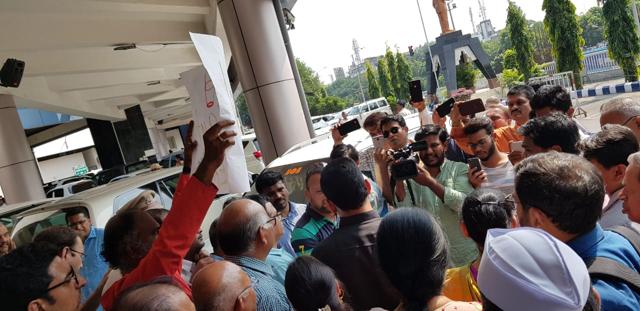
Mayor Rahul Jadhav and the commissioner assured the residents that a special general body meeting will be convened within a week to resolve the crisis.
“We have been facing water shortage issues since 2014. In December 2017, we had submitted a letter demanding better water supply to commissioner Hardikar. Ward numbers 25, 26, 24 of Wakad have been receiving only seven MLD (millions of litres per day) of water while the required amount is 13 MLD, ” said Sudhesh Raje, chairman, Pimpri-Chinchwad housing society federation.
BJP MIN TARGETS OWN DEPT, SAYS ITS REPORT ‘INACCURATE’
Even with the opposition parties criticising the Devendra Fadnavis government on its failure to successfully implement jalyukt shivar yojana (water conservation scheme), a minister in the Maharashtra goverment has blamed its own department of painting an “inaccurate” picture of the state.
Ram Shinde, minister of state for water conservation, on Monday blamed groundwater surveys and development agency (GSDA) for their ‘inaccurate’ report on Probable Scarcity Report 2018-19.
While blaming the government’s own agency, Shinde said, GSDA has been using old techniques since the last few decades.
“The GSDA survey is based on 3,900 wells which is inadequate to get an accurate picture of the state. Even GSDA officials have accepted it,” said Shinde. Jalyukt shivar scheme has helped 101 talukas report a rise in groundwater levels, he added.


