
 E-Paper



Personal experience shaped research in women’s health for this PU scientist
Indu Sharma, 37, assistant professor, zoology department in Panjab University is making better drugs for endometriosis caused in ovaries due to retrograde menstruation and also looking for its causes in women of different ages.


Endometriosis, a painful disorder in which tissue lining the inside of the uterus grows outside the organ, namely the ovaries, fallopian tubes and tissue lining the pelvis area, affects about 10% to 15% Indian women. Dr Indu Sharma, 37, assistant professor in the zoology department of Panjab University, whose research focus is on reproductive physiology, has been working on treating endometriosis with minimal side effects.
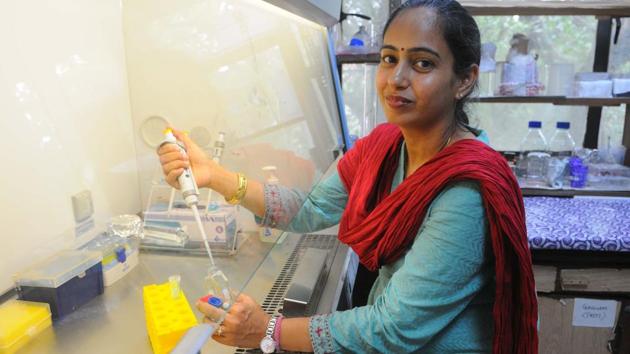
A PhD in experimental medicine and biotechnology from the Post Graduate Institute of Medical Education and Research (PGIMER) in experimental medicine and biotechnology, Sharma comes from Narayangarh near Ambala in Haryana.
With four projects completed on endometriosis, Sharma says people mistakenly associate the disorder with infertility as it is often diagnosed when women are trying to get pregnant. They are then offered hormonal treatment, surgery and technical assistance for conceiving.
“I have tried to establish that certain drugs (atorvastatin, rosiglitazone and 15dPGJ2), used for other diseases, can help cure endometriosis as well,” says Sharma, recipient of early career grant from the Science and Engineering Research Board-Department of Science and Technology-Early Career Research (ECR) Award, New Delhi. Trials for the same, however, are yet to be done.
RECIPIENT OF UGC START-UP GRANT RESEARCH
Her PhD thesis has been published four times, thrice in the journal Fertility and Sterility and one in the International Journal of Gynaecology and Obstetrics.
Also the recipient of UGC Start-Up Grant research project in 2017 and best paper award from the Infertility Society of India in 2006, Sharma is currently working on epigenetic profiling of reproductive disorders such as endometriosis, endometrial cancer and endometrioid carcinoma of ovary in order to find out common denominators of the three diseases as they occur from the same cell.
There are different factors leading to these diseases as they occur in women in different age groups but “we are trying to find that one factor which is common in them,” she says.
Sharma, who was junior demonstrator at PGIMER for two years from 2010 to 2012, believes her career got a fresh lease of life with the Biotechnology Career Advancement and Re-orientation Programme (BioCARe) of the Indian government’s department of biotechnology for increased participation of women scientists in biotechnology research,while getting seat in PGIMER in 2004. It was her first funded research and she was placed in Panjab University immediately afterwards.
PERSONAL EXPERIENCE LED TO TAKE RESEARCH
“After BioCARe I got the position at PU as a principal investigator in research, which means a lot to a researcher,” she says. “It is difficult to explain (to your in-laws and family) what you are exactly doing otherwise.”While her interest in science grew as she came from a family with a medical background, her father being a dentist and grandfather a vaidya (ayurvedic practitioner), an illness led to Sharma’s interest in women’s health. “A medical test before joining PGIMER revealed I had ovarian cyst for which I was treated,” she recalls. It strengthened her determination to make women aware of such problems.
A postgraduate from Kurukshetra University, Sharma says early diagnosis in various ailments in women is not easy because of the stigma around menstruation. Women still hesitate to ask for help to ease pain during their cycle.
This scientist who spends a large chunk of her time with her PhD students in labs or taking classes, starts the day with her children. She says her two-year-old goes to a crèche, Nilaya daycare, on campus and the other one is in school. With her husband working at the Terminal Ballistics Research Laboratory-Defence Research and Development Organisation, Sharma loves discussing with him their areas of research and current affairs.
When she’s not working, Sharma says she prefers gardening, but doesn’t get time to tend to her plants because her children keep her busy. “I have kept some plants here in my office because I don’t get much time for full time gardening,” she says.
Also fond of listening to music, Sharma keeps a portable digital audio player handy for her daily dose of music.


