E-Paper



Vasai demolition: Why the razing of dilapidated buildings marks a turning point for Mumbai’s ageing housing societies
Mumbai redevelopment news: A few residents stalled the redevelopment of two unsafe Vasai housing societies for years, but Bombay HC ruled safety comes first

 Prefer HTon Google


One month after the Bombay High Court ordered demolition of dangerously dilapidated buildings in two housing societies, the Vasai Virar Municipal Corporation (VVMC) has begun razing Pushpanjali and Deepanjali Cooperative Housing Societies (CHS) in Vasai (West) near Mumbai to pave the way for redevelopment.
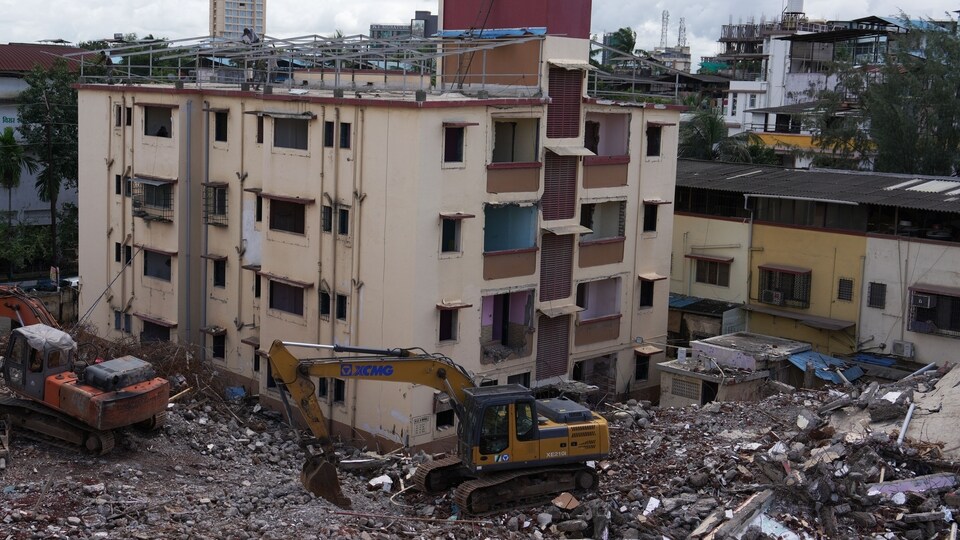
In its August 2025 order, the Bombay High Court (HC) directed members opposing redevelopment to vacate their flats and said that once a structure is certified unsafe, residents cannot prevent demolition by the civic body.
The court further ruled that minority objections cannot override redevelopment decisions taken by an overwhelming majority.
The two societies, located at Diwan and Sons Housing Enclave on Ambadi Road, comprise four buildings namely H-1 and H-2 of Deepanjali CHS and H-3 and H-4 of Pushpanjali CHS are nearly 40 years old.
On February 28, 2025, VVMC categorised the four buildings as extremely dangerous and labelled them as C-1 structures, meaning they were too dangerous for habitation and required immediate demolition.
Together, the two societies housed 112 members. Of these, 101 had already vacated their premises after the majority appointed a developer to undertake redevelopment.
Of the 112, only 11 members resisted, demanding more space than the 20% additional area offered by the developer. According to society members, some of the dissenters also had outstanding dues, said residents HT.com spoke with.
Residents said the buildings, constructed around 1985, had been showing signs of severe wear and tear for years.
“In the past five years alone, we have spent nearly ₹20 lakh on repairs,” one resident not wishing to be named said, adding that despite the expenses, structural safety remained a constant concern.
The four decade-old buildings included a mix of studio, 1BHK and 2BHK apartments.
A decade-long wait for redevelopment to materialise
According to the society members, redevelopment talks for the two societies date back to 2015, but the process repeatedly stalled as members struggled to find a developer.
“We got a developer after a long wait and didn’t want to miss the opportunity,” the resident said.
With most members eager to move forward, the dispute centred on a small minority’s insistence on higher compensation in terms of space.
The case
As many as 11 society members approached the Bombay High Court earlier this year, but the court dismissed their petition in August 2025, stressing that lives could not be put at risk. It allowed them to pursue grievances through legal channels but barred them from obstructing demolition.
The civic body was also empowered by the Bombay HC to evict resisting residents with police assistance if necessary.
However, the residents filed a review petition in the Bombay HC. Following this, the High Court came down heavily on the dissenting members for attempting to stall the demolition.
The court termed it an abuse of the legal process, imposing a ₹25,000 fine on each petitioner and setting a final deadline of September 15 to vacate. The order clarified that neither the civic body nor the societies could delay action on unsafe buildings.
Court intervention paves way for redevelopment, Vasai residents express relief
With demolition now underway, the majority of residents expressed relief that a long and contentious chapter is finally ending.
For families who vacated months ago, the court’s intervention has cleared the way for modern housing with 20% extra area and improved amenities.
Vilas Lakshri, a ground-floor resident of Pushpanjali CHS, said, “I vacated my flat in December 2024, and I’m finally relieved that demolition has begun after months of delays caused by the court case. Every monsoon, my flat used to get waterlogged, and I was in desperate need of a new home.”
“The developer has assured society members that the new buildings will be completed within two years and has already paid one year’s rent in advance. While the court case may cause some delay, we are hopeful of moving into our new apartments within the next two years,” he said.
Lakshri said that the ground plus three housing society will be converted into seven storey buildings and his 330 sq ft 1 BHK will be expanded by about 60 sq ft, with a dedicated bathroom for the bedroom and a balcony.
“The old flat had almost no resale value, but the new one will give us both comfort and dignity. For now, we are living in a rented 2BHK, but once the new 1BHK is ready, we will happily move back. The way I see it, a new apartment will always carry resale value and give us the option to upgrade in the future, unlike the old building, where the flat had virtually no worth," Lakshri said.
A representative of the developer awarded the redevelopment contract for the two housing societies, who wished to remain anonymous, said, “We have received the commencement certificate (CC) for redevelopment and are waiting for demolition to be completed. After that, we will redevelop the site and hand over new homes within the next two years.”
What is a dilapidated building?
A dilapidated building is a structure that has severely deteriorated due to age, poor maintenance, or structural damage, posing risks to residents. Such buildings are identified through civic inspections and structural audits, and are often earmarked for urgent repairs, evacuation, or redevelopment to safeguard lives and property.
The C1 category of a dilapidated building is the most dangerous classification, declared unfit for habitation and requiring immediate demolition to prevent collapse.
In Mumbai and its surroundings, it is mandatory for all buildings above the age of 30 to carry out a structural audit report prepared and undertake repair works, accordingly.
What is redevelopment?
In Maharashtra, several old buildings, especially those comprising two to seven storeys, are currently being redeveloped. Redevelopment of housing projects involves demolishing the old structure and replacing it with a modern, bigger building, subject to various norms.
Also, residents of the old building get larger apartments in the newer building for free, as the builder sells a certain number of apartments in the new building for a profit in the open market. The government also earns revenue by selling the floor space index (FSI) to the builder.
In a Cooperative Housing Society (CHS) in Maharashtra, 51% of the total members must provide written consent for a redevelopment project to be legally authorized. This 51% majority threshold applies to the society's total membership strength