
 E-Paper



Paradise destroyed
A buffer zone of just 100 metres for the Okhla Bird Sanctuary - the only place in the world after Nairobi to attract 400 bird species - could be disastrous


It is a paradise for our winged friends – the only zone after Nairobi in Kenya, Africa, to attract over 400 species all year round and over 1 lakh migratory birds from all over the world in winter. The Okhla Bird Sanctuary (OBS), 3.5 sq km of which is in Gautam Budh Nagar, Uttar Pradesh, is an area of international importance as it hosts 30% of the 1200 to 1300 species recorded in the Indian sub-continent!
Now, human beings are all set to put their needs over that of the fragile ecosystem. Environmentalists dismiss as “eyewash” the UP government’s recommendation to the Ministry of Environment and Forests (MoEF) to change to 100 metres the eco-sensitive zone limit between OBS and building projects in the area from the previous proposal of 1km. The intent seems to be to protect builders and not the sanctuary. “Had there been projects at a distance of 50 metres, the state government would probably have set that as the limit – to properly protect a sanctuary, the limit should at least be 500 metres,” they say, adding that a smaller buffer zone would destroy the bird sanctuary.

The Supreme Court in a December 4, 2006, order had directed the MoEF, as a final chance, to ask states for proposals to notify eco-sensitive zones – to which the states had not responded. “The state government first decides to set a limit for the eco-sensitive zone after almost seven years and then it decides to dilute it twice in a span of a few months,” the environmentalists add.
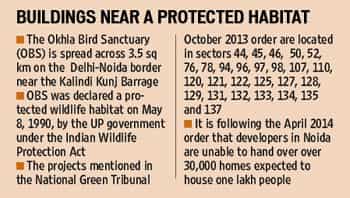
The sanctuary has been in the news due to the delay in handing over of a number of commercial and housing projects for about one lakh residents close by. The National Green Tribunal (NGT) in its October order last year had asked around 50 developers with projects located close to the OBS, to stop construction work as they did not have the requisite environmental clearances from the National Board for Wildlife. In April this year, the NGT had issued an order that forbade Noida Authority from giving completion certificates to projects within a 10-kilometre radius of the OBS, and so possession cannot be handed over in the projects in question.
It was also during this time that the UP government had submitted its recommendation for a 100-metre eco-sensitive zone (February 25, 2014). Delhi also recommended in March this year that the no-development zone be fixed in the Capital at 100 metres.
In April this year, the Supreme Court issued a judgment that reviewed the limit set aside for mining activities in the Goa Foundation case in 2006 from 10 km to 1 km (Goa Foundation vs Union of India, April 21, 2014).
Interestingly, the UP government first restricted 1 km radius as eco-sensitive zone. The affidavit of the district forest officer, dated August 2013, states that “The district-level committee under the chairmanship of district magistrate, Gautam Budh Nagar recommended that 1 km around the Okhla Bird Sanctuary should be declared as eco-sensitive zone and has identified different activities that fall under protected, regulated and permitted categories”.
In a later order in April 2014, it concluded that "it would be sufficient, if a 100-metre radius is fixed as the eco-sensitive zone." It is also stated in the April 2014 NGT order that the counsel appearing for the UP government was "unable to explain on what basis 100 metre radius has been arrived at by the UP government. She (the counsel) has stated that such decision has been taken in a scientific manner after consulting various authorities and the tribunal cannot find fault with such decision taken by the state government in its wisdom of taking such decisions before issuing a notification."
Their proposals are currently with the MoEF, pending approval, and the ministry has not as yet reached any conclusion in terms of the buffer zone. An officer from the ministry, however, has been quoted as saying that “we have received UP, Haryana and Delhi government’s proposal on the eco-sensitive zone declaration. We are expected to hold a meeting with the expert technical team on this issue probably next week. But we cannot specify the exact date when the eco-sensitive zone will be declared as it takes time. It will be done in compliance of the NGT order.”
Chetan Agarwal, an environment analyst, says, “The order has said that the MoEF has to sit down with the three concerned state governments, and come to a conclusion, and take their concurrence. At the same time, it is a well-known fact that that state governments present a unanimous view from the state - and these views typically give preference to real estate over wildlife. The forest and wildlife departments of the state are not equal players in the decision-making process, and if consulted, are often browbeaten into taking the state line. It is not clear how binding the direction to seek concurrence of the state is. If tomorrow the UP government were to say that the eco-sensitive zone should be 10 m, does it mean that MoEF will have to agree?”
A 100-metre limit is not adequate for the OBS, argues Faiyaz A Khudsar, a wildlife biologist. Inadequate buffer and increased construction work in the area will disturb natural rain and water flow during the monsoon. The buildings would be like concrete barriers. The Kanha National Part has a core zone of about 900 sq km and a buffer zone of about 1000 sq km. Exotic and rare birds still fly to the OBS from all over the world despite rapid urbanisation and industrialisation and discharge of untreated wastewater into the Yamuna, leading to deteriorating water quality in the area. Reduction in the limit of the buffer zone will destroy the sanctuary completely, he adds.
The OBS is the hub of migratory birds and is a significant wetland in itself. It has to have a proper buffer zone if its flora and fauna have to be left undisturbed. The over 300 species that exist here, including ducks, pelicans (Russian) and painted storks, use the place as a foraging area. It is a winter destination for migratory birds from both eastern and western Europe. The birds you get to see are jacanas, which are wetland birds, land birds or terrestrial birds such as barbets, hornbills that breed here and owls and owlets which are most susceptible to disturbances. Construction will impact the sensitive species more and eventually affect not just the numbers but the diversity, too. The generalist species such as pigeons, crows, mynas that are adaptable to human presence will eventually decline, points out Dr Monalisa Sen, a scientist working on environmental issues.
“A minimum limit of 500 m should be maintained,” adds Mahendra Pandey, an environment activist.


