
 E-Paper



Artemis III: NASA reveals 13 potential landing sites for the upcoming lunar mission
The proposed spots are in proximity to the lunar South Pole, which makes each site scientifically significant, the US space agency said.

 Prefer HTon Google


NASA has, as promised for Friday, announced the 13 potential landing sites for its upcoming Artemis III mission, under which the US space agency will send the first woman and person of colour to the Moon.
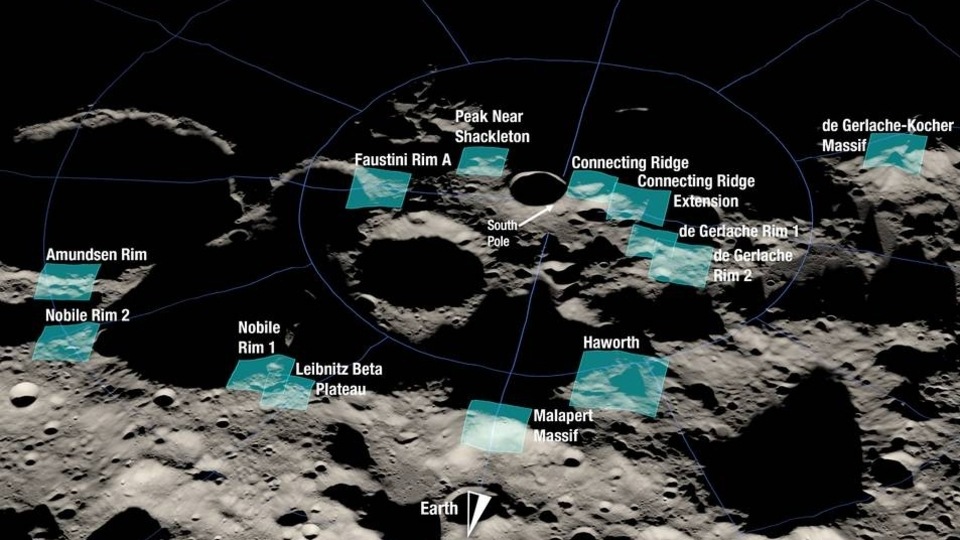
NASA has identified the following 13 regions as candidates for the landing of its Artemis 3 lunar mission: Faustini Rim A, Peak Near Shackleton, Connecting Ridge, Connecting Ridge Extension, de Gerlache Rim 1, de Gerlache Rim 2, de Gerlache-Kocher Massif, Haworth, Malapert Massif, Leibnitz Beta Plateau, Nobile Rim 1, Nobile Rim 2, and Amundsen Rim.
Each region is located within six degrees of the latitude of the lunar South Pole, and this proximity makes these sites scientifically significant. This is because the lunar South Pole has permanently shadowed regions rich in resources; it also has terrain unexplored by humans.
How were the regions selected?
For this, an agencywide team of scientists and engineers considered factors such as launch window availability, ability to accommodate a safe landing, accessibility, proximity to permanently shadowed regions, and, most importantly, the lighting conditions.
Why is sunlight critical for the mission?
Sunlight is required for a long-term stay on the Moon as it provides a power source and minimises temperature variations. Within each candidate site, there are areas with continuous access to sunlight throughout a period of six-and-a-half days, which is the planned duration of Artemis III.
The final selection
NASA will hold discussions with the broader science and engineering communities over the 13 proposed landing spots. The final selections will be made once the space body has identified the project's target launch dates.
More details are available here.


