
 E-Paper



NASA shares images of Jupiter's stormy weather, may last for centuries
The space agency shared a couple of pictures of the storms on Jupiter, saying that the stormy weather “can last for years, decades, or even centuries.”

 Prefer HTon Google


NASA on Monday shared stunning images of Jupiter, the fifth and largest planet in the solar system, showcasing its “stormy weather.” The space agency took to Instagram to share pictures of the storms on Jupiter, saying that the stormy weather “can last for years, decades, or even centuries,” with winds exceeding 643 kmph.
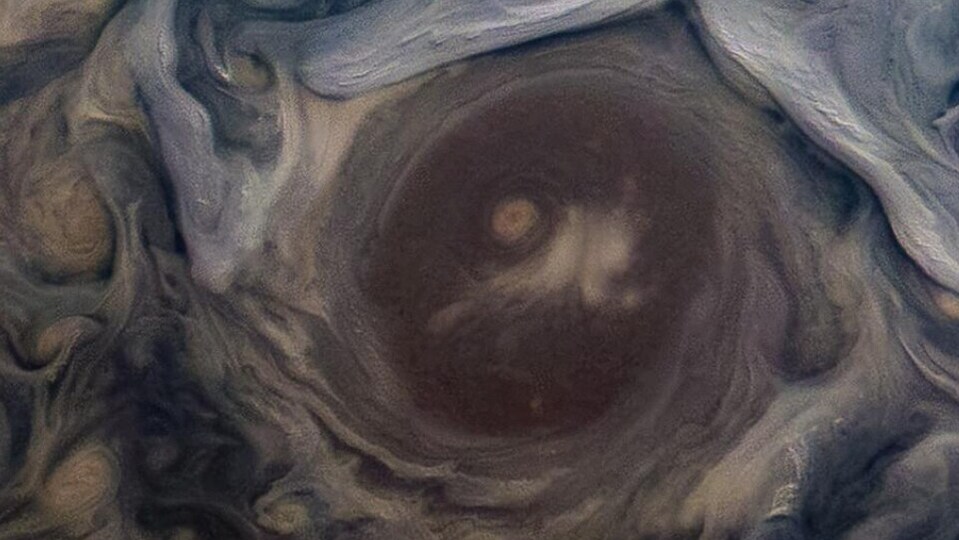
NASA described the images as blue, white, and tan clouds and storms swirling in Jupiter's atmosphere. “The clouds flow and curve gently around each other as they etch across the planet,” the space agency wrote.
Also Read | NASA shares stunning photo of Jupiter’s hellish moon Io, snapped by Juno mission spacecraft
NASA explained the nature of the storm
- The space agency said the image captures swirling storms on Jupiter, the fifth planet from the Sun. It was taken by the “Juno Mission,” a spacecraft dedicated to exploring the largest planet in our solar system.
- Due to the absence of a solid surface, storms on Jupiter can endure for extended periods, ranging from years to centuries, with wind speeds surpassing 400 mph (643 kph).
- Juno captured this storm within Jupiter's distinctive banded jet streams during a flyby approximately 8,000 miles (13,000 km) above the planet's cloud tops.
- These turbulent jet streams, composed of ammonia and water, crisscross Jupiter's predominantly hydrogen and helium atmosphere, contributing to the dynamic weather patterns observed on the gas giant.
Juno Mission
- NASA's Juno spacecraft has been exploring Jupiter's interior and origins since it reached in 2016, marking the first time such a study has been conducted.
- Using its orbit around Jupiter, Juno aims to unravel the mysteries surrounding the giant planet, including its origin and evolution. According to NASA, this will shed light on the history of our solar system and the formation of giant planets throughout the universe.
- Juno's unique orbiting pattern helps it avoid the hazardous radiation belts near Jupiter and its moons, ensuring its safety while conducting observations.
- Approximately every 38 days, Juno conducts close passes to Jupiter, allowing it to capture detailed images of the planet's massive clouds and intense storms, illuminated by lightning.
- Jupiter's magnetic field interacts with super-charged particles, resulting in auroras similar to Earth's northern and southern lights but on a much grander scale, reflecting the vastness of the planet, which could accommodate 1,300 Earths.


