
 E-Paper



NASA spacecraft Parker Solar Probe ‘safe’ after closest-ever approach to the Sun
On December 24, Parker Solar Probe came within just 3.8 million miles (6.1 million km) of the Sun’s surface, entering the corona, its outer atmosphere.

 Prefer HTon Google


NASA announced on Friday that its Parker Solar Probe is "safe" and functioning normally after completing the closest approach to the Sun ever achieved by a human-made object.
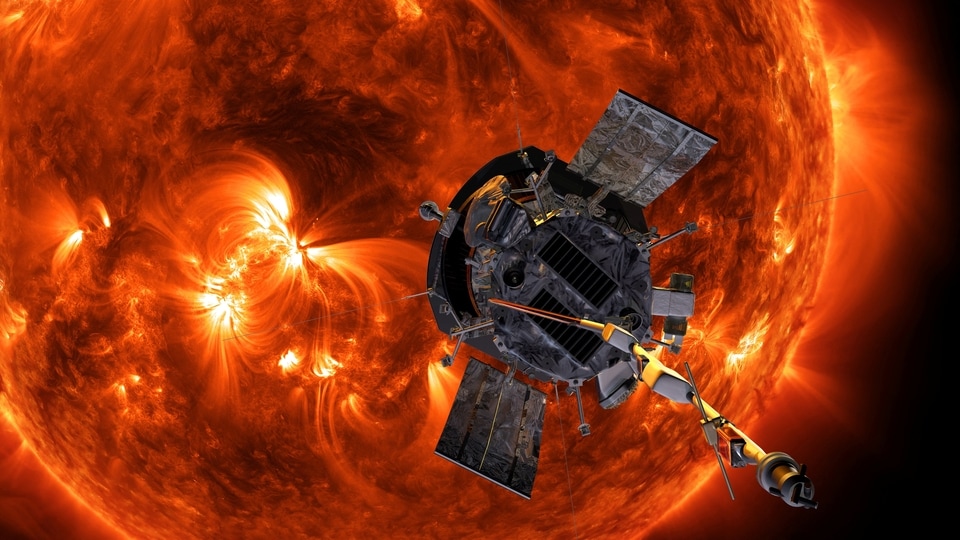
On December 24, the spacecraft came within just 3.8 million miles (6.1 million km) of the Sun’s surface, entering the corona, its outer atmosphere. The mission aims to deepen scientists' understanding of the Sun, Earth's nearest star.
The operations team at the Johns Hopkins Applied Physics Laboratory in Maryland received a beacon signal from the probe just before midnight on Thursday, confirming its health and operational status.
NASA stated: “Following its record-breaking closest approach to the Sun, NASA’s Parker Solar Probe has transmitted a beacon tone back to Earth indicating it’s in good health and operating normally.”
The spacecraft is set to send detailed data about its status and experiences on January 1. Scientists are hopeful that this mission will help them uncover how solar material heats to millions of degrees, pinpoint the origin of solar wind, and understand how energetic particles achieve near-light speeds.
Traveling at speeds of up to 430,000 mph (692,000 kph), the Parker Solar Probe endured extreme temperatures of up to 1,800 degrees Fahrenheit (982 degrees Celsius), according to NASA's website.
“This close-up study of the Sun allows Parker Solar Probe to take measurements that help scientists better understand how material in this region gets heated to millions of degrees, trace the origin of the solar wind (a continuous flow of material escaping the Sun), and discover how energetic particles are accelerated to near light speed," the agency explained.
Parker Solar Probe
Earlier, Nick Pinkine, mission operations manager at Johns Hopkins Applied Physics Laboratory, remarked in a NASA blog, “No human-made object has ever passed this close to a star, so Parker will truly be returning data from uncharted territory.”
Nicky Fox, a NASA official, expressed excitement in a video posted on social media Tuesday morning, saying, “Right now, Parker Solar Probe is flying closer to a star than anything has ever been before. It is just a total 'yay, we did it,' moment.”
Launched in 2018, the Parker Solar Probe has been steadily approaching the Sun, utilizing Venus flybys to adjust and narrow its orbit.
In its 2021 journey into the solar atmosphere, the spacecraft revealed fresh insights into the Sun's atmospheric boundaries and recorded detailed images of coronal streamers.
Additionally, one of its onboard instruments detected visible light from Venus, offering researchers a novel way to peer through the planet’s dense clouds and study its surface.


