
 E-Paper



Solar eclipse on December 14: Know why it won’t be visible in India
Solar eclipses happen when the moon comes between the Sun and the Earth, restricting the sun rays from reaching the planet and casts a shadow on it instead.

 Prefer HTon Google


The last major celestial event of this year, which is a total solar eclipse will occur on December 14. The eclipse is projected to last for five hours partially starting at 7:02pm, completely beginning at 8:02pm, reaching its peak at 9:43pm and coming to an end at 12:23am (December 15), as per the data on timeanddate.com. This odd timing of the event makes the spectacle unavailable to India for viewing.
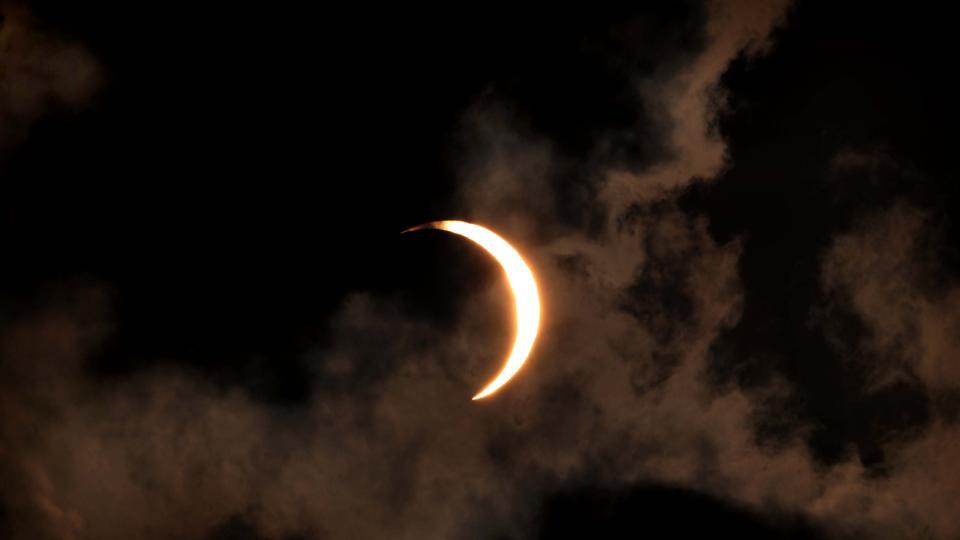
The total solar eclipse will be tracked from across the southern tip of South America and will also be visible in certain regions of Chile and Argentina. Partial phases of the eclipse will also be visible at some places in southern South America, south-west Africa and Antarctica.
Solar eclipses happen when the moon comes between the Sun and the Earth, restricting the sun rays from reaching the planet and casts a shadow on it instead. Parts of earth that receive the shadow of the moon during the eclipse are able to witness the event.
There are four different types of solar eclipses. A total solar eclipse that is scheduled to happen on December 14 is one of them. In a total eclipse, the moon covers the Sun completely and it only happens when the moon is closest to the Earth, that is close to perigee which is the point of the moon’s orbit is the nearest to Earth. The total solar eclipse is visible where the moon casts the darkest of its shadow, also called the umbra.
Also Read | Google celebrates Nobel Prize-winning economist Sir W Arthur Lewis with a doodle
Other types of eclipses include a partial solar eclipse when the moon only partially covers the sun and casts its light shadow on the planet, also called the penumbra. When the moon is not able to completely block the sun and the star’s outer edges are visible in the sky, forming a fire ring is known as an annular solar eclipse. In this case, the moon is farthest from the Earth. A hybrid solar eclipse is a mix of an annular and total eclipse. These are known to happen rarely and occur when an annular eclipse transitions into a total eclipse and vice versa.
The last solar eclipse that was visible in India was an annular solar eclipse on June 21.
Maximum five solar eclipses can happen in a year. The occurrence of five solar eclipses in a year is considered a rarity. As per the National Aeronautics and Space Administration (NASA), 1935 was the last time five solar eclipses happened in a single year. The same is projected to happen next in 2206. In the last 5,000 years, the quintuple occurrence of the event has happened only 25 times.


