
 E-Paper



Lionel Messi faces Lamine Yamal as the World Cup 2026 final becomes football's most extraordinary generational duel
Lionel Messi and Lamine Yamal meet as Argentina face Spain in a World Cup final pitting enduring greatness against fearless youth and football's next era.

 Prefer HTon Google


When Argentina and Spain walk into the World Cup final, the contest will carry the usual weight of nations, histories and contrasting footballing cultures. Argentina are attempting to defend the title that completed Lionel Messi’s career. Spain, European champions and arguably the tournament’s most assured collective, are seeking to establish the beginning of another era of dominance.
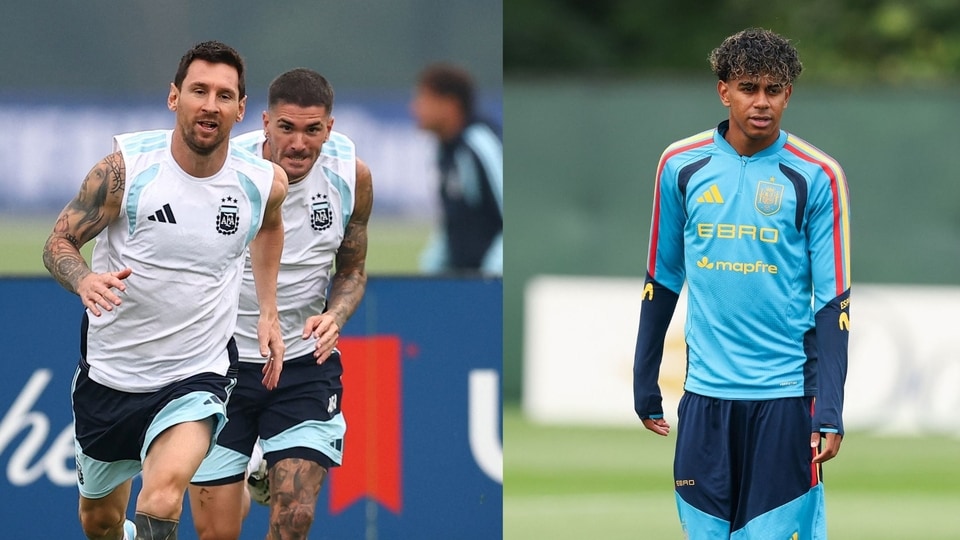
Yet the final’s most compelling tension is concentrated in two players separated by two decades.
Messi, 39, returns to football’s greatest match as Argentina’s captain, creative centre and enduring source of inevitability. Lamine Yamal, who turned 19 during the tournament, arrives as the most electrifying representative of a generation that grew up watching Messi redefine what an attacking footballer could be.
It is tempting to frame their meeting as a ceremonial transfer of power. That would be convenient, and wrong.
Messi is not appearing in this final as a relic awaiting succession. He has remained Argentina’s decisive force, producing goals, assists and match-altering interventions throughout the tournament. Yamal, meanwhile, cannot be placed safely in the future. He is already central to Spain and Barcelona, already a European champion, and already carrying responsibilities that once belonged only to established superstars.
This is not the past meeting the future. It is two versions of football’s present colliding.
Two revolutions at opposite ends of a career
Yamal represents the extraordinary acceleration of the modern game. Elite talent is identified earlier, promoted faster and exposed to greater tactical, physical and commercial demands before adulthood has properly settled.
By 19, he has already accumulated a volume of senior football that would have been almost unimaginable for Messi at the same age. Barcelona have not merely introduced him to the first team; they have entrusted him with the No.10 shirt, attacking authority and much of the club’s post-Messi imagination.
His rise reveals how football now treats precocity. The exceptional teenager is no longer protected at the margins of the senior game. He is expected to transform it immediately.
Messi represents the opposite revolution: the extension of greatness.
He can no longer dominate matches through the relentless acceleration and repeated dribbling that defined his youth. Instead, he has reconstructed his influence. He walks, observes and waits. He identifies the spaces that matter, conserves his movement and then intervenes with devastating precision. Age has reduced his volume, not his consequence.
Together, Messi and Yamal stretch the boundaries of the modern footballing life. One has reached the summit with extraordinary speed. The other has discovered how to remain there far beyond the sport’s traditional limits.
Their tactical differences are as important as their shared characteristics. Both are left-footed, both emerged through Barcelona’s academy and both instinctively move inwards from the right. But Yamal is still fundamentally a winger, isolating defenders, stretching the pitch and creating disorder through acceleration.
Messi has become something more elusive: part playmaker, part forward and part gravitational force. He does not simply occupy space. He changes how opponents defend it.
That contrast reflects the teams around them. Spain are built upon structure, positioning and collective control. Yamal is their most brilliant destabiliser, but the system does not depend entirely upon him. Argentina are tactically more flexible and emotionally more volatile. Their structure exists partly to release Messi from ordinary responsibilities so that he can decide extraordinary moments.
Spain possess perhaps the tournament’s most complete system. Argentina possess football’s greatest exception to systems.
The final also carries a profound Barcelona imprint. Messi was formed in Spain before becoming Argentina’s national redeemer. Yamal was formed by the same institution, but represents a modern, multicultural Spain shaped by migration and multiple inheritances.
Their careers demonstrate that footballing identity is rarely contained neatly by borders. Academies, families, neighbourhoods and nations all participate in the making of a player.
Whatever happens in the final, it will not settle whether Yamal can become Messi, because that is neither a fair question nor a useful one. Messi’s career is an historical anomaly, not a template that another teenager should be required to reproduce.
Yamal’s challenge is not to inherit Messi’s throne. It is to build a career whose meaning eventually belongs only to him. For one night, however, football’s greatest surviving genius and its most dazzling young possibility will compete for the same trophy. One is still resisting the end of his era. The other has refused to wait for his to begin.


