
 E-Paper



Netherlands arrive with a World Cup spine strong enough to dream, and flaws sharp enough to fear
The Netherlands, with a talented squad led by Ronald Koeman, aims for the semi-finals in theWorld Cup 2026.

 Prefer HTon Google


Three World Cup finals. Zero trophies. Another squad talented enough to make the wound relevant again. The Netherlands arrive in North America carrying exactly the same promise and exactly the same caveat they always do - brilliant in parts, incomplete in ways that matter.
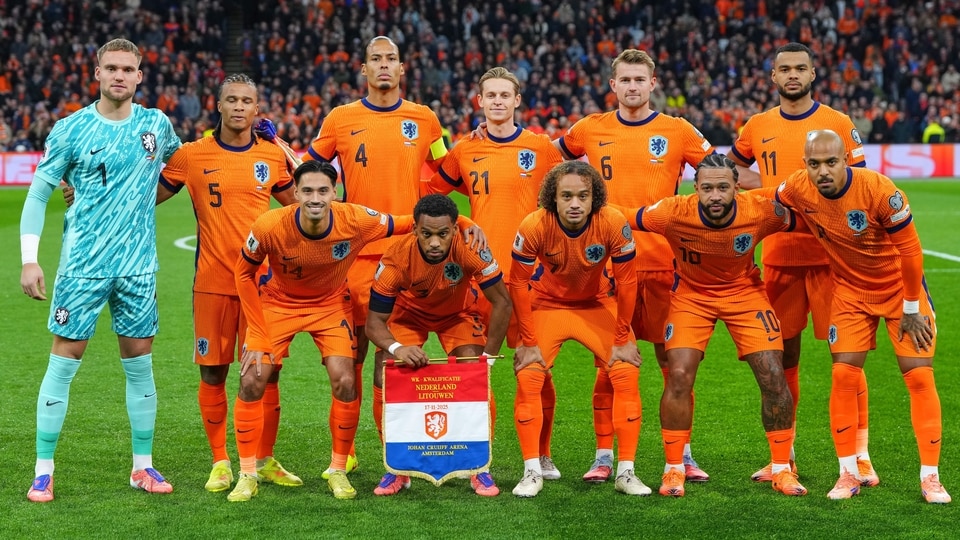
Ronald Koeman has a squad good enough to reach the semi-finals. Whether it holds together long enough is a different question.
Group F is no favour
The Netherlands land in Group F with Japan, Sweden and Tunisia, three opponents who each expose a different part of their game. Japan press hard and punish slow circulation. Sweden are physical, aerial and organised in the box. Tunisia will sit deep and dare the Dutch to unlock a compact block for 90 minutes.
The fixtures run: Japan in Dallas on June 14, Sweden in Houston on June 20, and Tunisia in Kansas City on June 25. The Netherlands should top this group. But they are not walking through it.
The Spine is legitimate
Van Dijk, Frenkie de Jong, Gakpo, Depay. That is a tournament-grade backbone in any system. Van Dijk remains one of world football's elite organisers. Frenkie changes geometry, receiving under pressure, carrying through lines, and converting defensive possession into attacking territory. Gakpo brings physicality, shooting and tournament temperament. Depay, at his best, is the hinge around which the entire attack rotates.
The spine is not the problem.
The right flank is
Jeremie Frimpong is absent. That is quietly the most damaging call in the squad. Frimpong bends defensive blocks through acceleration. He makes things happen on the right that no one else in this group can replicate.
Dumfries is a fine wing-back, dangerous at the far post, excellent in space, a real weapon in transition. He is not Frimpong. He attacks crosses. He does not beat three men by going through them. Against Sweden's aerial block or Tunisia's compressed shape, that distinction will surface.
Fitness is the Elephant in every room
Memphis Depay is in the squad. He is also coming off thigh and calf problems with limited minutes at Corinthians. Timber is in the squad. He returned to training at Arsenal after a groin issue sidelined him for 14 matches. Kluivert and Noa Lang are both recovering from injuries. Stefan de Vrij misses out entirely with a thigh problem.
If three or four of those fitness questions are answered badly at the same time, this squad looks very different.
The defence is the foundation they build from
Even without De Vrij, the Dutch defensive depth is real. Van Dijk organises. Ake composes. Van de Ven covers at pace, rescuing aggressive high lines. Timber builds technically from the right when fit. Van Hecke covers aggressively. Hato gives youth and flexibility at the back.
Koeman has enough here to structure a genuine back three, Van Dijk in the centre, Ake on the left, Timber on the right, with Van de Ven providing a pace safety net. This is the strongest department in the squad by a distance.
Midfield creates danger, not goals
Frenkie progresses. Gravenberch powers. Reijnders runs vertically and contributes goals. Koopmeiners brings left-footed balance and set-piece quality. Wieffer and De Roon give control when Koeman wants protection.
The gap is between the lines. The Netherlands have progressors. They may not have a natural lock-picker against a deep, organised block. When opponents crowd Frenkie and funnel play wide, Dutch attacks become cross-dependent. That is when Gakpo and a fit Depay become essential, not just useful, but structurally necessary.
Best XI, both versions
The balanced side: Verbruggen; Timber, Van Dijk, Ake; Dumfries, Frenkie, Gravenberch, Hato; Reijnders, Gakpo; Depay.
The cautious version pulls Wieffer or De Roon into midfield and lifts Reijnders higher. The attacking version pushes Lang or Malen into the front line. Koeman will almost certainly rotate between all three depending on the opponent, which is either tactical intelligence or a sign that the squad's full identity is still unsettled.
What Their World Cup Actually Hinges On
If Timber is fit, Frenkie controls games, Dumfries stays available, and Depay rediscovers sharpness as the tournament develops, the Netherlands can reach the semi-finals. That is a genuine ceiling.
If the fitness doubts cascade, the attack collapses onto Gakpo moments, and the right flank is exposed in a knockout match against a side with pace, the ceiling drops sharply. This is not the first Dutch squad talented enough to threaten everyone and just imbalanced enough to fall one game short of what the talent deserved.
They are not France, Spain, Argentina or Brazil. They do not have that attacking certainty. They have a defensive foundation, midfield control and enough match-winning individuals to make any knockout fixture deeply uncomfortable.
A blade with history on the handle. A few loose screws near the grip. In tournament football, that can still cut deep, if it holds together.


