Asian Games shows Indian table tennis a doubles direction
Sutirtha and Ayhika stunned Chinese gold medal favourites in the quarters, but it was no fluke result for Indian table tennis
Published on: Oct 5, 2023, 22:34:34 IST
By Rutvick Mehta
Prefer HTon Google
Share via
Copy link
Straight from breaching the Chinese table tennis bastion that fetched them the bronze medal at the Hangzhou Asian Games, Sutirtha Mukherjee and Ayhika Mukherjee will jump into the World Table Tennis (WTT) circuit in Muscat, competing at a WTT Contender event that begins on Saturday.
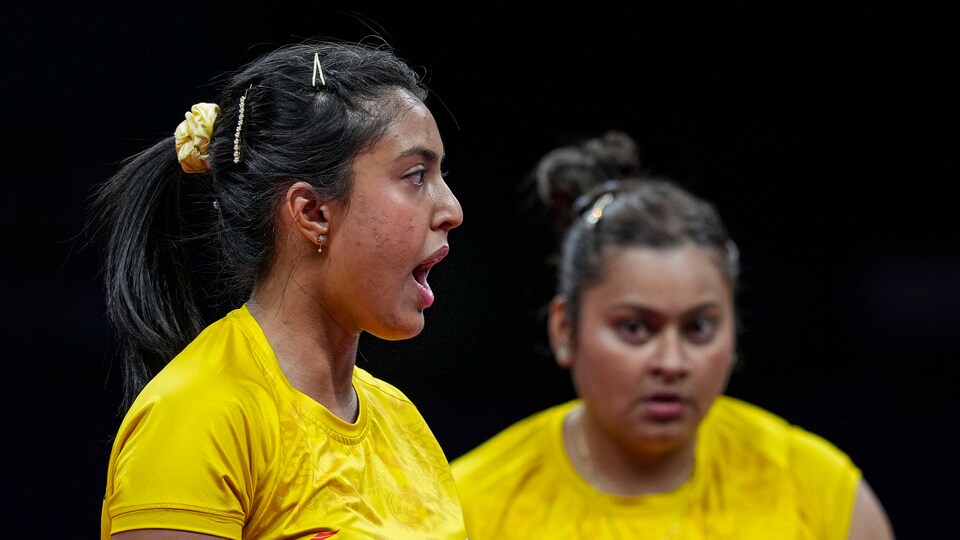
Sutirtha Mukherjee (R) and Ayhika Mukherjee during women's doubles semifinal match of table tennis against Korean pair of Suyong Cha and Sugyong Pak at the 19th Asian Games (PTI)
It is little time for the Mukherjees to reflect upon the most cherished couple of weeks of their lives at the Asian stage. But it is also what they now need: turning up and competing more frequently on the elite WTT tour to replicate such performances at the world and Olympic stage.
It is also perhaps what Indian table tennis needs to tap into leading into the 2024 Paris Olympics and beyond. From an Asian Games where Indian paddlers were largely below-par in the team and individual events (with the exception of Manika Batra, who made the singles quarter-finals), a couple of fairly inexperienced doubles pairs stood out.
Sutirtha and Ayhika’s stunning win over the Chinese world champion pair Chen Meng and Wang Yidi in the quarters and a fighting 4-3 defeat to the North Koreans proved that their odd upsets on the WTT tour earlier this year were no fluke. Theirs, however, wasn’t the only Indian pair among the last eight.
Manav Thakkar, 23, and Manush Shah, 22, reached there going past higher-ranked Pang Yew En Koen and Quek Izaac of Singapore and, pitted against the world No. 1 Korean pair of Jang Woo-jin and Lim Joog-hoon in the quarter-finals, the youngsters gave them a mighty scare in a nail-biting 2-3 defeat. Squaring things up at two games all, Manav and Manush lead 6-1 in the deciding game before the top-ranked Koreans summoned their class and experience to claw back and edge ahead.
The promise and potential in doubles from these young combinations, though, was evident in Hangzhou.
“We have some good doubles teams and we can surely put greater focus on doubles going ahead,” said Soumyadeep Roy, who coaches the Mukherjees and was national coach at the Tokyo Olympics.
“The way Manav and Manush also played, it showed they can give anyone a run for their money. The younger generation has started believing that. And that is the biggest takeaway from this Asian Games,” he added.
Another big takeaway? China, which has swept the last three Asian Games golds in women's doubles and medalled in the category in every edition since 1974, had no presence in the semi-finals this time. The men's doubles had only one pair on the podium (gold) from the country that has historically bossed the sport. While China’s aura may largely still be unadulterated in singles, other nations are increasingly getting into the mix in doubles.
Where table tennis differs from other global racquet sports like tennis and badminton is that all the top singles players also dabble in doubles. While you hardly get to see that in modern tennis, badminton has specialised doubles teams. In table tennis, the world’s top two male singles players are also the second-ranked doubles pair, and each of the four best women singles players constitute the world No. 2 and 3 doubles outfits.
And the Indians have started beating them. Months before the Mukherjees beat Chen Meng and Wang Yidi, they beat Koreans Jeon Jihee and Shin Yubin, the current world doubles No. 1, en route to their WTT Contender title in Tunis amid a top-class field. No wonder the two were not overawed fronting up to the world No. 2.
"We don’t fear playing the big names," Ayhika said. “Our mindset was to believe in ourselves, and we knew with our playing style we will make some difference.”
The challenge for them now will be to do this more consistently. And for that, they’ll do well to play a lot more against these top pairs on the WTT tour, which — for multiple reasons including lack of sponsorship — hasn’t been as frequent after they decided to turn their attention to their doubles partnership last year.
“The more we play, the more we will benefit from that and the more we will improve,” Ayhika said. “Now we have many more tournaments that we want to focus on and, step by step, make it to the Olympics. The Olympics is the ultimate goal that we want to work towards.”
Doubles will form a key part of the team events at the Olympics, where mixed doubles also offers medals. Doubles, though, often runs the risk of being pulled down the priority list in India, as the selection drama around the 2022 Commonwealth Games (CWG) showed. Then, Manika and Archana Kamath were a top-10 doubles pair competing together regularly in WTT events but, after a flurry of court cases, the latter was excluded from the contingent and the combination of Manika and Diya Chitale — they had never played together before — was fielded in Birmingham.
With the Sutirtha-Ayhika and Manav-Manush combos showing at this Asian Games that “we aren’t too far behind the leading pairs of the world”, as Roy put it, doubles could continue to be more rewarding for Indian TT on the bigger stages.
“We still have room to improve the doubles system in India and how we can use that,” Roy said. “But this would really make everyone think that we can aim higher.”
Not least the protagonists.
“This is just the start,” Ayhika said. “We have to go a long way.”

 E-Paper




 Prefer HTon Google