
 E-Paper



Naihati, a new table tennis hub in Bengal
In Sutirtha and Ayhika's town, their former coach Mihir Ghosh continues the search for new champions.

 Prefer HTon Google


“Even when you take one small step, good things start happening if you have the right intention and are willing to work for it,” says Mihir Ghosh. For the 63-year table tennis coach, it is an aphorism.
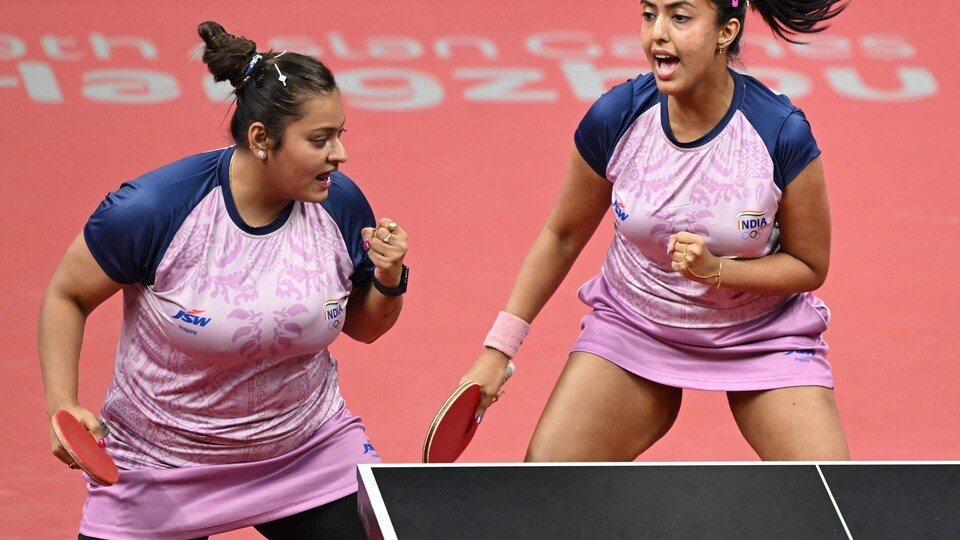
It is also the most plausible explanation Ghosh has for the miracle in Hangzhou when Sutirtha Mukherjee and Ayhika Mukherjee beat world champions Cheng Meng and Wang Yidi in the quarter-final to assure India their first medal in women’s table tennis in the 72-year history of the Asian Games.
Ranked No. 2 in the world and seeded second in the Asian Games, the Chinese pair lost 11-5, 11-5, 5-11, 11-9 on Saturday. The pair had not dropped a game till the quarter-finals.
“If they play again, most probably the Chinese will win. But sometimes, fates align to reward your dedication, your effort” says Ghosh, some 20 years after teaching the Mukherjees to hold a paddle. “Sutirtha came first, Ayhika a few months later.”
From then to a podium finish in a sport China has a stranglehold on, it has been some journey. One with interruptions for Sutirtha, who was suspended for age-fudging in 2015 and had her government funding stopped after the Tokyo Olympics, and a change in rubber in 2009 that transformed Ayhika from an early loser in tournaments to a champion.
In 42 years of coaching, part of which overlapped with his career as a player from Bengal who would cause the odd upset at national championships and the National Games, Ghosh says he must have trained “at least a thousand, around 25 of whom have won national titles and played for India.” But what makes Sutirtha and Ayhika special is that “even for five minutes you can’t take them away from the table.”
For long, being the birthplace of the novelist Bankim Chandra Chattopadhyay and having one of the oldest municipalities in India were Naihati’s claims to fame. Some 44km from Kolkata, this town in the West Bengal district of North 24 Parganas has over the past few years also become a hub for table tennis.
While Kolkata was always the nerve centre of a sport Bengal do well in across age categories and the senior competitions – the Mukherjees train at former national champions Soumyadeep Roy and Poulami Ghatak’s academy in Kolkata – districts too threw up champions from the 1980s to the 2010s.
Siliguri saw a spurt in coaching centres after the Bengal Table Tennis Association (BTTA) took the state championship there in 1970. The city in north Bengal began producing national champions from the 1980s when Ganesh Kundu broke through, the trickle becoming a torrent after Mantu Ghosh became the women’s national champion in 1993.
The Narkeldanga Sadharan Samity, a club in central Kolkata, was another grooming ground for future national champions Arup Basak, Kishalaya Basak, Mouma Das, Ranadeep Das, Munmum Basak, Niloy Basak, Jayanta Chandra and Souvik Chakraborty, who along with Mamta Prabhu, is at Asian Games as coach.
Baisakhi Sangha, a club in Tollygunge in south Kolkata, was a third producing Ghatak, a seven-time national champion. Anindita Chakraborty, who was 39 when she won her last team title for Bengal in 2017, 24 years after her first, is from the suburb of Uttarpara, some 15km from Kolkata.
In the 2005 world championships, all five in the women’s team and three of the five in the men’s side that represented India were from Bengal. In the 2003 National Games, Bengal won 12 gold, seven of them from table tennis.
Internecine politics and a tussle with the Table Tennis Federation of India (TTFI) led to BTTA being disaffiliated in 2004. At one point, Bengal had three associations running the sport including BTTA which continued to hold tournaments. The sport is now under Bengal State Table Tennis Association.
Through all this, Naihati grew into prominence. Now a coach, Amit Mukherjee became the national cadet champion in 1990 and 1991 and the sport grew in popularity once Naihati hosted the state championships in 2004. With their WTT Contender title in Tunis last June, Sutirtha and Ayhika are the headline act in a town from where Mukherjee, Aniket Sen Chowdhury, Moumita Dutta, Mousumi Pal, Kausani Nath, Ronit Bhanja, Arjun Ghosh, who is Mihir Ghosh’s son, Sourav Saha, Sourav Ghosh and Munmun Kundu have represented India.
“Whatever table tennis is happening in Bengal now is happening in Naihati,” says Robi Chatterjee, an avuncular, veteran administrator who was general secretary of BTTA. “And at its forefront is Mihir.”
Chatterjee said he knows Ghosh from the 1970s when he came for training under the late Saroj Ghosh. “He has staked his all for the sport. Literally”
This story is best heard from Ghosh. “When I retired in July 2020, my benefits totalled around ₹77 lakh,” he says over the phone from Naihati hours after Sutirtha and Ayhika’s sucker-punch of a win. “By then, my retirement plans were sorted. With the money I got, I would build a table tennis academy."
In a world taking baby steps into normality after the first wave of Covid-19, Ghosh began work after buying land of around 4355 square feet for ₹30 lakh. “I told the land owner that I will buy this but will pay you only in August. He agreed and this reinforced my belief that when your intentions are honest, help is always available.”
Parents of his wards chipped in and raised nearly ₹5 lakh. But for the academy to be functional, Ghosh said he spent around ₹50 lakh of his money. From coaching at different centres in Naihati from 1982, Ghosh has been living his dream since 2021. At the Mihir Ghosh Table Tennis Academy which has 12 tables, eight coaches and 50 players who pay around ₹2000 each per month.
He tells his trainees, Suthirtha and Ayhika included, to train elsewhere once they reach a level as he wants to focus on grooming new players. “Some of them still stay on, some don’t,” says Ghosh on Sunday, the chatter of table tennis balls constant in the background.
He had had his family’s buy-in. “My wife Alpana has been a big support and sons Arinjit and Arjun encouraged me. All three work and I have a pension. From a government job to a career as player and coach, table tennis has given me everything. Meeting running costs is a monthly challenge and I am looking for sponsorship. So, I know this can still turn out to be misadventure. But it would still mean at least I tried giving back,” he said.
The Mukherjee pair would know a thing or two about that. “I told them, this is an opportunity that could change your lives. So why stop at bronze,” he said.


