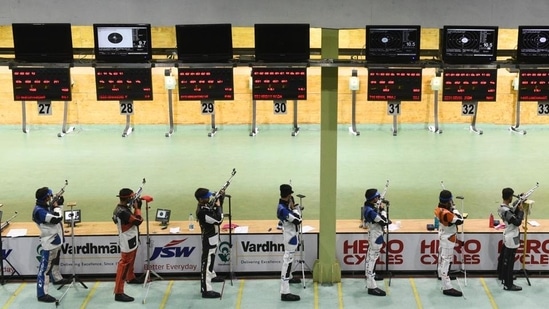
At the recently concluded President's Cup in Wroclaw, Poland, radical experiments with the sport's format were tried out, including one-on-one duels for finals
Not long ago, a shooting competition in an indoor hall was considered a dull, boring affair. Only those connected with the sport would venture into the range; the spectators had to maintain silence and range officers would spring to action over the slightest commotion from the gallery to guard the zen-like focus of shooters on the firing lane.
Young shooters in action at the Karni Singh shooting range in New Delhi ((Vipin Kumar / HT Photo))
All that changed dramatically in the last few years. The sport felt the pressure from other exciting and spectator-friendly disciplines to keep its place in the Olympic programme. Shooting went through a complete overhaul with international federation (ISSF) making efforts to engage audiences.
Shooting finals today make for enthralling contests, packed with background music and lot of cheering from the stands. An announcer gives the details of the format and reveals the scores at every stage to keep the spectators involved. The shooters have learnt to adapt to this new environment.
Since the 2016 Rio Olympics, the ISSF has brought several changes in the format in each discipline to make it more competitive, and also interesting for the spectators. For the 2020 Tokyo Olympics, the mixed team event was introduced and several format experiments were tried out.
With the next Olympic cycle about to begin, there are enough indications that more tweaking is on the cards in rifle and pistol events, going by the experiments at the recently held ISSF President’s Cup in Poland. The rifle and pistol events saw the introduction of semi-final after the qualification stage and scores were given in points. There were more one-on-one duels on show. Eight shooters who would earlier qualify for the final, were divided into two groups for a semi-final contest and two from each set progressed to the final. The scoring pattern was revised and points were given based on the score of shooters – 4 points for (best score), 3 points (second best), two points and one point for next best scores. From a 24-shot final, the semi-finals were 10-shot affair with the first shooter eliminated after five shots. The final, with four shooters, was a 15-shot competition. The last five shots saw two shooters pitted against each other for the gold medal.
“I quite liked the format,” said pistol shooter Abhishek Verma, who won bronze in 10m air pistol at the President’s Cup. “A shooter has to come again and again to the firing point and give their best every time and also wait in the waiting area for a much longer time which is mentally very challenging as compared to the earlier system of continuous 24-shots at one go.”
The most grueling event--the 50m rifle three positions, was also played with two qualification rounds and a two-stage final. Eight shooters eventually progressed to stage one of the final, where six series of five shots each (kneeling, standing and prone positions) decided who advanced to the final stage. In stage 2, the four shooters with the best results from stage 1 started from zero and shot a four series from standing position. The two best from here then competed in a shoot-off--the first to reach 10 points--for gold.
“These are drastic changes,” said Sanjeev Rajput, seasoned rifle 3-position shooter. “A fast, quick shooter will have the advantage in this format but we have to wait and see,” said the 40-year-old who competed in Tokyo. In every Olympic cycle they bring changes. It takes time for the shooters to understand and train and by the time you think you have mastered it, there is another change. Yes, it is challenging to adapt but for someone like me who has been in the sport for so long."
While the format change might not be always welcomed by the shooters, the changes in the ambience has certainly drawn more spectators to the ranges.
“You can see lot of cheering and clapping now,” said Deepak Dubey, coach and range officer at the Dr. Karni Singh Range in New Delhi. “It keeps the spectators involved. The shooters took some time to adapt. Earlier they used to feel that any noise is disturbing their concentration, now they have got used to it. It has brought in more people to the ranges. We call school kids to watch the finals and they really enjoy themselves which you could not have imagined a few years back.”
For the 2024 Paris Olympic programme, skeet mixed team has been included, making it the third mixed format to be introduced after pistol and rifle events at the Tokyo Olympics. All together there will be 15 events, five each in rifle, pistol and shotgun, competed in Paris.
While the formats and qualification system in shooting for Paris 2024 is yet to be finalised, expect big changes.
Stay updated with the latest sports news, including latest headlines and updates from the Olympics 2024, where Indian athletes will compete for glory in Paris. Catch all the action from tennis Grand Slam tournaments, follow your favourite football teams and players with the latest match results, and get the latest on international hockey tournaments and series.
Home/Sports/Others/What Shooting At The Paris Olympics May Look Like

 E-Paper