
 E-Paper



Carlos Alcaraz's US Open reign ends in heartbreak as Ben Shelton survives five-set epic to reach semi-finals
In a thrilling US Open quarter-final, Ben Shelton overcame Carlos Alcaraz, winning the match in a tiebreak 10-7.

 Prefer HTon Google


Ben Shelton kept asking Carlos Alcaraz the same question through five sets of a bruising US Open quarter-final: how many times can you find another answer?
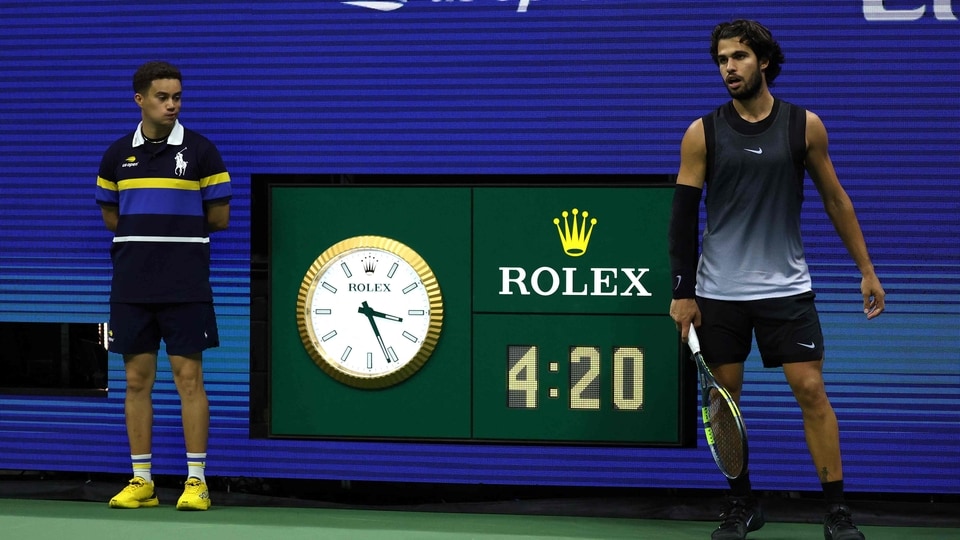
Alcaraz found one in the opening set. Shelton found several of his own after that. By the time the contest reached a deciding fifth set, neither had been able to shake the other off, with the match reduced to one final test of nerve after repeated swings in momentum.
Alcaraz took the opener 7-6(5), but Shelton responded emphatically, winning the second 6-1 and the third 6-3 before the Spaniard forced a decider by taking the fourth. What initially threatened to become another Alcaraz escape had instead developed into a sustained examination of his ability to absorb pressure and respond.
Shelton had lost all three of their previous meetings, but little about the match suggested he was carrying that history with him.
The American's serve immediately gave Alcaraz problems, while his forehand repeatedly denied the Spaniard the time he usually needs to establish control from the baseline. Alcaraz still managed to break at 5-5 in the first set, only for Shelton to break straight back and force a tie-break.
Shelton then moved 5-3 ahead, bringing the first major pressure point of the night. Alcaraz's response was ruthless He reeled off four straight points, finding greater depth and aggression from the forehand wing just as the set appeared to be slipping away, and stole the breaker 7-5.
Shelton turns the match
If losing such a set was supposed to deflate Shelton, the opposite happened. He returned with greater aggression in the second, attacked Alcaraz's second serve and began dictating rallies earlier. Alcaraz's first-serve level dipped, the errors mounted, and Shelton punished him with three breaks in a dominant 6-1 set.
The surge did not stop there. Shelton broke at the start of the third and then escaped from 15-40 on his own serve, repeatedly finding his biggest deliveries when Alcaraz threatened to drag himself back into the contest.
At one stage, Shelton had won nine consecutive games stretching across the second and third sets. Against a player renowned for disrupting an opponent's momentum, it was a remarkable stretch of control.
Alcaraz finally stopped the run with a love hold, celebrating loudly as he tried to reset the match, but Shelton remained composed on serve. Even when Alcaraz created opportunities late in the set, the American held him off and completed a 6-3 third set. Suddenly, Alcaraz was a set away from defeat.
Also Read: Mbappe matches Raul, Haaland hits 59 in 59 as Madrid, Man City start Champions League in style
Alcaraz refuses to fold
The fourth began with another moment of danger. Alcaraz faced a break point in his opening service game, with Shelton threatening to take immediate control of the set. The Spaniard escaped, and then turned the pressure around almost instantly.
He attacked Shelton's next service game, earned break points and converted to move ahead before consolidating the advantage. It was not the free-flowing Alcaraz normally associated with his best Grand Slam tennis. He was still being pushed, still having to protect service games and still unable to completely blunt Shelton's power. But the quality that kept surfacing was his resistance.
When the match threatened to move decisively Shelton's way, Alcaraz found enough. When Shelton appeared close to separating himself, the Spaniard produced another response. Shelton's achievement was that he kept forcing him to do so.
Four sets had produced no final answer. Shelton was one set from the biggest win of his career. Alcaraz was one set from surviving another night in which his margin for error had repeatedly disappeared. Everything had come down to the fifth.
The deciding set
The deciding set demanded one last escape from Alcaraz, but this time Shelton refused to provide it. The Spaniard kept fighting, stretching rallies and searching for the surge that had rescued him in the fourth, yet Shelton continued to answer under pressure. Neither man could find the decisive separation and the contest eventually spilled into a 10-point match tie-break, where the American held his nerve when it mattered most. Shelton took it 10-7 to complete a stunning 6-7(5), 6-1, 6-3, 1-6, 7-6(10-7) victory and end Alcaraz’s US Open title defence.


