
 E-Paper



How China Is Girding for an AI Battle With the U.S.
As Washington tries to limit its progress, Beijing is spending more to build an artificial-intelligence ecosystem that doesn’t rely on U.S. technology.


 Prefer HTon Google


China is ramping up efforts to build a domestic artificial-intelligence ecosystem that can function without Western technology, as it steels itself for a protracted tech contest with the U.S.
Washington has been trying to slow China’s AI progress through export controls and other restrictions that limit Chinese access to U.S. capital, talent and advanced U.S. technologies. To an extent, those restrictions have worked. But China is fighting back with expanding efforts to become more self-sufficient in AI—a push that could ultimately make it less vulnerable to U.S. pressure if it succeeds.
Many of the initiatives were on display at an AI conference that ended this week in Shanghai, which Chinese authorities used as a showcase for products free of U.S. technologies.
One startup, Shanghai-based StepFun, touted a new AI model that it said required less computing power and memory than other systems, making it more compatible with Chinese-made semiconductors. Although Chinese chips are less capable than American products, Huawei Technologies and other companies have been narrowing the gap by clustering more chips together, boosting their performance.
China also released an AI global governance plan at the event, the World Artificial Intelligence Conference, which called for establishing an international open-source community through which AI models can be freely deployed and improved by users. Industry participants say it showed China’s ambition to set global standards for AI and could undermine the U.S., whose leading models aren’t open-source.
The conference followed a series of announcements and investments in China aimed at turbocharging its AI capabilities, including rapid expansions in power generation and skills training.
The whole-nation effort, led by Beijing, includes billions of dollars in spending by state-owned enterprises, private companies and local governments.
China’s securities regulator has largely refrained from approving initial public offerings of companies whose businesses aren’t related to “hard tech” sectors such as semiconductors and AI, so that capital can concentrate on funding technologies of strategic importance, people involved in the process said.
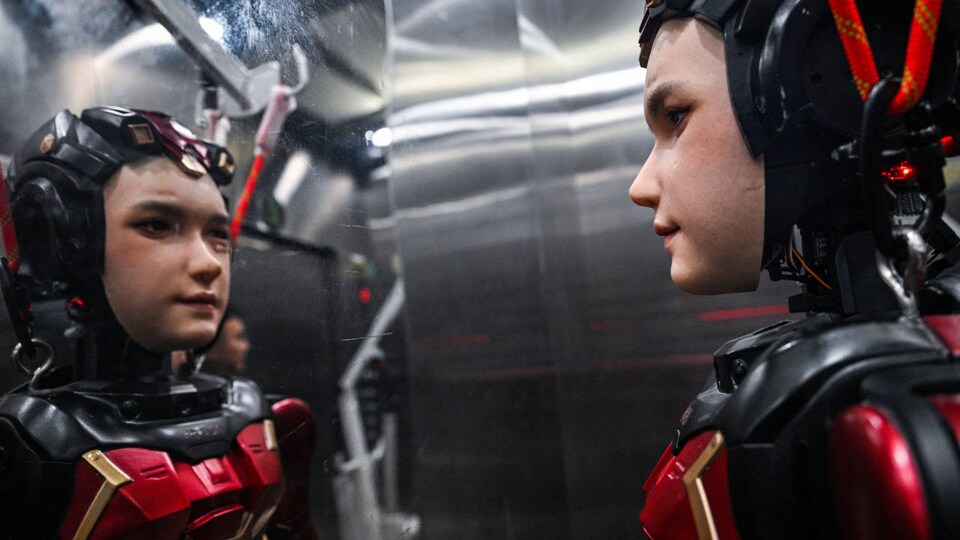
China’s AI push has included the expansion of skills training.Remote-controlled robots boxing at the AI conference in Shanghai.
Victory in the global AI race carries high stakes. AI is expected to upend economies and militaries, and leadership in the sector is seen as critical to future global influence and national security.
The U.S. maintains its early lead, with Silicon Valley home to the most popular AI models and the most powerful chips. Much of China’s AI spending has led to waste and overcapacity.
China also clearly wants U.S. technologies. Access to advanced chips has been a priority for Chinese negotiators in trade talks, The Wall Street Journal has reported. Sales of Nvidia’s H20 AI chips to China were recently restored by Washington after it restricted them in April, a reversal seen by Beijing as a gesture of good faith in the talks.
The Trump administration is taking steps to try to preserve the U.S.’s lead. It recently announced an AI “action plan,” which aims to slash red tape and make it easier for tech companies to build data centers needed to train AI models.
Earlier this year at the White House, OpenAI and Japan’s SoftBank unveiled a $500 billion effort to build new AI data centers, though the project has faced delays.
China, though, has shown a willingness to spend whatever it takes. The rising popularity of DeepSeek, the Chinese AI startup, has buoyed Beijing’s hopes that it can become more self-sufficient. Huawei has published several papers this year detailing how its researchers used its homegrown chips to build large language models without relying on American technology.
“China is obviously making progress in hardening its AI and computing ecosystem,” said Michael Frank, founder of think tank Seldon Strategies.
‘Project Spare Tire’
China’s biggest AI challenge is overcoming its difficulty in sourcing the world’s most-advanced chips. Washington has cut China off from some of Nvidia’s most sophisticated semiconductors, as well as the advanced machine tools used to make cutting-edge chips, restrictions that many experts believe will continue to hold China back.
Huawei is helping spearhead efforts to navigate those restrictions. During a meeting with President Xi Jinping in February, Chief Executive Officer Ren Zhengfei told Xi about “Project Spare Tire,” an effort by Huawei and 2,000 other enterprises to help China’s semiconductor sector achieve a self-sufficiency rate of 70% by 2028, according to people familiar with the meeting.
Increasingly, the company has been able to bundle together the best chips it can produce to match the performance of some American computing systems. That is helping local companies reach some of the same computing goals as the U.S., such as training state-of-the-art generative AI models, though it consumes more power than U.S. chips.
U.S. researcher SemiAnalysis recently reported that one such Huawei cluster, which connects 384 of its Ascend chips, outperforms Nvidia’s flagship system with 72 graphics-processing units on some metrics.
Morgan Stanley analysts forecast that China will have 82% of AI chips from domestic makers by 2027, up from 34% in 2024.
China’s government has played an important role, funding new chip initiatives and other projects. In July, the local government in Shenzhen, where Huawei is based, said it was raising around $700 million to invest in strengthening an “independent and controllable” semiconductor supply chain.
Prodded by Beijing, Chinese financial institutions, state-owned companies and government agencies have rushed to deploy Chinese-made AI models, including DeepSeek and Alibaba’s Qwen. That has fueled demand for homegrown AI technologies and fostered domestic supply chains.
Some companies ordered expensive AI servers to deploy the models even before they came up with a use for the technology, according to people familiar with the matter.
Open-source advantage
At the Shanghai conference, organized by China’s government and featuring more than 800 companies, Chinese researchers played down the impact of U.S. export controls on advanced chips. They compared notes on how they were focusing on overcoming bottlenecks through better model designs and engineering techniques.
Many also touted Chinese companies’ tendency to give users free access to modify and deploy their AI models, an open-source approach that has boosted adoption of Chinese models globally.
While the world’s best large language model is still American, the best model that everyone can use free is now Chinese. According to benchmark provider Artificial Analysis, the overall performance of China’s best open-weight model has surpassed the American champion since November.
In recent weeks, a flurry of Chinese companies have flooded the market with open-source models, many of which are claiming to surpass DeepSeek’s performance in certain use cases. OpenAI’s Sam Altman said his company had pushed back the release of its open-source model indefinitely for further safety testing.
Talent and power
China is also investing heavily in other areas, including more electricity to power domestic data centers to develop and run AI.
It is spending $564 billion on grid construction projects in the five years up to 2030, an increase of more than 40% from the previous five years, Morgan Stanley researchers forecast.
China currently has about 2.5 times as much power-generation capacity as the U.S., a disparity that is projected to grow larger in the next five years despite the U.S. expanding power generation.
China has also approved more than 600 colleges to set up degree programs in AI, according to data released by the country’s Ministry of Education in April. That is up from 35 universities with such programs in 2019.
In Beijing, primary and secondary schools will begin mandatory AI lessons for students starting in September.
China’s efforts have already enabled it to develop a robust pipeline of homegrown talent, according to researchers from the Hoover Institution and Stanford University, who recently evaluated the backgrounds of more than 200 authors involved in DeepSeek’s papers between 2024 and February 2025. More than half of these DeepSeek researchers never left China for schooling or work, they found.
The U.S. has fewer universities that offer AI degree programs, but American universities dominate rankings for computer and information science. This April, President Trump signed an executive order mandating AI education and learning opportunities for American youth.
Write to Raffaele Huang at raffaele.huang@wsj.com and Liza Lin at liza.lin@wsj.com


