ALMOST EVERY week the world takes another step towards artificial super-intelligence. The most powerful AI models can do an astonishing array of tasks, from writing detailed reports to creating video on demand. Hallucinations are becoming less of a problem.
Across the board, American unemployment remains low, at 4.2%. Wage growth is still reasonably strong, which is difficult to square with the idea that AI is causing demand for labour to fall. (Unsplash )
Small wonder, then, that so many people worry they will soon be surplus to requirements. Earlier this year global Google searches for “AI unemployment” hit an all-time high. In cities such as London and San Francisco “How long do you reckon you have left?” is a common topic of conversation. But is ChatGPT actually putting anyone out of work?
Lots of pundits claim that it is. Many point to a recent paper by Carl Benedikt Frey and Pedro Llanos-Paredes, both of the University of Oxford, which suggests a link between automation and declining demand for translators. At the same time, however, official American data suggests that the number of people employed in interpretation, translation and the like is 7% higher than a year ago. Others point to Klarna, a fintech firm, which had boasted about using the technology to automate customer service. But the firm is now doing an about-turn. “There will always be a human if you want,” Sebastian Siemiatkowski, its chief executive, has recently reassured.
Chart 1
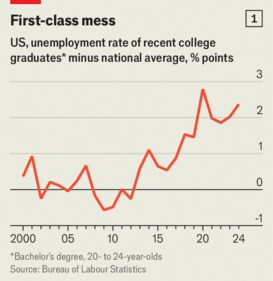
Others still scour the macroeconomic data for signs of the AI jobs-pocalypse. One popular measure is the ratio of the unemployment rate between recent college graduates and the overall American average. Young grads are now more likely than the average worker to be jobless (see chart 1). The explanation runs that they typically do entry-level jobs in knowledge-intensive industries—paralegal work, say, or making slides in a management consultancy. It is exactly this sort of work that AI can do well. So maybe AI has eliminated these jobs?
Well, no. The data simply do not line up with any conceivable mechanism. Young grads’ “relative unemployment” started to rise in 2009, long before generative AI came along. And their actual unemployment rate, at around 4%, remains low.
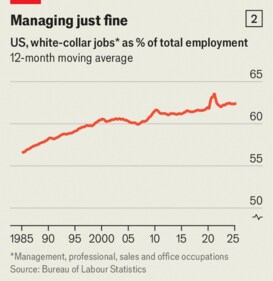
Returning to a measure we introduced in 2023, we examine American data on employment by occupation, singling out the type of workers that are often believed to be vulnerable to AI. These are white-collar employees, describing people in back-office support, financial operations, sales and much more besides. There is a similar pattern here: we find no evidence of an AI hit (see chart 2). Quite the opposite, in fact. In the past year the share of employment in white-collar work has risen very slightly.
Across the board, American unemployment remains low, at 4.2%. Wage growth is still reasonably strong, which is difficult to square with the idea that AI is causing demand for labour to fall. Trends outside America point in the same direction. Earnings growth in Britain, the euro area and Japan is strong. In 2024 the employment rate of the OECD club of rich countries, describing the share of working-age people who are actually in a job, hit an all-time high.
There are two competing explanations for these trends. The first is that, despite the endless announcements about how companies are ushering AI into every facet of their operations, few make much use of AI for serious work. An official measure suggests that less than 10% of American firms use it to produce goods and services. The second is that even when companies do adopt AI, they do not let people go. AI may simply help a worker do their job faster, rather than making them redundant. Whatever the explanation, for now there is no need to panic.

 E-Paper