
 E-Paper



Game, set, memories: Wimbledon, the most coveted Grand Slam
The grass is always green here, the shots forever pretty. As the excitement builds up at the 128th Wimbledon Championships, Indian tennis legends share their association with the only Grand Slam played on grass with us.


Sliced backhands meet booming serves as champions glide across the grass, grunting like gladiators and wielding graphite sabres to unleash lightning volleys on lush green courts. Off the court, the stands are a medley of musicians, movie stars, connoisseurs and commoners.
As the excitement builds up at London's All England Club for the 128th Wimbledon Championships, a wizened 77-year-old tennis veteran is staying up late at Chennai's upscale Oliver Road neighbourhood to root for Swiss maestro, Roger Federer.
The Krishnans', Indian tennis's first family, have created a private court at their Mylapore residence, one of the few natural grass courts in the country, where Ramanathan Krishnan and his son Ramesh, 53, relive memories of the silken brand of touch-tennis that the father and son perfected during their more than 30-year-long association with the championship.

"Although all four of the quartet of present-day stars - Rafael Nadal, Novak Djokovic, Andy Murray and Roger Federer - are equally good, Roger is a champ. I like him for the smoothness of his strokes that stands out at Wimbledon," says Ramanathan about Federer, who is carrying forward the tradition of classical stylists, who ruled people's hearts before graphite racquets and the slambang serve-volley routine wrenched the aesthetics out of tennis.
When Indian tennis's original touch artist, the best singles player to have stepped on the hallowed turf, talks about Wimbledon, you've got to pay attention. "It was Ramesh's idea to create a grass court in Chennai as a tribute to Wimbledon. The championships are dear to both of us. For the last few years, we place the television at the court and watch the action from here," says Ramanathan, who reached the Wimbledon semi-finals in 1960, losing to eventual champion and former world number one, Neale Fraser. The next year, he again made it to the last four, beating Roy Emerson in straight sets, but lost in the semis to eventual champion and tennis legend Rod Laver. "My fondest memory of the championships is my victory over Emerson," says Krishnan Senior. "He was on his way to creating a record of winning 13 Grand Slam titles, which stood for a long time. If I remember correctly, it was Pete Sampras who broke it," says Ramanathan.
Ramesh Krishnan, who inherited the legacy of deft touch-tennis that his father pioneered (along with Mexico's Rafael Osuna and Italy's Nicola Pietrangeli), became the juniors champion at Wimbledon in 1979. Ramesh gets nostalgic as he reminisces about his best performance in 1986, when he reached the quarter-finals, beating sixth-seeded Swede Joakim Nyström on the way. "There's a certain timelessness about playing at the Centre Court. It is a wonderful mixture of tradition and glamour, and a wonderful garden party. Don't forget, it's still played on a lawn. The modern game, after all, began as lawn tennis," Ramesh points out.
Old-World Niceties
Author Irvine Welsh once wrote about Indian tennis icon Naresh Kumar, that he had seen more Wimbledons than Welsh had seen bookies' offices. Welsh wasn't exaggerating. Kumar played at Wimbledon in 20 consecutive championships between 1949 and 1968. The doubles specialist, who once led Rod Laver in a first-round match at Wimbledon in 1960, says the tournament is still firmly anchored in the old world. "Also, I have fond memories of the place. During the 101 matches that I played at Wimbledon, I was fortunate enough to play against all the great champions of my time."
The high noon of Kumar's Wimbledon exploits came in 1958, when along with Ramanathan Krishnan, he beat defending champions Budge Patty and Gardnar Mulloy, who had emerged triumphant in 1957. "We had our pictures in the London Times. It created quite a stir back home," says Kumar.
According to Kumar, the best Indian player to feature at Wimbledon is none other than his erstwhile doubles partner. "Ramanathan, who made it to two successive semi-finals in the championships in 1960 and 1961, has the greatest record in singles play there."
HT column: Wimbledon's charm is timeless: Leander Paes

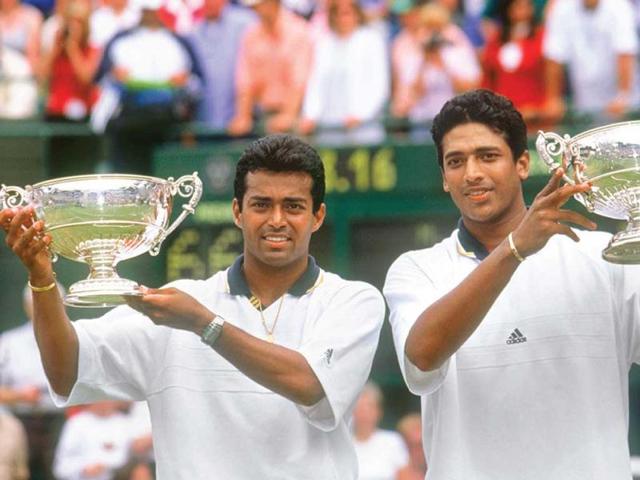
A new generation of Indian tennis champions vouches that Wimbledon is still the most coveted Grand Slam. Mahesh Bhupathi, 40, for instance, was the men's doubles champion in 1999 with Leander Paes. He also won the mixed doubles in 2002, with Elena Likhovtseva and repeated the feat three years later, this time partnering with Mary Pierce. "Playing Wimbledon is special, winning a title there is a dream and being able to win three times was amazing," he says. Ask Bhupathi about the enduring appeal of Wimbledon and he jokes: "It's like asking a cricketer why it is special playing at the Lord's!"
Rules And The Big W
When Sania Mirza, ranked World No. 6 in women's doubles, was a gangly adolescent in Hyderabad, she looked up to German champion Steffi Graf for inspiration and was fascinated with the way Fräulein Forehand demolished her rivals at Wimbledon. Mirza, 27, says that even today, after spending more than a decade on the circuit, playing at the Wimbledon is a special experience. "Its aura is different. As you grow up, you dream of playing here. The clothes and grass are very different from the other slams," says Mirza.
Read: Wimbledon quotes trail

The world's oldest tennis tournament has an all-white, some say stuffy dress code. A few years ago, Radek Stepanek was ordered to change his shoes ahead of a match against Novak Djokovic since they were deemed too colourful. Before that, Andre Agassi skipped Wimbledon from 1988 to 1990, reportedly protesting against its outdated clothing rules. But then he came around, disappointingly conformed and won here in 1992.
Over the years, the potent serve and volley cocktail dished out by Boris Becker, Pete Sampras, Novak Djokovic and Andy Murray, among others, has lent a new dimension to the championships. What hasn't changed, says Ramanathan Krishnan, is the old-world charm and hospitality with which the tournament is hosted. "Wimbledon is a slice of history. The hosts organise the tournament beautifully. They treat No.1 and the unseeded player in the same manner. Of course, the champions are granted some privileges such as Centre Court appearances. But otherwise, it is still the most egalitarian tournament in the world, where the organisation is a masterpiece," says the grand old man of Indian tennis.
The protagonists might have changed over the last 127 years, but the alchemy and atmosphere of Wimbledon continue to cast its spell over the racquet magicians.
|
Boris Becker turned a generation of cricket lovers in India into tennis fan boys in 1985. The game can never have enough of more maverick players like him, writes Aasheesh Sharma. July 7, 1985 was the day Boris Becker visited our living room and never left. I remember my parents watching TV and raving about a blond German teenager. He went on to win Wimbledon and grunted his way to earn the moniker, Boom, Boom. |

Follow @aasheesh74 on Twitter
From HT Brunch, June 29
Follow us on twitter.com/HTBrunch
Connect with us on facebook.com/hindustantimesbrunch


