
 E-Paper



NASA shares mesmerising pic of 'irregular galaxy' 7 million light-years away from Earth
The picture shows a collection of stars and galaxies. Many people thought the image looks ‘beautiful.’

 Prefer HTon Google


NASA shared a stunning photograph of a 'dwarf galaxy' that is considered to be irregular because of its shape. Since the space agency posted this picture, it caught the attention of many. Several took to the comments section of the post to share how 'amazing' the galaxy looks.
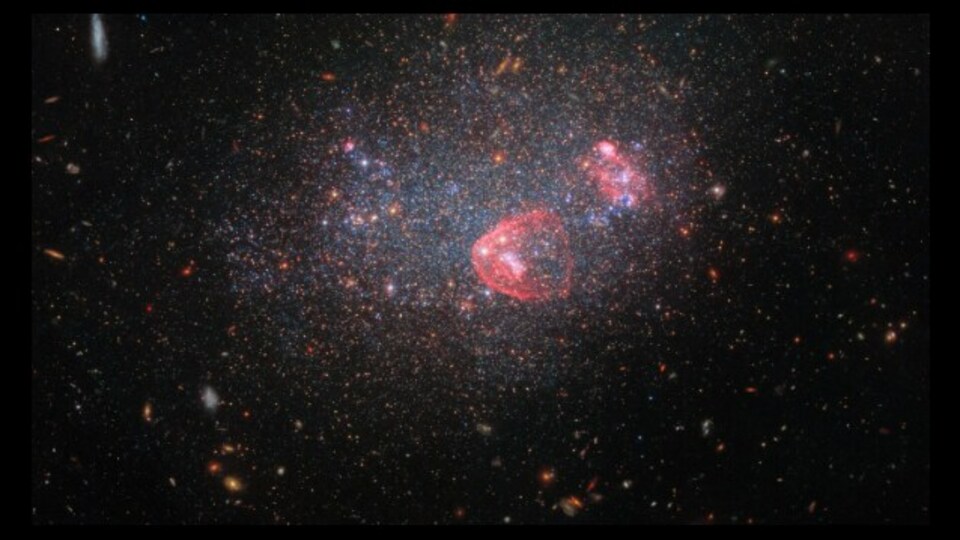
As NASA shared the picture, in the caption of the post, they informed, "In the constellation Virgo about 7 million light-years from Earth, you’ll find a billion stars in this dwarf galaxy. It’s considered an irregular galaxy because of its unorderly shape which resembles a space version of a sparkly snow globe. By carefully examining the stars, astronomers are investigating the evolutionary links between ancient galaxies and the role they had on modern galaxies such as our own. This image was created with data from @NASAHubble’s Wide Field Camera 3 and the Advanced Camera for Surveys by combining twelve camera filters." (Also Read: Flower garden to pulsating flames: NASA shares science experiments conducted in space)
Take a look at the post shared by NASA here:
This post was shared on December 22. Since being posted, it has gained more than two lakh likes. The share also has numerous comments.
Check out what people are saying about this post here:
An individual wrote, "OMG, I love this galaxy, it's cute."
A second shared, "Vastness of space is beyond our understanding of the world."
"This is so amazing," commented a third.
A fourth said, "Looks like a guitar pick."
A fifth added, "Thank you, NASA! Without you, we will know nothing about the space!"


