
 E-Paper



Pitch black sky turns blue in Spain and Portugal as meteor crosses, netizens share videos
Despite the widespread accounts, there has been no official confirmation of the meteor sighting.

 Prefer HTon Google


In Spain and Portugal, a stunning blue fireball illuminated the night sky, captivating the attention of numerous social media users who reported witnessing a spectacular meteor. Countless individuals shared captivating photos and videos of this awe-inspiring event. Despite the widespread accounts, there has been no official confirmation of the meteor sighting.
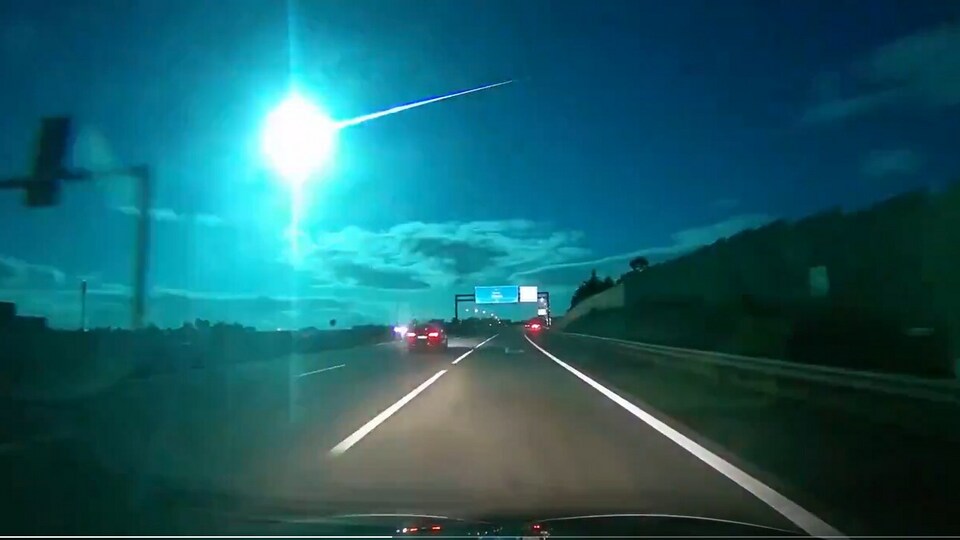
In several videos, individuals can be observed capturing various perspectives of the meteor. What remains consistent across all recordings is the vivid blue hue of the fiery celestial object, which illuminated the night sky for a few fleeting seconds before vanishing. (Also Read: Aurora illuminates sky in Ladakh's Hanle as extreme solar storm hits Earth: 'Extraordinarily beautiful')
Take a look at a few videos here:
According to NASA, "Scientists estimate that about 48.5 tons (44 tonnes or 44,000 kilograms) of meteoritic material falls on Earth each day. Almost all the material is vaporized in Earth's atmosphere, leaving a bright trail fondly called 'shooting stars.' Several meteors per hour can usually be seen on any given night. Sometimes, the number increases dramatically—these events are termed meteor showers."
The space agency also added, "Meteor showers occur annually or at regular intervals as the Earth passes through the trail of dusty debris left by a comet. Meteor showers are usually named after a star or constellation that is close to where the meteors appear in the sky. Perhaps the most famous are the Perseids, which peak in August every year."
Before this, a meteor shower called Lyrid took place in April. According to NASA, the Lyrids meteor shower, which peaks in late April, is one of the oldest recorded meteor showers, with a history spanning 2,700 years. The Chinese documented its observation in 687 BC. One of the things that makes the Lyrids unique is their meteors, which are known for being bright and fast. It is best to watch the Lyrids in the Northern Hemisphere during the dark, preferably after moonset and before dawn.


