E-Paper



‘Sheerly embarrassed’: Man recalls 20-minute drive with foreign clients on Gurgaon’s pothole ridden roads
A man shared an embarrassing Gurgaon drive, highlighting poor public infrastructure outside tech parks.

 Prefer HTon Google


A social media post by a Gurgaon based professional has sparked a fresh conversation online about the contrast between India’s modern private infrastructure and the condition of public facilities outside corporate campuses.
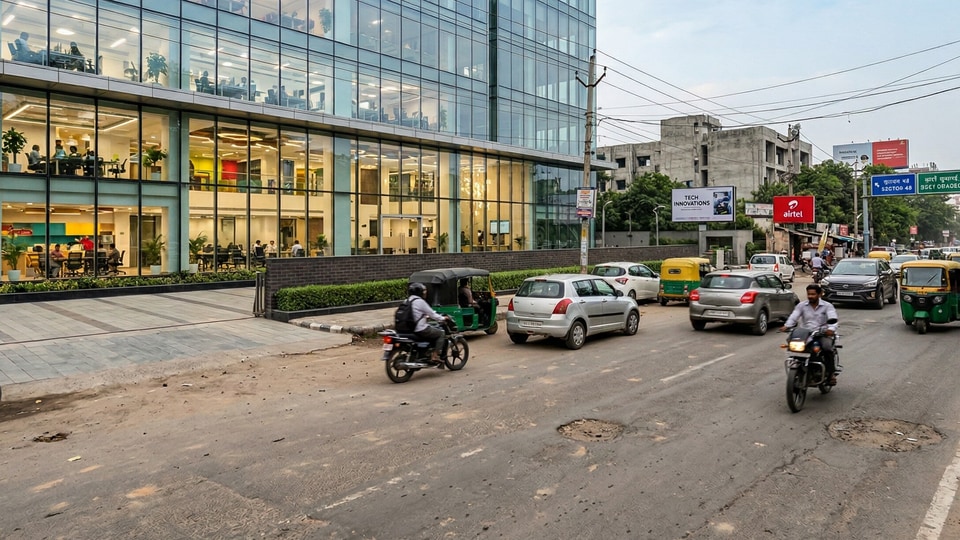
The man, identified as Pranav Bhardwaj, shared his experience on X about working in a tech park in Sector 59, Gurgaon. In his post, he described how impressive the office complex looked from inside but how the situation changed the moment he stepped out of the building with visiting clients.
(Also read: ‘Gurgaon ke entitled parents’: Mom slams irresponsible parenting in viral video)
His post quickly gained traction on the platform, drawing more than 66,000 views and several reactions from users who debated the state of infrastructure in Indian cities.
A stark contrast outside the office complex
In the post, Bhardwaj recounted an incident involving his Chinese clients whom he had to drop at a nearby hotel. What was meant to be a routine drive turned into a moment of embarrassment for him.
He wrote, “I had my office in one of such tech parks in sector 59, Gurgaon. It looked absolutely amazing inside. Once my Chinese clients got stuck with me in a task and i had to drop them to their hotel nearby. I was sheerly embarrassed by the fact that just once you are out of this building, roads were full of dust, potholes and cattle. A nearby dhaba had its sewage outlet on road, it was overflowing like anything, my car jumped like it is an offroad drive, one of them held the handle above to maintain balance. Those 20 minutes drive with them was one of the most embarrassing drive for me. You can’t be taking India’s pride in private infra when your public infra is bad.”
Check out the post here:
Social media reacts
The post triggered a range of responses from social media users, many of whom shared similar experiences or offered broader perspectives on India’s development challenges.
One user wrote, “Move to Noida and see the difference.” Another commented, “Compared to the size of its economy and youth population, India’s infrastructure still lags behind.”
(Also read: 'Stop spending entire life savings building family home': Gurgaon CEO's advice to Indian parents divides internet)
Some users attempted to place the issue in a larger developmental context. One person said, “You should have asked the Chinese how things were in 2008. When development begins, private infrastructure improves first. Then larger public infrastructure such as roads, railways and airports follows. After that, the city transforms. This is a well known pattern. The last thing to change is people’s mindset, but once it changes, it tends to stay for a long time.”
Others echoed the frustration expressed in the original post. A user remarked, “For sure, no matter how hard we try to portray India as a prosperous country, the ground reality always exposes us.” Another added, “It is indeed embarrassing to drive foreign colleagues to their hotels or restaurants due to bad roads and a lack of traffic discipline.”
(Disclaimer: This report is based on user-generated content from social media. HT.com has not independently verified the claims and does not endorse them.)