
 E-Paper



US Presidential Election 2020: Election night in US, world awaits verdict
Americans are also voting to elect 435 members of the House of Representatives, which is currently controlled by Democrats, and 35 members of the US Senate (including special elections in Arizona and Georgia), dominated by Republicans. Democrats are expected to keep control of the House, but the big fight is for the senate.


A record number of Americans are expected to have voted by the end of Tuesday, when polling closes and counting begins in what has been called the most consequential election in US history — to either re-elect President Donald Trump, who is running on the promise of delivering a strong economy and law-and-order; or replace him with his Democratic challenger, Joe Biden, who has vowed to make defeating the Covid-19 pandemic his top priority, and unify a strongly divided nation.
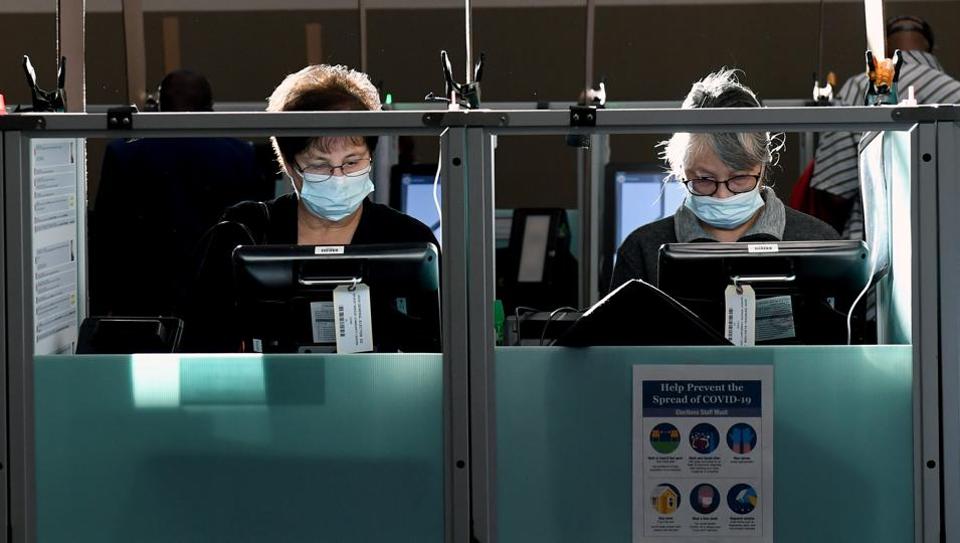
Americans are also voting to elect 435 members of the House of Representatives, which is currently controlled by Democrats, and 35 members of the US Senate (including special elections in Arizona and Georgia), dominated by Republicans. Democrats are expected to keep control of the House, but the big fight is for the senate.
Also on the ballot is an Indian American who stands to make history if elected: Kamala Harris, the Democratic nominee for vice-president. She will be the first black woman and the first of Indian, South Asian and Asian descent, elected to the high office. Four Indian American members of Congress are seeking re-election — Pramila Jayapal, Ro Khanna, Ami Bera and Raja Krishnamoorthi — and a few others, who are running for their first terms.
Biden has led Trump consistently in national polls and battleground states; the race has remained remarkably stable. The former vice-president is leading the incumbent by 8.4 percentage points (51.8%-43.4%) in the FiveThirtyEight weighted average of polls and by 6.7 (50.7%-44%) percentage points in the RealClearPolitics average, but only by 2.3 points in the aggregator’s polls in the top battleground states.
Florida, North Carolina, Pennsylvania, Michigan, Wisconsin, Arizona, Nevada, Minnesota and Iowa are the battleground states that will determine which of the two nominees gets past threshold of 270 electoral college votes to win the race.

Polling closes at staggered times, across three time zones. Florida, North Carolina and Arizona, which are likely to wrap up counting their votes earlier than others, are expected to present the first indications of which way election 2020 was headed. Trump won the 2016 election with 304 electoral college votes to Hillary Clinton’s 227; but the Democrat won the popular vote by nearly three million votes.
Both Trump and Biden voted early along with nearly 100 million Americans, who had already cast their ballots till the opening of last-day of polling Tuesday; 35.7 million in-person at early voting centres and 63.9 million by mail, a preferred choice for Americans concerned about the continuing onslaught of the Covid-19 epidemic that has killed more than 231,000 people and infected 9.2 million.
“We’re looking at a historic turnout in 2020, from 138 million roughly ballot cast in 2016 to possibly 150, or more in 2020,” said Meena Bose, professor of political science at Hofstra University in New York. “Absentee ballots (mail-in votes) are expected to triple from what they were in 2016, from less than a quarter to possibly close to three quarters.
She added: “And for the first time in American history, more votes are likely to be cast before the election than on election day whether that be absentee ballot, or by early [in-person] voting.”
Tensions and tempers have been rising, with a looming spectre of violence. A ring of tall, unscalable fence was thrown around the White house overnight in a reminder of the protective measures undertaken last summer during the anti-racism protests. President Trump warned of “violence in the streets” in a tweet Monday that was flagged by Twitter. Shops and business establishment boarded up in downtown Washington DC; Massachusetts has National Guards standing by and Oregon has declared a state of emergency in Portland. They are getting ready for unrest and violence no matter who won.
The International Crisis Group, an independent organization that works towards preventing wars and seeks to sound the alarm to prevent deadly conflicts, has warned that “the ingredients for unrest are present. The electorate is polarized, both sides frame the stakes as existential, violent actors could disrupt the process and protracted contestation is possible”. It added that Trump’s “often incendiary rhetoric suggests he will more likely stoke than calm tensions.”
The two nominees wrapped up their closing arguments in rallies and speeches across the battleground states that will determine the outcome. Both of them were in Pennsylvania, where Trump threw an angry and ominous warning at the state’s governor Tom Wolf. “You look at what’s going on in Philadelphia - we’re watching you, governor,” he said at a rally, adding, “Make sure your governor doesn’t cheat, because they are known for very bad things here. But we have a lot of eyes watching, a lot of very powerful eyes here.”
Biden closed his case in Pittsburg, where he had launched his campaign in April 2019, with a commitment to bring under control the Covid-19 epidemic. “We’re going to act to get COVID-19 under control. On Day One we will put into action the plan I have been talking about.” He added that he will choose “unity over division, hope over fear, science over fiction and … truth over lies”.


