
 E-Paper



5 years ago, a ship blocked Suez Canal: What a revisit tells us amid Hormuz Strait crisis
In 2026, the world finds itself facing similar crisis as the Strait of Hormuz, which controls around 20% of the world’s oil trade, remains effectively blocked

 Prefer HTon Google


The world today finds itself in the midst of a raging war that has brought the global oil and energy trade close to a standstill, mainly because the Strait of Hormuz, under the control of Iran, stands choked with hundreds of ships awaiting their fate and journey.
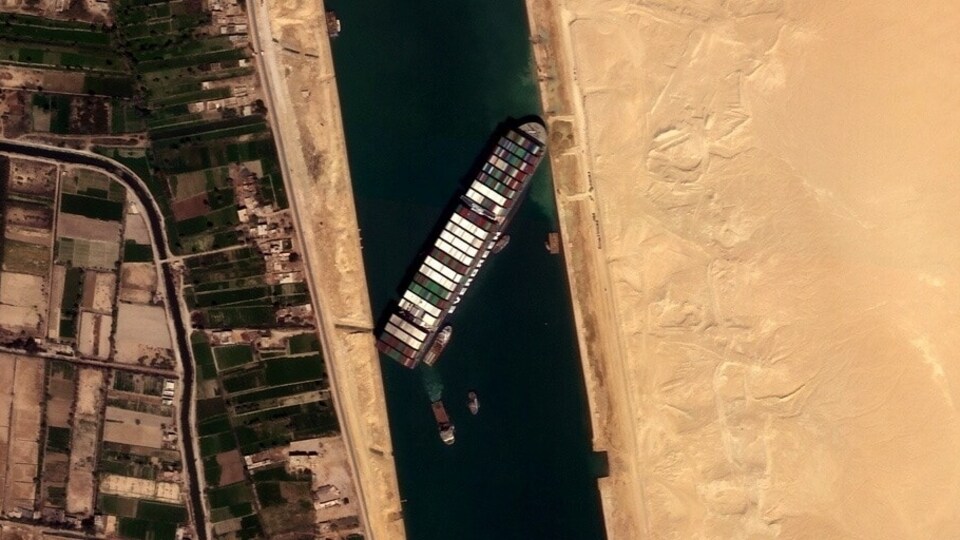
It is all but reminiscent of a similar waterway chokehold that brought the global trade to a worrying halt, though under under much less tense circumstances — the Suez Canal logjam triggered by the wedging of one of the world’s largest container ships.
March 23, 2026, marked five years of when the Japanese-owned container vessel, MV Ever Given, with an all-Indian crew of 25 members aboard, blocked the Suez Canal in 2021, and did not budge for the six days. This led to not just a global trade crisis but an event that also became all that everyone could talk about at the time.
Also read: US, Iran holding talks, says Trump; announces 5-day pause on attacks on energy sites
Here’s a look at what had happened
On March 23, 2021, the 200,000-tonne Panama-flagged ship Ever Given wedged across the narrow, man-made Suez Canal. It blocked the maritime traffic at one of the most crucial maritime trade routes as it got stuck diagonally across the canal; and no other ship could pass through until Ever Given was moved out of the way.
Among the reasons why this happened were also strong winds paired with a sandstorm and high tailwinds, which led to the loss of maneuverability of the ship.
Efforts to refloat the ship were put in motion immediately but did not bear immediate results.
Within a day, dozens of tankers lined up to cross through the Red Sea and the Mediterranean, leading to a traffic jam across the waterway.
Also read: The Hormuz crisis: End of energy certainty
By March 25, 2021, the company that owned the ship, Japan’s Shoei Kisen Kaisha, said that it was facing “extreme difficulty” while trying to refloat the vessel. It issued an apology on its website “for causing a great deal of worry to ships in the Suez Canal and those planning to go through the canal”.
In a bid to not make conditions worse around the canal, Egypt suspended all traffic through the canal while hundreds of ships already across the giant vessel waited to cross through. After efforts to nudge the vessel did not lead to any significant development, and a Dutch salvage firm’s head said that it could stay stuck for “days or weeks”, some ships stuck there even started to go through the much longer, time-consuming, and considerably costlier way around Africa.
On March 26, 2021, the US reportedly intervened and offered Egypt help to move the board as it posed a significant threat to world trade.
Nature led to the blockade, it came to the rescue too
The Ever Given was paralysed due to the force of nature: strong winds. In the end, nature itself had to intervene paired with correct logistics to salvage the situation after week-long efforts did not work.
Things changed when two high-powered tugboats — the Dutch-flagged Alp Guard and the Italian-flagged Carlo Magno — were brought into the picture to refloat the mammoth ship and resume traffic through the Suez Canal.
Along with the two tugboats, the natural force that came into play was a tide, which reached its highest point in months aided by a full moon, helping refloat the ship by the sixth day.
The boat was partially refloated by the night of March 29, 2021 drawing cheers and foghorn blasts. By the next day, it was fully refloated and sent to the Great Bitter Lake for a full inspection.
Suez Canal blockade held up $9.6bn worth of goods every day
The kind of chokehold the maritime trade routes have on global trade is backed by the massive figures of goods that the Suez Canal obstruction was holding up each day — estimated $9.6bn (£7bn) worth of goods, according to shipping data, as reported by BBC.
According to the data on Lloyd's List, one of the world's oldest running journals, the westbound traffic through the canal was valued at the time around $5.1 billion a day; and the other way, it was around $4.5 billion. The Suez canal is one of the world’s busiest trade routes between the East and the West, and separates Africa from the Middle East and Asia.
Years later, another key trade waterway blocked
Now, in 2026, the world finds itself facing a similar crisis as the Strait of Hormuz, which controls around a fifth of the world’s oil trade, remains effectively blocked in a bid by Iran to get an edge over the United States.
The world’s oil, LPG, and other energy supplies remain crippled as Iran has refused to let ships pass through, particularly those linked with the US or Israel.
Several countries across the world have called for de-escalation in the war, particularly because it puts the world’s energy trade in harm’s way.
In a major escalation, Trump had given Iran a deadline till Monday evening to reopen the Strait of Hormuz, failing which it threatened to attack Iran’s energy infrastructure. In response, Iran said if that happens, it would target the energy infrastructure of the entire region.
However, just hours later came a major breakthrough between the two sides as Trump announced that both the countries have engaged in “very good” and "productive” conversations over the last two days, and that he has instructed its department of war to “postpone” any attack on Iran’s power plants and energy infrastructure. Iranian state media denied his assertions.
The fate of the Strait of Hormuz still remains unclear, five years to the day of the Suez Canal disruption.


