At least 573 workers at hydropower project sites and tunnels across Nepal’s Rasuwa and Nuwakot districts — two of the worst-hit areas in Wednesday’s flash flood — are trapped or out of contact, days after a wall of ice, rock and water tore down the Lhende-Bhote Koshi-Trishuli river system.
Nepal government data seen by HT put the number of workers missing across at least 11 project sites at 934, late on Friday. Of these, 361 have since been rescued or made it out on their own.
Four hydropower projects account for most missing workers
The workforce at these projects often includes foreigners, including Indians. Officials and survivors at some of these plants, who spoke to HT, said the real figure is likely higher: five of the 11 sites are under-construction projects that may hold unregistered workers.
Deep Dive
What are the main hydropower projects affected by the floods in Nepal?
Why is the number of missing workers at the hydropower sites suspected to be higher than reported?
How is the Nepal government coordinating the rescue operations at the flood sites?
Apart from Indians, the trapped include nationals of Nepal, South Korea, China and Germany, an official at Nepal’s ministry of energy, water resources and irrigation said.
Most of the trapped are concentrated at four projects. Upper Trishuli 1 (216MW) has reported at least 322 people missing. Upper Trishuli 3B has 122 missing, Upper Trishuli 3A has 43, and the Rasuwagadhi Hydropower Project (111MW) has 44, according to the data.
{{/usCountry}}Most of the trapped are concentrated at four projects. Upper Trishuli 1 (216MW) has reported at least 322 people missing. Upper Trishuli 3B has 122 missing, Upper Trishuli 3A has 43, and the Rasuwagadhi Hydropower Project (111MW) has 44, according to the data.
{{/usCountry}}Also read: Those who survived Nepal floods: How a 97-year-old woman cheated death, was pulled alive from rubble
India steps up rescue efforts with specialist teams
India sent a third relief flight on Friday, carrying an 11-member specialised technical team of medical and tunnel experts. The team carried out an on-site reconnaissance of the affected hydropower tunnels during the day, the Indian embassy in Kathmandu said. “A specialised technical team from India carried out on-site reconnaissance of hydropower tunnels in the area affected by the flash flood, which will help in facilitating early search and rescue of stranded individuals,” the embassy said in a statement.
A fourth sortie — a C-130J Hercules — is expected to depart for Kathmandu on Saturday, carrying a 13-member Indian Army tunnel rescue team with specialist equipment picked on the basis of the reconnaissance team’s on-ground assessment. It is also carrying a 19-member contingent of six forensic teams to assist in the analysis of DNA samples for identification of mortal remains, and is likely to carry relief supplies as well.
Also read: Sadhguru's Isha Foundation shares update on 77 pilgrims missing after Nepal floods
Ajay Choudhury, a quality-control engineer at Upper Trishuli 1, was among those who got out. “At 8.59am the wave of flood overtook our project site. It is an under-construction site with at least three tunnels. As soon as we saw the huge wave of water coming towards the site, we ran. It must have taken us around 40 seconds to reach the hills nearby after coming out of the site. Scores of workers like us fled the dam construction site. In my estimate there are nearly 150-200 workers who could not escape in time. The tunnel entrance closed, and the walls crashed. People there are from Nepal, India, China and Germany.”
Ashok Kumar Mandal, assistant manager (HR) at Upper Trishuli 1, said the muck blocking the tunnels was 10-12 feet high. He and Choudhury are among 120 workers who escaped and walked for two days to reach Nuwakot before being brought to Kathmandu by bus. “Before the flood destroyed the under-construction dam and blocked all tunnels, the lights went out. When everyone started shouting and I too came out on the road, within a minute the water had touched my ankle. We saw around 35-40 workers working on the other side of the Trishuli river, being swept away by the wave. I remember seeing my watch at 9.02am from the hills. The water had risen to almost 50 metres as it covered the site completely. In another location, the muck of debris completely blocked the three tunnels, trapping our friends inside. Our friends are buried in debris inside the tunnel and the walls of the dam that crumbled.”
The 120 survivors walked across the hills from Dhunche to Nuwakot for almost seven hours on Friday, starting at 2pm before reaching a road near a damaged bridge around 9.30pm, from where they were bussed to Kathmandu. “No one wanted to walk on the road. Everyone was injured to some degree but preferred walking in the higher reaches to avoid being washed away. We have now been housed in a shelter outside the Pashupati Temple,” Mandal said.
Nepal deploys helicopters, rescuers across affected sites
The response is being coordinated across multiple sites. Brigadier General Raja Ram Basnet, spokesperson for the Nepal army, said 15 helicopters and at least 84 trained personnel had been deployed, with hundreds of rescuers available. “We won’t comment on the number of people trapped. The operation is ongoing at several hydropower project sites,” he said. A Chinese company is also set to join the rescue, a second official at the energy ministry said.
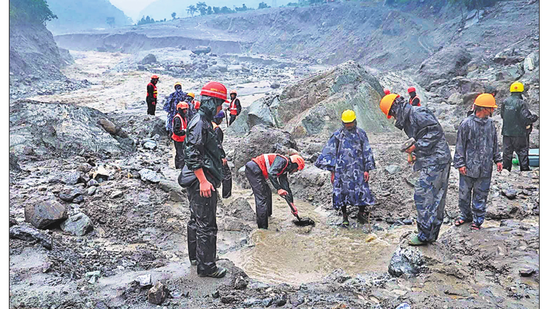
The Nepal Mountain Guide Association has sent teams to several of the tunnels, roped in by the private operators of the hydropower projects. Tul Gurung, president of the association, said that at Chilme — a 22MW operational site run by the Chilme Hydropower Company — six people are reported trapped in a 250-metre tunnel. “Our teams reached 130 metres, after clearing the debris. We are yet to find them. There is a wall of debris separating rescuers from the six men who are trapped in this debris. They are cutting through the muck,” he said.
His teams are also at Upper Trishuli 1, where surveys are under way. “Time is of the essence here. We are using all our resources. After completing the survey we will take one shot tomorrow at digging the first 80 m tunnel where most people are trapped.”
NDRF on standby as Nepal weighs further assistance
The Nepal government is yet to formally request NDRF assistance, which is the trigger required for deployment. NDRF officials said the Union home ministry has asked them to be on standby. India sent the NDRF to Nepal after the 2015 earthquake and to Turkey and Myanmar in recent years.
The affected projects are run by a mix of state-owned and private operators, several in partnership with Chinese or South Korean firms. They include Nepal Water and Energy Development Company, Rasuwagadhi Hydropower Company, Perfect Energy Development, Trishuli Hydropower Company and the Nepal Electricity Authority.
The flash flood has killed at least 675 people, according to the latest data, with nearly 3,000 more missing across Nepal and Tibet. Nepal Tourism Board said 49 Chinese nationals and 5 Indians were among those rescued on Friday.