A Visual Guide to the Scale of the U.S.-Israeli Air War on Iran
The allies have killed Iranian leaders and destroyed thousands of military targets in an attempt to bring down Tehran’s regime.
Updated on: Mar 18, 2026, 12:34:53 IST
WSJ
Prefer HTon Google
Share via
Copy link
The U.S. and Israeli militaries have pounded Iran’s security forces for nearly three weeks, leaving a trail of destruction aimed at accomplishing what some analysts have said is impossible: dislodging the Tehran regime with air power.
FILE - Parliament Speaker Ali Larijani gives a press conference in Tehran, Iran. (AP)
Graphics.
The combined armed forces of the U.S. and Israel have destroyed air-defense systems, drone bases and missiles. Iran’s conventional naval vessels have largely been sunk or disabled, and its air force has been grounded. Much of Tehran’s leadership is in hiding as the bombs fall.
The strikes have killed more than 1,100 Iranian military personnel and over 1,300 civilians, according to the Human Rights Activists News Agency.
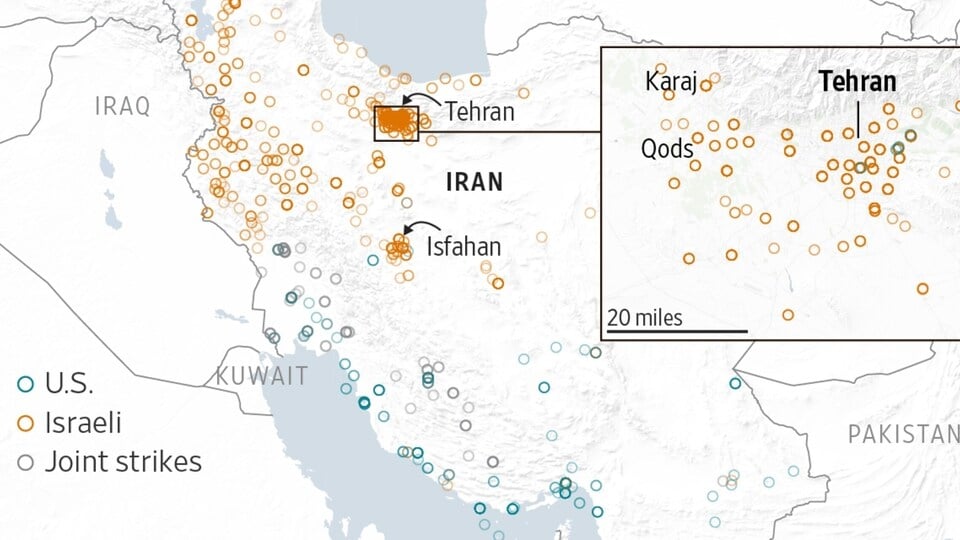
Here is a look at the scale of the U.S.-Israeli campaign and its targets.
Israel has targeted Iranian leaders, killing Supreme Leader Ayatollah Ali Khamenei, as well as a top national-security official, Ali Larijani, and others responsible for the government’s repression apparatus. Some of them are depicted below.
American forces have flown more than 6,500 combat flights and struck more than 7,000 targets across Iran. The U.S. has focused on destroying Iranian military sites, with many of its strikes hitting targets along Iran’s Persian Gulf coast in the south.
Israel quickly gained air superiority over northern Iran, including the capital, Tehran, early in the war. It then moved to hitting Iran’s supply of ballistic missiles, launchers and weapons factories.
As the conflict has continued, both countries have attacked targets across Iran.
A U.S. bomber on the ground at RAF Fairford in England.A satellite image shows damaged buildings at a military garrison in Iran.
Pentagon officials have said the U.S. campaign is focused on ensuring that Iran can’t continue to threaten America and its allies. To that end, U.S. air and naval strikes have damaged or destroyed more than 100 Iranian naval vessels and destroyed ballistic missile and drone launch sites, according to information from U.S. Central Command, responsible for American military forces in the Middle East. The strikes have also targeted command and control centers for the Islamic Revolutionary Guard Corps, a powerful force formed to defend the regime, and weapons-production facilities such as the Yazd military depot, which produces light and heavyweight torpedoes.
Israel has dropped more than 10,000 munitions in over 7,600 strikes on more than 2,200 regime targets in some 5,000 sorties over Iran, according to the Israeli military.
The Pentagon is deploying to the region roughly 2,200 Marines who might play a role in forcibly opening the Strait of Hormuz. Overall, the U.S.has sent 50,000 American servicemembers to the Middle East to support the operation, said Adm. Brad Cooper, the commander of U.S. Central Command.
This explanatory article may be periodically updated.
Get the latest World News, breaking headlines and global updates from the US, UK, Pakistan, Bangladesh, Russia and other countries. Follow major international events on Hindustan Times.
Home/World News/A Visual Guide To The Scale Of The U.S.-Israeli Air War On Iran

 E-Paper





 Prefer HTon Google