
 E-Paper



A West African country just saw a coup, all borders closed. What is happening?
Results from Sunday’s presidential vote, a contest between President Embalo and his main challenger, Fernando Dias were to be released on Thursday.

 Prefer HTon Google


Soldiers in Guinea-Bissau have seized control of the country and demanded that last Sunday’s elections be annulled, saying they acted to stop an alleged plot involving drug traffickers and political figures to rig the vote.
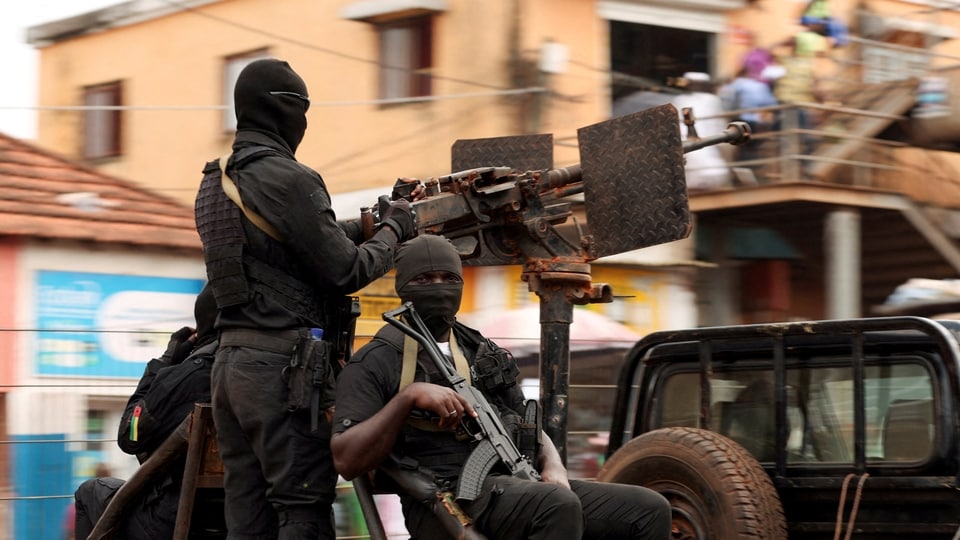
Results from Sunday’s presidential vote, a contest between President Umaro Sissoco Embaló and his main challenger, Fernando Dias were expected to be released on Thursday (November 27).
The group, which calls itself the ‘High Military Command for the Restoration of National Security and Public Order,’ announced that it had suspended state institutions and removed President Embaló from power, according to a Bloomberg report.
They also ordered the closure of land, air and sea borders along with an overnight curfew, Al Jazeera reported.
Guinea-Bissau lies on the West African coast, bordered by Senegal to the north and Guinea to the south and east, with the Atlantic Ocean and the scattered islands of the Bijagós Archipelago stretching along its western edge.
Also Read | Africa springs a stunning surprise on Russia as West faces its biggest geopolitical shock in year
State powers seized by junta
General Denis N’Canha said on Wednesday, first at army headquarters and later on national television-that the junta “will exercise the powers of the state effective immediately.”
The military halted the electoral process ahead of Thursday’s expected results from the November 23 presidential and legislative polls, saying they stepped in to prevent an effort to destabilize the country and manipulate the vote. N’Canha claimed “well-known local and foreign drug barons” were involved.
As gunfire echoed across the area, hundreds of people ran or drove away in search of safety, AFP reported.
What is happening in Guinea-Bissau?
Both Embaló and his main rival, Fernando Dias, had claimed victory.
On Wednesday night, Dias claimed he had won the election and accused Embaló of staging a false coup to avoid defeat.
He said the takeover and reports of the president’s arrest were “fabricated” to stop results from being released.
Dias gained support from the main opposition party after its candidate was disqualified. Embaló was later arrested after gunfire near the presidential palace, according to Jeune Afrique.
The opposition African Party for the Independence of Guinea and Cape Verde, which was barred from running, backed Dias and called for protests and for results to be published.
Embaló, elected in 2019, was seeking a second term in a country of 2 million people that has long been a transit hub for cocaine moving from Latin America to Europe, the Bloomberg report added.
Drug trafficking networks have been accused of influencing politics and the military, weakening the $2.5 billion economy.
What is happening on the ground?
On Thursday, Bissau’s streets were mostly empty as soldiers patrolled, borders were closed, and the president was in custody, AFP reported.
Armed troops guarded the presidential palace and monitored the city overnight.
The officers said they had taken “total control” and suspended the electoral process, with provisional results no longer expected.
Later in the day, N’Canha said a command of officers from all branches of the armed forces would run the country “until further notice.”
He said the military uncovered a plot involving “drug lords” and the import of weapons to alter the constitutional order. The army also shut down all media programming and imposed a curfew.
Guinea-Bissau marred by coups and instability
Guinea-Bissau has faced repeated coups and attempts since its independence from Portugal in 1974, including one in October, the AFP report added.
Its drug-trafficking routes have deepened political instability over the years.
The reported coup adds to a growing list of military takeovers in West Africa, where contested elections and political tensions have made governments more vulnerable.
Military spokesperson Dinis N’Tchama said the army acted after discovering “an ongoing plan … to manipulate electoral results” involving politicians, a major drug trafficker, and both local and foreign actors.
Several international bodies condemned the takeover, while the United Nations said it was watching developments “with deep concern.”


