
 E-Paper



America’s tariff avalanche catches Switzerland unawares
The soaring rate is based on exports of Trump’s favourite metal


 Prefer HTon Google


THE FIREWORKS in celebration of the Rütlischwur, the foundational oath of Switzerland on August 1st 1291, had just subsided when Donald Trump announced that Swiss exports to America would soon face tariffs of 39%. It came as a shock to Europe’s most stubbornly independent country. After consulting with businesses and holding a crisis meeting on August 4th, the government announced it will make America a more attractive offer.
Switzerland had negotiated early and swiftly. The deal it offered “was not so different from that of the European Union”, says a senior Swiss official. It contained similar pledges to invest in America, an overall tariff rate that was lower than the EU’s, a few concessions on agriculture and various other offers, such as collaboration in training American manufacturing workers. Switzerland could hardly open the Swiss market any further: the country had already cut tariffs on nearly all industrial goods to zero, and its currency is overvalued by about 50%, according to The Economist’s Big Mac index.
What sealed Switzerland’s fate was its outsize trade surplus with America. The Eidgenossenschaft (oath confederation), as the Swiss call their country, exported goods worth about $48bn more to America in 2024 than it imported. That comes to about 5% of Swiss GDP—too much for the deficit-obsessed American president, who bizarrely thinks this amounts to “stealing money” from Americans. The country was lucky that he did not take as his baseline early 2025, when Switzerland’s trade surplus with America ballooned to a whopping $54bn in the first quarter alone.
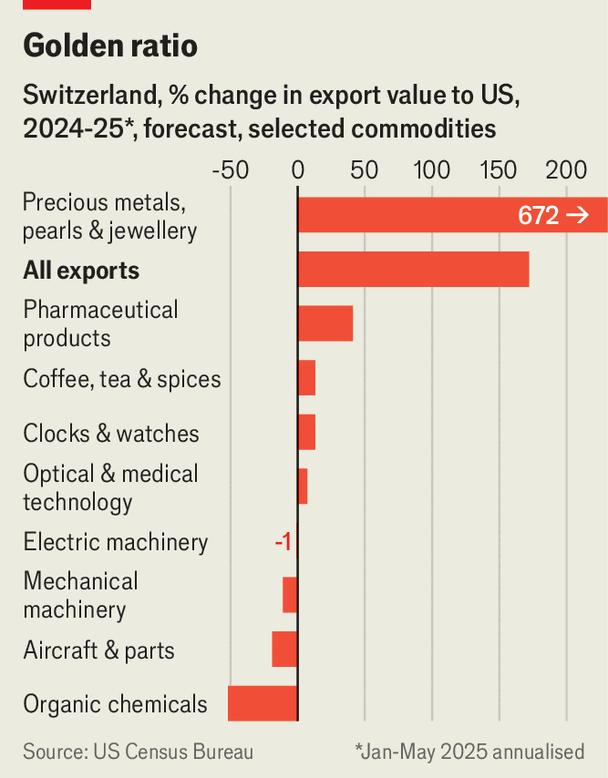
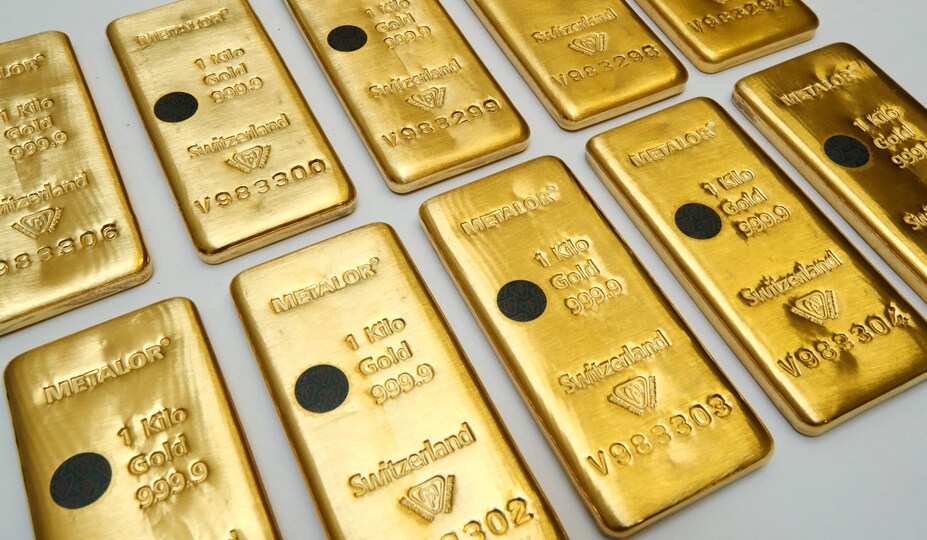
The culprit behind that surge was Mr Trump. Upon his inauguration, uncertainty over America’s economic policy rose sharply, leading investors to seek safety in one of Switzerland’s main exports: gold (see chart). The country is responsible for about a third of global gold refining, and typically exports around $4.5bn-worth of the precious metal to America each year. But in 2024 America imported $12.5bn-worth of gold from the country.
Switzerland’s role as a refiner can make trade flows look deceptively big. Although its gold exports amounted to $116bn last year, it also imported $100bn-worth of the metal. With some 1,000 workers in total, the industry is not exactly a jobs-booster. America charges no tariffs on gold imports, and Mr Trump is not likely to impose any on his favourite metal. Switzerland’s gold exports, along with the watches and jewellery it sells to America (worth $7bn in 2024), may simply have convinced the president the country is rich enough to bear more.
Pharmaceuticals are the other Swiss export that aroused the president’s ire. The Swiss shipped $35.5bn of these to America last year. “We want to be making pharmaceuticals in our country,” Jamieson Greer, the US trade representative, said after the tariff announcement. America is also keen to bring down the prices of medicines. Mr Trump sent letters to 17 pharma CEOs, including those of Novartis and Roche, two Swiss companies, to demand prices in line with the lowest in comparable economies. “I don’t think it was a coincidence that we had a tough call with the president 20 minutes after he had sent out his letters to the pharma industry,” says the Swiss official. Luckily for Switzerland, tariffs on drugs will remain at zero until America makes decisions about its global pharma policy.
Because of the exemptions for gold and (temporarily) pharma, Switzerland faces an overall effective tariff rate of just 12% for now. But businesses other than gold and pharma must pay the 39% rate, much to their dismay. They might end up as the main victim of Mr Trump’s economically misguided focus on bilateral trade balances. Half of Switzerland’s overall trade surplus with the world is with America, because its specialties—pharma, gold, luxury items and high-end machinery—fit American demand.
Thermoplan, the sole supplier of coffee machines to Starbucks, a coffee chain, is reluctantly considering a partnership with an American firm to lower the tariff burden. “There is a wide range of responses among businesses. Some say they will just increase prices, others have already lost half of their orders from America,” says Daniel Kalt of UBS, a bank. Switzerland is likely to face a mild recession, should the tariffs stick. Many hope negotiations will bring down the rate. And Switzerland’s flexible economy will be able to adjust.
The Swiss will also look more eagerly to co-operate with others. The EU’s better deal is helpful because Swiss firms are integrated into European supply chains, and the country trades far more with Europe than America. Yet politically, being slighted by America hurts. The country is moving towards a referendum on a permanent package of agreements with the EU, in place of its long-standing patchwork of temporary deals. Eurosceptics who want to reject that proposal will find their case harder to make. “Their narrative is breaking down now, being alone out there has not paid off,” says Mr Kalt. That was also the central insight of the Rütlischwur more than 700 years ago.


