
 E-Paper



At UNGA, Joe Biden calls for cooperation on Covid-19, climate change; hails Quad
In an address at the UNGA, US President Joe Biden called on UN members to come together to tackle hurdles such as climate change and the Covid-19 pandemic, while he also pointed to the importance of the Quad grouping

 Prefer HTon Google


US President Joe Biden, in his maiden address at the UN General Assembly (UNGA) on Tuesday, called on UN member states to work together to confront common challenges such as climate change and Covid-19, and underscored his commitment to multilateralism citing the elevation of the Quad grouping with India, Australia and Japan to summit-level engagement.
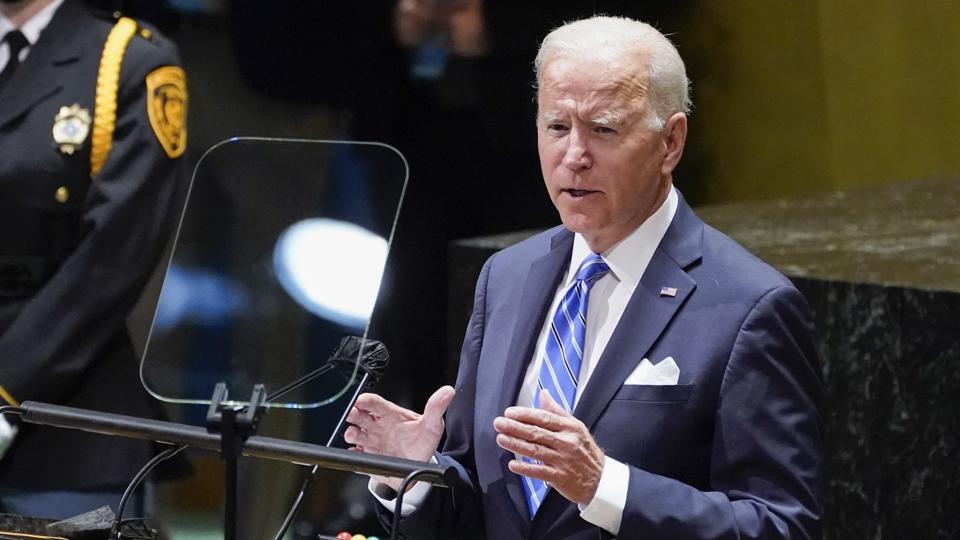
Crucially, the US president said the Indo-Pacific was among the most consequential regions in the world.
Biden defended the messy end to the war in Afghanistan, said America was ready to compete with China economically and ideologically but was not seeking to relaunch another Cold War, and reaffirmed support for multilateral bodies such as the United Nations and the World Health Organization that had been attacked and abandoned by his predecessor, former US president Donald Trump.
Joe Biden stressed on a theme in his UNGA speech that contrasted Trump’s America First approach as he called for countries to work together. Citing the death and devastation brought on by the Covid-19 pandemic, the American president said “our shared grief is a poignant reminder that our collective future will hinge on our ability to recognise our common humanity and to act together… I believe we must work together as never before”.
Defending his decision to end the war in Afghanistan he said, “We’ve ended 20 years of conflict in Afghanistan. And as we close this period of relentless war, we’re opening a new era of relentless diplomacy of using the power of our development aid to invest in new ways of lifting people up.”
The US president has faced criticism and questions at home and abroad about the pull-out of international troops from Afghanistan, including from allies and partners such as India, and of the chaotic evacuation marked by the killing of 13 US troops and about 200 Afghan civilians.
Ten people were killed in a US drone strike during that period who turned out to be civilians, including seven children, and not Islamic State-Khorasan operatives as the US had initially described them.
In his UNGA address, Joe Biden went on reiterate the importance of working together with other countries and multilateral bodies. Over the last eight months, he said he had prioritised “rebuilding our alliances, revitalising our partnerships, and recognising they are essential and central to America’s enduring security and prosperity”.
He spoke of the Nato and the EU, which also had faced withering criticism and harsh words from Trump.
“We elevated the Quad partnership among Australia, India, Japan and the United States to take on challenges ranging from health security to climate to emerging technologies,” Biden said of the Quad grouping, which is scheduled to hold its first in-person summit meeting on Friday, with Indian Prime Minister Narendra Modi, Australian PM Scott Morrison and Japan’s PM Yoshihide Suga at the White House.
The first in-person summit of the Quad was held virtually in March as Biden’s initiative, elevating engagement of the grouping rapidly from the level of officials to ministers.
Though the US president did not name China, it formed the backdrop for chunks of his speech. Arguing that the world faced a choice between those who support western democratic values and authoritarian regimes such as the one in Beijing, Joe Biden said, “The future belongs to those who give their people the ability to breathe free, not those who seek to suffocate their people with iron-hand authoritarianism.”
“The authoritarians of the world, they seek to proclaim the end of the age of democracy, but they’re wrong,” the US president said.
Biden, however, made it clear that he isn’t seeking any conflict. The United States would “compete vigorously and lead with our values and our strength to stand up for our allies and our friends”, he said at the UNGA. “We’re not seeking - say it again, we are not seeking - a new Cold War, or a world divided into rigid blocks.”


