
 E-Paper



AUKUS to deepen cooperation on hypersonics, electronic warfare capabilities
US President Joe Biden, UK Prime Minister Boris Johnson and the Australian PM Scott Morrison spoke on Tuesday to assess the progress under AUKUS.


In a step that enhances their security commitments and visibility in the Indo-Pacific, with a clear eye on the challenge posed by China’s military assertiveness and technological advances, leaders of Australia, United Kingdom and the United States (AUKUS) have declared that they are commencing “new trilateral cooperation on hypersonics, counter-hypersonics, and electronic warfare capabilities”.
The three allies are also expanding their information-sharing and cooperation on defence innovation.
US President Joe Biden, UK Prime Minister Boris Johnson and the Australian PM Scott Morrison spoke on Tuesday to assess the progress under AUKUS.
According to a statement issued by the leaders, the three countries reiterated their commitment to a free and open Indo-Pacific, opposition to Russia’s invasion of Ukraine, and commitment to an “international system that respects human rights, the rule of law, and the peaceful resolution of disputes free from coercion”.
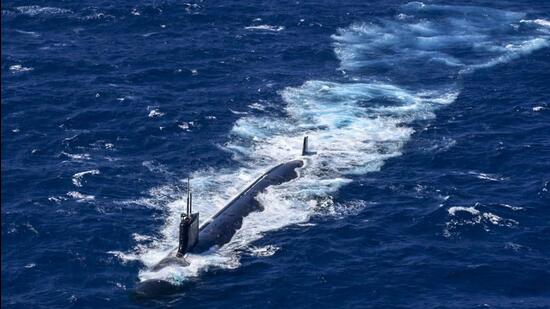
The three leaders also said they were pleased with the progress in our trilateral programme for Australia to establish a conventionally armed, nuclear-powered submarine capability. “We are fully committed to establishing a robust approach to sharing naval propulsion technology with Australia that strengthens the global non-proliferation regime.”
This initiative, announced in September 2021, had led to the emergence of AUKUS.
AUKUS leaders said put together, the initiatives would add to their existing efforts to “deepen cooperation on cyber capabilities, artificial intelligence, quantum technologies, and additional undersea capabilities”. They also noted that as work progressed on these and other critical defence and security capabilities, the three countries would seek opportunities to engage allies and close partners.
The conversation comes in the backdrop of a consistent American message over the past month that the Russian invasion will not distract it from the challenges in the Indo-Pacific. In early March, leaders of the Quadrilateral Security Dialogue - which includes India and Japan, besides the US and Australia - had met and a Quad leader-level summit is scheduled for this summer in Tokyo.
When AUKUS was first announced, there was a debate within the strategic community in both Delhi and Washington on whether the initiative would undermine Quad, or whether it would act as a supplement to Quad - the dominant view, over time, has tilted towards the latter, with governments and experts seeing it as an additional step in a countering the China challenge in the military domain.
While Quad countries have regular joint military exercises, and there is deepening bilateral military and defence cooperation between the individual members among Quad, the grouping has largely focused on an affirmative agenda that revolves around cooperation on Covid-19 vaccine production, emerging technologies, climate, education and now humanitarian assistance.


