
 E-Paper



Bangladesh’s new ruler is in a race against time
The country’s police have gone missing


OVER THE past ten days Dhaka, Bangladesh’s capital, has been transformed. Images of Sheikh Hasina, the former prime minister who fled the country on August 5th, and Sheikh Mujibur Rahman, her father and Bangladesh’s founding father, have vanished from billboards. Walls covered in posters and slogans advertising the Awami League (AL), their party, have been painted over with colourful graffiti displaying slogans and scenes from the protests that brought down Sheikh Hasina. “Gen Z cleans the mess”, reads one, “Courage is contagious”, another. The mood has changed along with the appearance of the city. “It’s very freeing to be able to talk openly about things after all these years,” says a young NGO worker.
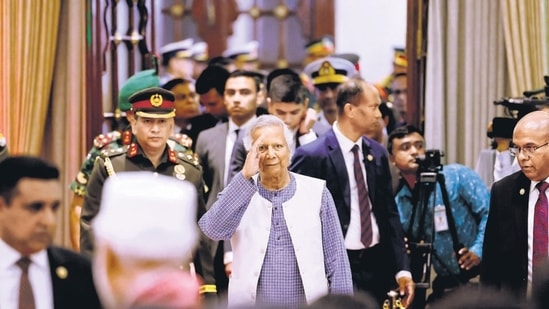
For now, the political transformation seems to be keeping pace. Since taking charge on August 8th, the interim government, led by Muhammad Yunus, a Nobel peace laureate and social entrepreneur, has overseen a rapid leadership overhaul of key institutions. Mr Yunus has appointed a new chief justice and a new central-bank governor. At least 16 university vice-chancellors have stepped down following pressure from students. The government has announced it will try those responsible for state-sponsored killings during the protests, has started to throw out cases filed against students since they began in July, and embarked on police reforms to restore trust in law enforcement.
Slowly, life is returning to normal. Primary schools reopened on August 14th; Dhaka’s metro will do so on August 17th. Factories are operating again and workers have begun returning to offices. High-school and university exams, slated for August, have been rescheduled to September, to allow students time to recover and prepare. Police stations have begun to reopen, too, raising hopes that the many ordinary people who have spent the past few weeks guarding their neighbourhoods at night can return to a more normal rhythm.
Yet questions remain over how solid this return to normality really is. Mr Yunus’s position, though backed by the army and popular support, is legally precarious: Sheikh Hasina abolished a constitutional provision for caretaker governments between elections. The worry is that Mr Yunus will have to step down before reforming the political system enough to break the cycle of retribution between Sheikh Hasina’s AL and the Bangladesh Nationalist Party (BNP) of Khaleda Zia that has scarred Bangladesh’s politics ever since independence from Pakistan in 1971.
The constitution mandates that an election be held within 90 days. But observers in Dhaka say Mr Yunus needs more time to insulate the judiciary, the police and the electoral system from renewed political capture. “If we hold an election in two years, we may have a balanced political system,” reckons Major General Shahidul Haque, a retired officer and former ambassador. “But if we have one too soon, we’ll just end up with the same old thing.”
The reopening of police stations shows how quickly things could go wrong. Most are still staffed by soldiers. The police remain loth to return to work, fearing retaliation for violence committed during the protests. But that is wearing thin, says General Haque. “The army does not have the capacity to do this forever, so they really need to redeploy the police as soon as possible.” The risk is that, otherwise, the country faces anarchy or martial law.
As The Economist went to press the new law-and-order structure was undergoing one of its first tests. On August 15th, the anniversary of Sheikh Mujib’s assassination in 1975, AL supporters traditionally hold big rallies. The interim government declared the day a normal working day. Urged on by Sheikh Hasina from exile in Delhi, the AL called for a rally anyway.
Pressure from the countries’ political parties to hold early elections is another danger. For now, they are showing restraint. “We support the interim government,” says Mirza Fakhrul Islam Alamgir, the BNP’s secretary-general. “We want an election as soon as possible, but the political environment needs to be ready for it.” Other party leaders say much the same. Yet if they sense a wobble in Mr Yunus’s government, they may change their tune.
Another risk is that the students whose protests swept Mr Yunus to power lose patience and try to take matters into their own hands. The resignation of the former chief justice on August 10th was prompted partly by a large protest outside the Supreme Court. More such politics by protest could undermine Mr Yunus’s authority. To make Bangladesh a vibrant democracy, his government needs to move fast.


