E-Paper



Beijing’s Trade Tactics, Ukraine Stance Cast Pall Over Europe-China Ties
After Trump’s election, China and Europe sought warmer ties, but rifts over Russia and trade sparked conflict.


BRUSSELS—China and Europe face a common threat from President Trump’s tariffs. That isn’t enough to bring the two economies closer.
Instead, European frustration is mounting over Beijing’s support for Russia’s war in Ukraine and what officials view as a flood of low-cost products on global markets.
Those concerns loom over a summit between European Union and Chinese leaders in Beijing on Thursday. The event was billed as a chance to mark 50 years of diplomatic relations between the two economies, but officials on both sides are striking a somber tone amid growing pessimism about the relationship.
The summit has already been shrunk to a single day from two—at China’s behest.
Europeans say they want China to take concrete steps to address their concerns. China wants to enlist the EU’s help in pushing back against Trump’s trade policies, and Beijing views the bloc’s criticisms of its industrial and trade policies as misguided.

Chinese and European leaders must “make the right strategic choices” amid a fast-changing and tumultuous global environment, Chinese leader Xi Jinping told visiting EU leaders in Beijing on Thursday, according to Chinese state media. “The more severe and complex the international situation is, the more China and the EU should strengthen communication, enhance mutual trust and deepen cooperation.”
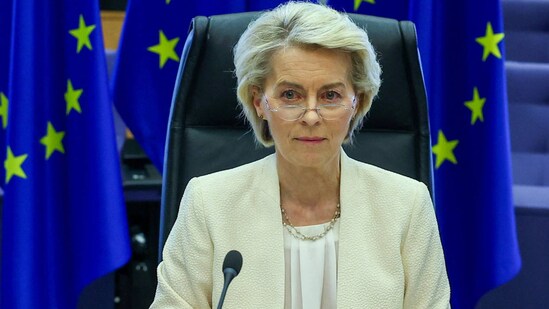
The EU has toughened its stance toward Beijing in recent years. The European Commission, the bloc’s executive body, refers to China as a rival, and its president, Ursula von der Leyen, says she wants to curb Europe’s reliance on China for vital materials.
Some European governments have been skeptical of her approach. But China’s rationing of Western access to critical raw materials jolted many of them, providing a rare moment of unity in the bloc about what they see as Beijing’s hardball tactics.
Germany, a central player in European foreign policy, pledged earlier this year to reduce risks in its economic relationship with China.
At a meeting of the Group of Seven industrialized economies last month, von der Leyen went further, accusing China of creating a pattern of “dominance, dependency and blackmail” and calling for a united response. China said the comments were “riddled with bias and double standards.”
Von der Leyen is attending the summit along with European Council President António Costa, who represents the bloc’s 27 member states. The two leaders met Xi on Thursday and are due to meet with Chinese Premier Li Qiang later in the day.
China has sought to position itself as a force for stability and an antidote to Trump’s trade measures, offering olive branches that have included lifting sanctions against European lawmakers and easing visa requirements.
Chinese Foreign Minister Wang Yi recently dismissed concerns that China’s export controls on rare earth elements are fueling discord with Europe, saying that as long as Chinese regulations are adhered to, “the normal demands of European companies will be guaranteed.”
European officials remain unconvinced, and question whether Beijing will address their basic economic concerns. Some think China could expand activities that would hurt European companies.
“The China-EU relationship does face some challenges,” Chinese Foreign Ministry spokesman Guo Jiakun said at a briefing on Monday. “Some in the EU,” he said, have “exaggerated specific economic and trade issues and groundlessly accused China on the Ukraine issue,” referring to accusations that China supports Russia in the war.
The summit comes on the heels of a World Trade Organization arbitration ruling on Monday that gave the EU a partial win in an intellectual-property dispute with China centered on mobile technology. A European Parliament delegation visited Taipei this week, meeting Taiwan President Lai Ching-te and other officials—a form of engagement that China has long denounced as a challenge to its sovereignty claims over the self-governed island.
And the EU has launched several investigations into Chinese subsidies. Last month, it announced plans to exclude Chinese companies from bidding on public procurement above 5 million euros, equivalent to about $5.9 million, for medical devices after an EU probe found that China’s policies were keeping European companies out of China’s medical-devices procurement market.
The bloc also blacklisted half a dozen Chinese firms in its latest sanctions package targeting Russia, including for the first time two regional Chinese banks—a move that Beijing criticized as harmful to economic ties.
Even so, Beijing played down tensions with the EU ahead of the summit and urged the bloc to seek common ground with China. During a visit earlier this month to Brussels, Berlin and Paris, Wang, the Chinese foreign minister, urged European leaders to take a positive and pragmatic approach toward China, according to readouts from China’s Foreign Ministry. Other officials, including Beijing’s envoy to the EU, made similar appeals in recent days.
But in Brussels, Wang also told EU foreign-policy chief Kaja Kallas what European officials have long suspected, according to two people at the meeting—that Beijing didn’t want to see Russia lose the war because it would mean the U.S. turning its attention fully toward China.
“I think we should expect a very difficult moment and not a dealmaking moment,” said Abigael Vasselier, head of China’s foreign-relations program at the Mercator Institute for China Studies, a European think tank on China. Wang’s meeting in Brussels, she said, “has put back the question of China’s support for Russia in the center of the discussion.”
EU leaders traveled to China after a summit in Japan on Wednesday. The bloc is looking to deepen ties with Tokyo on defense, trade and economic security and believes the two sides share similar concerns over China’s economic policies and its support for Russia.
Following Trump’s election in November, Beijing and Brussels briefly softened their mutual criticism. Some Europeans discussed pursuing deeper ties with China to hedge against a more volatile Washington.
Chinese state media have suggested that the EU’s pivot toward a more confrontational approach toward Beijing is aimed at currying favor with the Trump administration as it negotiates a trade deal. Washington and Brussels appear to be nearing a deal that would set tariffs on European exports to the U.S. at 15%.
Still, there are some issues the two sides could cooperate on.
EU and Chinese officials are in talks about a possible price agreement on electric vehicles that could replace the bloc’s tariffs, which were imposed last year after a lengthy investigation concluded that Chinese subsidies are unfairly disrupting the European EV market.
China struck a similar price deal with some of France’s biggest brandy sellers after an antidumping investigation into European brandy. EU officials viewed Beijing’s brandy investigation, as well as two ongoing probes into European dairy and pork, as retaliation for the bloc’s decision to open its EV investigation and impose tariffs.
The European and Chinese leaders will also discuss climate issues, although any statement is unlikely to break new ground on controlling carbon emissions, Vasselier said.
The EU is going to the summit with the expectation “that the Chinese will first understand our concerns, and second take concrete actions as soon as possible,” a senior EU official said last week. “Otherwise, we will have to defend our own interests,” the official added.
Write to Kim Mackrael at kim.mackrael@wsj.com, Laurence Norman at laurence.norman@wsj.com and Chun Han Wong at chunhan.wong@wsj.com