When Marina Silva resigned as Brazil’s environment minister in 2008, she was an international rock star. Deforestation in the Amazon had plummeted by 50% during her five-year tenure. She had been showered with awards and included on lists of influential thinkers. She was also admired for her tenacity. Brought up poor and illiterate as one of 11 siblings on a rubber plantation, Ms Silva went on to graduate from university, be elected as Brazil’s youngest senator and forge Brazil’s climate policies. Even her resignation, in protest at large infrastructure projects in the Amazon, seemed to bolster her integrity.
Brazilian Environment Minister Marina Silva gestures as she waits before the launching of the 2025/26 Harvest Plan at Planalto Palace in Brasilia on June 30, 2025 (AFP FILE)
Now Ms Silva is under attack in Brazil. Having returned to the helm of the environment ministry in 2023, on July 2nd she was summoned before a committee in the lower house of Congress to testify about deforestation. Lawmakers hurled insults at her for almost seven hours. They called her “inelegant” and “a disgrace”, compared her to terrorists and told her to resign. In a previous exchange, senators had told her she “should know her place” and that she did not deserve respect.
Such chauvinist language is nasty, and reflects the state of environmental discourse in Brazil today. Since Ms Silva’s last stint in office, Congress has become both more powerful and more beholden to agribusiness and fossil-fuel lobbyists. The government of President Luiz Inácio Lula da Silva (known as Lula) is desperate for cash. As his relationship with lawmakers sours, he is increasingly loth to stand in their way.
Those attacking Ms Silva want to pass a bill that would dismantle many of Brazil’s environmental regulations. It would exempt infrastructure, mining and farming projects that have a “small or medium-size impact” from having to carry out an environmental-impact assessment, putting them on a fast track instead. In some cases developers would be allowed to judge the impact of their own works. Projects the government deems strategic would automatically qualify for simpler licensing. The World Wide Fund for Nature, a charity, calls it “the biggest setback in Brazilian environmental legislation in the last 40 years”. A final vote on the bill could come as soon as July 16th.
The impulse to simplify Brazil’s licensing laws is reasonable. The country has 27 states and over 5,000 municipalities, which sometimes enforce their own rules. This is a pain for businesses that operate across different regions. Yet the proposed law would gut environmental protections and offer new avenues for corruption. “Just because a project is deemed strategic for the government does not mean the environmental impact disappears,” says Ms Silva. It could also create legal uncertainty. Brazil’s top court has ruled that projects with a medium-size impact should not qualify for fast-track licensing. Flávio Dino, a judge on the Supreme Court, has said he expects the bill to be contested.
That the bill could pass while Lula is president frustrates environmentalists. He took office in 2023 promising to tackle the illegal ranchers, loggers and miners that proliferated under Jair Bolsonaro, his far-right predecessor. He beefed up IBAMA, the environmental regulator. Deforestation fell. In November he will try to bolster his credentials when Brazil hosts the COP30, the UN’s annual climate conference. Lula “will need to make a choice between his environmental promises and pleasing Congress”, says Marcio Astrini of the Climate Observatory, a network of charities in Brazil. “He can’t have both.”
Three forces are undermining Ms Silva. The first is that Congress has become emboldened. In the past decade Brazil’s legislature has given itself vastly greater spending powers. In 2015 lawmakers’ amendments to discretionary spending in the federal budget, which amounts to some $40bn a year, represented less than 2% of the total. Today such “earmarks” account for a quarter of non-mandatory spending—far higher than the average in the OECD, a club of rich countries. Representatives demand pork in exchange for backing laws. In June a bill that will regulate offshore wind energy only passed in Congress after lawmakers forced Lula to include unrelated subsidies in the draft.
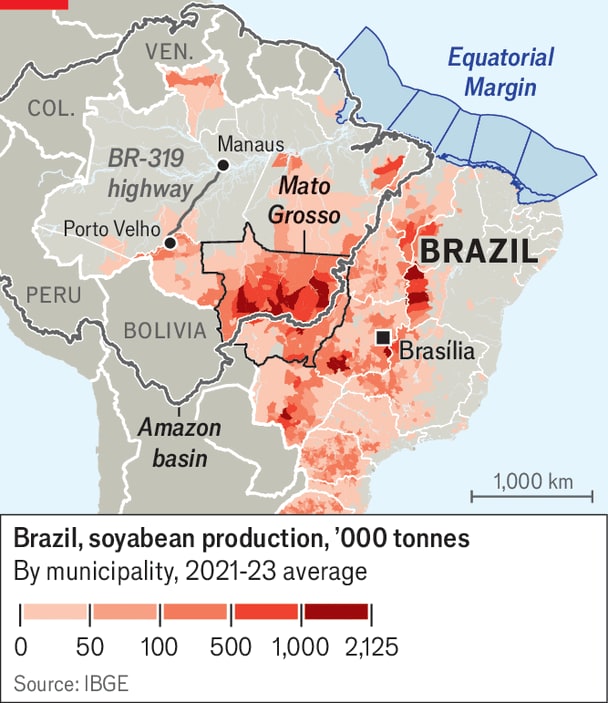
As it has gained power, the composition of Congress has shifted rightwards. Though Mr Bolsonaro lost the presidential election in 2022, his party and centre-right groupings swept the legislature. The rural caucus now comprises almost two-thirds of lawmakers in both houses. The lobby is particularly strong at a local level. Lawmakers in Mato Grosso, Brazil’s soyabean heartland, are trying to have parts of the state reclassified as tropical savannah instead of Amazon. This would let farmers raze 65% of trees on their land, instead of only 20%. Governors elsewhere are gunning for looser licensing laws. This would allow for the completion of the BR-319, a once-abandoned 900km (550-mile) highway that cuts through pristine jungle. Lula has promised to finish much of the road by the end of his term.
Brazil’s oil lobby has also gained clout. Prospectors believe the country’s northern coastline is rich in crude oil, in an area called the Equatorial Margin (see map). But because it lies near the mouth of the Amazon river, IBAMA has prohibited drilling there. Lula and several of his ministers want to exploit it, and think the licensing law could help. If this happened, Brazil could become the world’s fourth-largest producer of crude by 2030, up from seventh today. On June 17th the national oil agency put 172 exploration blocks up for auction, including some near the Amazon basin. The government plans to offer more oil concessions this year, which it hopes will raise some $4bn.
The final obstacle is the government’s fragile finances. The IMF says public debt is on course to hit 92% of GDP this year, up from 60% in 2013. Much of this borrowing happened under Lula’s predecessors. Yet he is not helping. Without accounting trickery, the government will miss its fiscal goal of reaching a primary surplus of 1% by 2026. Lula has ramped up social spending and raised the minimum wage. The Senate is set to approve his plan to exempt people who earn up to 5,000 reais ($920) a month from income tax. That will cost around $5bn a year in lost revenue. Easy oil money is thus particularly appealing.
Every cloud
And so Brazil’s environmental movement is squeezed. Yet Natalie Unterstell of the Talanoa Institute, a think-tank in Rio de Janeiro, sees a silver lining. Only 34 of the 172 blocks put up for auction found takers. Even the union of oil workers did not back licensing sites near the mouth of the Amazon river, which Brazil’s public prosecutor tried to suspend. Mr Astrini is blunt. If the licensing bill passes, “We will not stop fighting for the environment. We will just hire more lawyers.”
For more coverage of climate change, sign up for the Climate Issue, our fortnightly subscriber-only newsletter, or visit our climate-change hub.
Get the latest headlines from US news and global updates from Pakistan, Nepal, UK, Bangladesh, Russia and US Iran war Live, get all the latest headlines in one place on Hindustan Times.
Home/World News/Brazil Is Bashing Its Patron Saint Of The Environment

 E-Paper