For over a century, no European peace treaty has been signed without the participation of the United States. Woodrow Wilson’s vision shaped the Treaty of Versailles after World War I, and Harry Truman hammered out the post-World War II order with Soviet leader Joseph Stalin and British Prime Minister Winston Churchill at the Potsdam Conference. More recently, in 1995, U.S. envoy Richard Holbrooke led the talks that ended the wars in the former Yugoslavia.
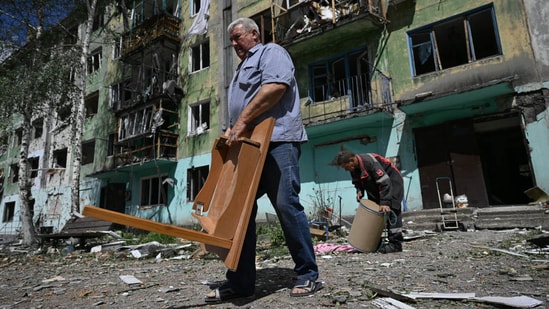
The aftermath of a Russian strike in Ukraine’s Donetsk region, Aug. 12, 2025.
Perhaps this tradition was on Donald Trump’s mind when he agreed to meet with Russian President Vladimir Putin in Alaska on Friday to discuss an end to the Russian invasion of Ukraine, among other subjects. After all, the U.S. is a European power, standing at the center of the NATO alliance, and as such its attitudes toward the future of Europe must be taken into account.
But when it comes to achieving peace in Ukraine, the summit’s chances of success are small. A twofold dilemma confronts the White House. Putin’s love of obfuscation and delay makes negotiating with him fiendishly difficult; and the Trump administration’s publicly stated desire to reduce America’s military presence in Europe undermines its own position from the start. As a result, the summit is more likely to prolong the war than end it. It could even contribute to Ukraine’s defeat.
Russians are weary after more than three years of fighting, and the war’s economic and military toll continues to rise. But when it comes to Ukraine, there are few limits to Putin’s zeal, and Russian forces are currently finding success on the battlefield, punching through Ukrainian lines this week. A time may come when Putin will concede that Russia cannot conquer all of Ukraine, the original goal of the 2022 invasion. But there is no reason to think he has reached this point yet.
Putin has used negotiations to his advantage before. Russia’s war on Ukraine began in 2014, with its annexation of Crimea and invasion of eastern Ukraine. Putin’s war aims involved more than the acquisition of territory. His goal was to exert direct control over Ukraine or, at least, to gain veto power over Kyiv’s foreign-policy choices. In this sense, the invasion was a failure: Though Russia held on to the Ukrainian territory seized in 2014, it couldn’t achieve its political goals. Instead, Kyiv became less politically beholden to Russia after 2014, as a self-evident consequence of invasion.
Though the U.S. and Europe condemned Russia’s land grab, they didn’t intervene militarily, and the economic sanctions they imposed had little effect. In 2014-15, Putin made deals with Ukraine, France and Britain, agreeing to withdraw from Ukrainian territory (excluding Crimea) in exchange for autonomous status for the occupied regions. Putin’s goal was to convince the world that his intentions were relatively benign. He had gone into Ukraine, but he would go no further; he was looking for the exits.
Putin also has a solid understanding of vanity. He flattered the U.S. and Europe, leading them to believe that by failing to resist Russia militarily they were showing maturity and helping to avoid a world war. In the following years, Russian diplomats attended countless meetings on implementing these collective agreements, and by 2021 France, Germany and the U.S. had restored normal relations with Russia. But Russia never withdrew its soldiers from Ukraine. Putin’s pantomime of diplomacy had been nothing but a holding pattern, a prelude to his massive invasion of Ukraine in 2022.
This background is crucial for understanding Putin’s approach to negotiation and his intentions at the Alaska summit. The Kremlin has expressed pleasure at Putin’s meeting with Trump, while remaining deliberately vague about its expectations.
Meanwhile, Ukraine’s President Volodymyr Zelensky has insisted that he will not cede “land to the occupier.” For Kyiv, the nightmare scenario is that Trump will pressure Ukraine to end the war by ceding some or all of the territory Russia has conquered, legitimizing the invasion and leaving the country vulnerable to renewed aggression in the future.
History shows that the U.S. has been successful at concluding wars in Europe when it has participated in them or at least demonstrated military pre-eminence. Wilson joined the leaders of Britain and France at Versailles because American troops had helped defeat Germany in World War I. After World War II, Truman had to share the peacemaking limelight with Stalin, whose armies occupied most of eastern Europe.
In the 1990s, the U.S. was free to shape the future of Europe because its uncontested victory in the Cold War made it the world’s sole superpower. To end the wars in the former Yugoslavia, Holbrooke invited representatives of Serbia, Croatia and Bosnia to negotiate at a U.S. Air Force base in Dayton, Ohio, to telegraph the scope of American air power to the participants. He got his point across.
In Ukraine, by contrast, Washington has helped supply Kyiv with weapons but kept away from the fighting. Now the U.S. intends to scale back its commitment. “We’re done with the funding of the Ukraine war business,” Vice President JD Vance announced on Aug. 10. For the Trump administration, the war in Ukraine is not an occasion for augmenting American power but for diminishing it, by passing the job of defending Europe back to the Europeans.
This doesn’t mean that the administration should eschew diplomacy with Russia. Negotiations can be open-ended, and they can benefit from unexpected contingencies. But the Trump team should remember that Putin has every incentive to buy time by engaging in insincere peace talks, as he has often done in the past. Since the U.S. is too distant from the conflict and has too little leverage to force Russia to a settlement, the countries most likely to bring the war to an end are Ukraine and its European partners. For the first time in a century, the U.S. may be more bystander than participant in the denouement of a major European war.
Michael Kimmage is a professor of history at the Catholic University of America and the author of “Collisions: The War in Ukraine and the Origins of the New Global Instability.”
Get the latest headlines from US news and global updates from Pakistan, Nepal, UK, Bangladesh, Russia and US Iran war Live, get all the latest headlines in one place on Hindustan Times.
Home/World News/Can The U.S. Still Be Europe’s Peacemaker?

 E-Paper