
 E-Paper



Rise of emperor Xi is ominous for India and QUAD
Consolidation of power by President Xi in his third term does not augur well for India as it is the only country in QUAD that stands for strategic autonomy and does not have a security alliance with US unlike Japan and Australia

 Prefer HTon Google


The enforced exit of Chinese President Xi Jinping’s predecessor Hu Jintao from the Great Hall of People, with not a murmur from all the assembled 2300 delegates at the closing session of twice a decade party congress on October 22, was brutal display of power by core leader of the middle kingdom. It was as if Hu was led to the political gallows by the party enforcers.
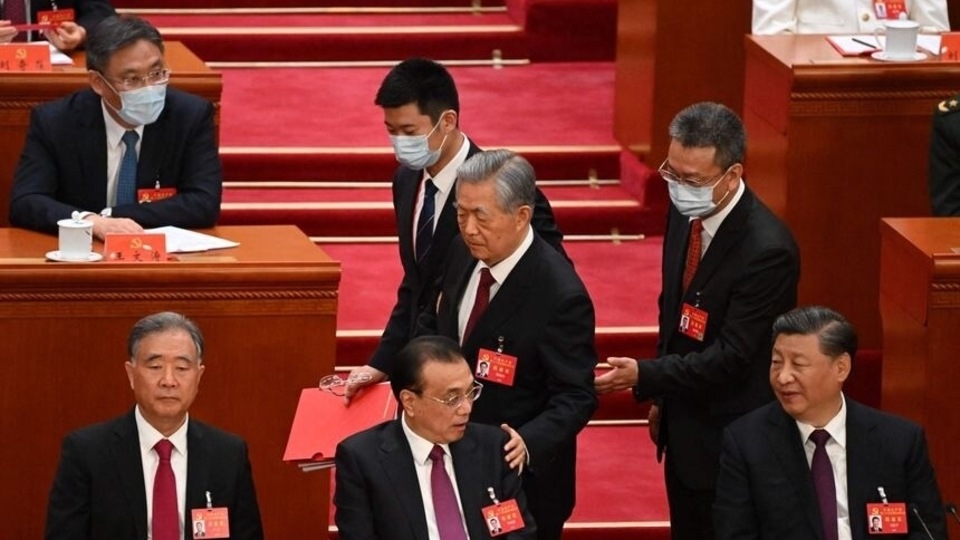
While Chinese propaganda media described the unceremonious exit of former leader Hu on account of his health, the entire event was orchestrated deliberately before the international media and with a signal to all 96 million members of the Communist Party of China.
With all the top leaders present at the congress even refusing to acknowledge the existence of Hu on that day, the message from President Xi to the adversaries is open to interpretation as not a word was spoken during the display of power. Hu’s pat on the back of Premier Li Keqiang while exiting was as if to tell him that even his time was up. The message was that President Xi is the uncontested leader of China and all his adversaries will be summarily crushed as Hu was that day.
With President Xi re-elected for the third term and his key allies making it to the all-powerful standing committee of the Politburo, the uncertainty factor has increased in the world with Xi now comparable to Chairman Mao in terms of consolidating political power in China. Essentially, President Xi is the sole proprietor of China or absolute dictator, and this has serious ramifications for India and the world in the short and long term.
While Japan and Australia are security alliance partners of the US, China under core leader Xi may create trouble for India along the 3488 km Line of Actual Control (LAC) as India is the only member of QUAD which practices strategic autonomy and is not under any alliance umbrella of Washington. As the PLA aggression on the LAC in May 2020 was cleared at the highest levels, it is quite clear that Beijing will drag its feet over resolution of East Ladakh boundary while at the same time trouble could be expected in Sikkim and Arunachal Pradesh sector.
The rise of wolf warrior diplomats under President Xi will not allow any compromise with India on the border issue while at the same time encouraging economic ties as bilateral trade deficit is heavily tilted towards Beijing. One must remember that China under Chairman Mao wanted to impose the 1959 cartographical line on the East Ladakh LAC and that led to the 1962 war.
As President Xi’s objective is to make China militarily and economically as powerful as the US by the end of this decade, Beijing will also strengthen its resolve to take-over Taiwan and use Pakistan tactically to ensure that India is kept under check through internal disturbances, religious radicalization, and terror. As China rises economically, its capacity to use political and money muscle to tackle its adversaries will increase manifolds apart from its cyber offensive capabilities.
The QUAD-China friction will also increase in the Indo-Pacific as the PLA Navy acquires long sea legs with its high capacity and endurance platforms with its aircraft carrier strike forces expected to patrol the Indo-Pacific by 2025. If China can breach the first chain of islands by militarily co-opting Taiwan soon, then the PLA nuclear powered ballistic missile submarines will have a free run of the Indo-Pacific.
However, being an unquestioned leader like Chairman Mao has its own pitfalls and therein lies the danger to the world particularly India. It was the massive failure of Chairman Mao’s myopic Great Leap Forward between 1958-1962 which was the prime factor for Chinese belligerence on the border with India.
The 1962 India-China border skirmish was used by Chairman Mao as a digression from the failure of the agricultural revolution and at the same time ramp up Han nationalism against India. The story could well repeat itself as President Xi like Chairman Mao has shown that he takes no prisoners. Hu Jintao was just the first signal.


