
 E-Paper



China’s Xi Reminds Tibet That Beijing Is in Charge
The trip underscores Beijing’s focus on tightening party control over ethnic minorities, especially in the restive region.


 Prefer HTon Google


Chinese leader Xi Jinping traveled to Tibet to drive home a message of control to the restive region on China’s western periphery, where he demanded more efforts to reinforce Communist Party rule over the heartland of Tibetan Buddhism.
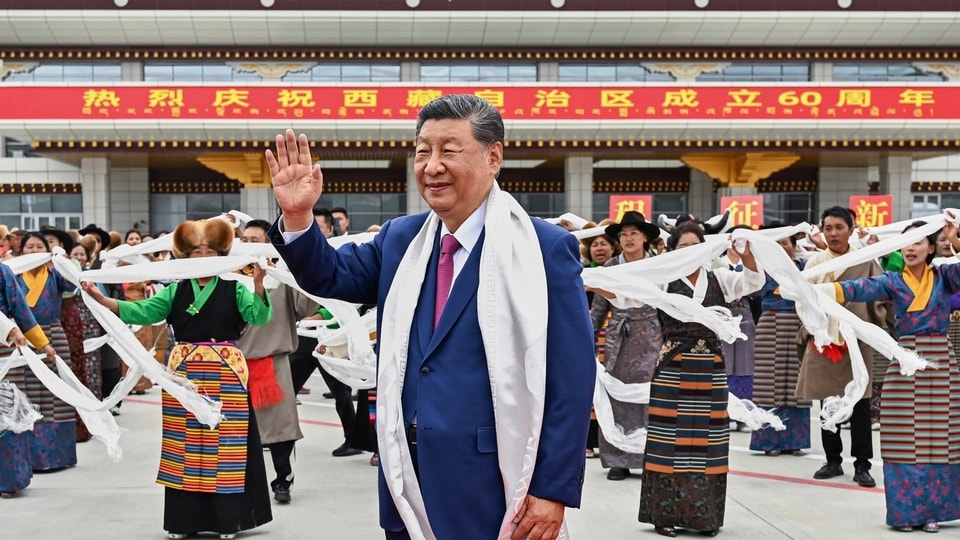
During a visit to the Tibetan capital of Lhasa this week, Xi told officials to get Tibetans to speak more Mandarin Chinese and bring Buddhist devotees closer in line with socialist principles—part of efforts to forge a stronger national identity among China’s 1.4 billion people.
The trip was Xi’s second visit to Tibet in four years, underscoring his focus on tightening party control over ethnic minorities—particularly in a region where resentment against Beijing has simmered for decades and sometimes flared into violent protests. Xi is the most senior Chinese leader to visit Tibet since Jiang Zemin went there as party chief in 1990.
“To govern, stabilize and develop Tibet, we must first maintain political and social stability, as well as ethnic unity and religious harmony in Tibet,” Xi told officials, according to the state-run Xinhua News Agency. “To handle Tibetan affairs well, we must always adhere to the party’s leadership.”
The visit came as Beijing gears up for a fight over the choice of successor to the Dalai Lama, the exiled Tibetan spiritual leader, who turned 90 in July. The officially atheist Communist Party has denounced him as a separatist and insisted that they get to choose the next incarnation of the Dalai Lama. The Dalai Lama, for his part, declared last month that a religious panel based in India would have sole responsibility for choosing his successor.
In Lhasa, where Xi arrived Wednesday, the Chinese leader presided over festivities marking the 60th anniversary of the Tibet Autonomous Region, which Beijing set up in 1965 as part of its approach to granting ethnic-minority communities some nominal political autonomy while the party maintained control.
Xi attended a cultural performance that conveyed “the sincere feelings of the people of all ethnic groups in Tibet to always listen to the party, be grateful to the party, and follow the party,” according to state media.
The festivities culminated in a grand ceremony on Thursday, staged against the backdrop of the Potala Palace, a residence for the Dalai Lama before his flight into exile in 1959. There, Xi listened to officials praise the party’s efforts to develop Tibet and reviewed processions of army and paramilitary troops, police officers, community representatives and cultural performers.
Tibet’s achievements over the past 60 years prove that only under the leadership of China’s Communist Party “can we achieve prosperity and progress in Tibet,” Wang Huning, the party’s top official overseeing ethnic affairs, said at the ceremony. “All attempts to split the motherland and undermine the stability of Tibet are doomed to fail,” he said.
The party has sought to consolidate control over Tibet since sending troops into the region in 1950. Since then, Beijing has directed long-running efforts to assimilate ethnic Tibetans and quash what it calls separatist forces led by the Dalai Lama, who was a teenager when the People’s Republic took control of Tibet.
The assimilation drive intensified after Xi took power in 2012, as he sought to forge a singular national identity centered on the Han Chinese majority and loyalty to the Communist Party.
While Xi’s predecessors relied more on economic development as a way to naturally integrate ethnic minorities, he has opted for a comparatively hard-line approach, with the party taking an active role in reshaping cultural identities.
In Tibet, Beijing has imposed increased restrictions on Tibetan religion, education and language, while boosting the government’s ability to surveil residents—such as by building a network of police outposts that doubled as mini-community centers offering amenities such as household tools and cold medications. Authorities have also sent Tibetan children to state-run boarding schools at ever-younger ages, educating them predominantly in Mandarin and inculcating Chinese culture.
Chinese officials and media have also generally replaced the name “Tibet” with “Xizang” in English-language references to the region, switching to the standard Romanization of the Chinese name used by Beijing.
Chinese officials generally reject claims that they are diluting or suppressing Tibetan culture, instead arguing that the Communist Party has improved the lives and livelihoods of people in Tibet while preserving their religious and ethnic identities.
Xi previously visited Tibet as China’s leader in 2021, marking the 70th anniversary of Beijing’s annexation of the region. His trip this week represents the first time the country’s leader attends the Tibet Autonomous Region’s anniversary celebrations.
State media said Xi’s two trips in the past four years underscored the importance of Tibet to the party.
The visits “fully demonstrate General Secretary Xi Jinping and the party center’s high degree of attention to Tibetan affairs and their sincere care for cadres and the people of all ethnic groups in Tibet,” Xinhua said. “The party’s glory shines upon the frontiers, and the people of the frontiers align their hearts with the party.”
Write to Chun Han Wong at chunhan.wong@wsj.com


