
 E-Paper


Climate change is making some African deserts greener
That could help farmers but will also bring dangerous floods


 Prefer HTon Google


For decades Lake Chad seemed to be a terrifying portent of climate collapse. It had been among the world’s largest lakes, on which tens of millions depended in Chad, Cameroon, Niger, and Nigeria, the four countries that share it. Yet years of punishing droughts, compounded by diversion for irrigation, between the 1960s and 1990s helped to shrink it by as much as 90%. With the planet warming and the Sahara desert apparently advancing, Lake Chad seemed destined to disappear. The famines that ravaged the surrounding Sahel in the 1980s looked like a grim preview of Africa’s hotter, drier future.
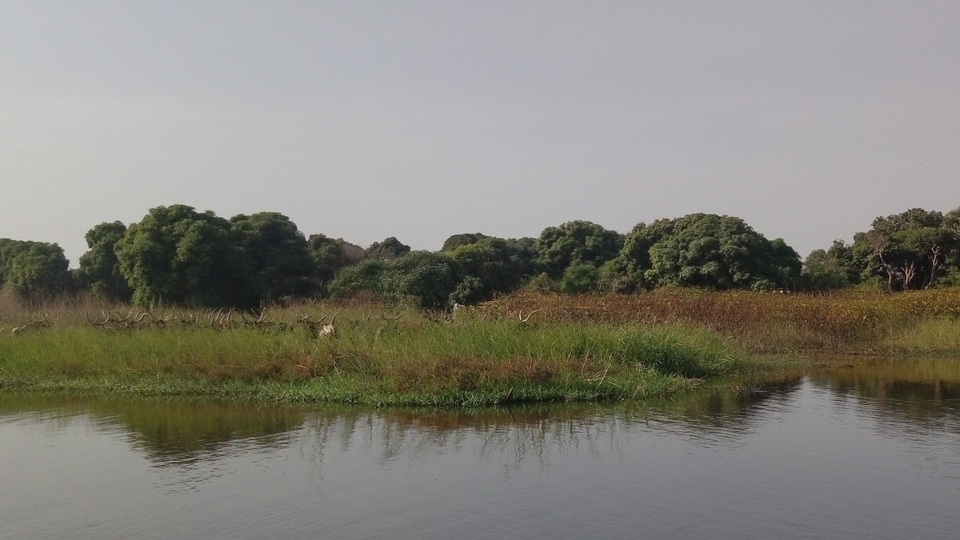
Instead the opposite happened. Today Lake Chad (pictured below) has more water than it has had for decades. A new study by the World Bank and the International Water Management Institute finds that its open-water area more than doubled in little more than a decade after 2012, reaching over 8,300 square kilometres in 2025. Elsewhere, too, waters are rising. Four of Africa’s biggest water bodies—Victoria, Malawi, Tanganyika and Turkana, the world’s largest permanent desert lake—have risen sharply in recent years. So has Africa’s biggest wetland, the Sudd marshes, which have swollen so much since 2020 that South Sudan’s landscape may have been altered for good.
Each case, like Africa’s 54 countries, is different. Yet rising waters in seemingly unlikely places such as Lake Chad hint at two important aspects of the continent’s climatic future. First, much of Africa may turn out to be wetter than many expect, especially those who recall the Sahelian droughts of the 1970s and 1980s. Second, exactly how climate change will play out across much of the continent is deeply uncertain, arguably more so than elsewhere. Helping Africans adapt to shifts that will be severe but hard to predict is a priority for the continent’s delegates at COP31, the UN’s annual climate summit that ends in Turkey on November 20th.
Plenty about Africa’s changing climate is clear-cut. Its few glaciers are vanishing. The seas along its coasts are rising. Heatwaves are growing longer, more frequent and more intense. A new study by the African Climate & Development Initiative at the University of Cape Town finds that since 2010 hot spells in South Africa have been nearly three times as “extreme”—a measure that combines duration, temperature and the area affected—as in the previous three decades. The World Meteorological Organisation says every African sub-region has grown hotter since 1961.
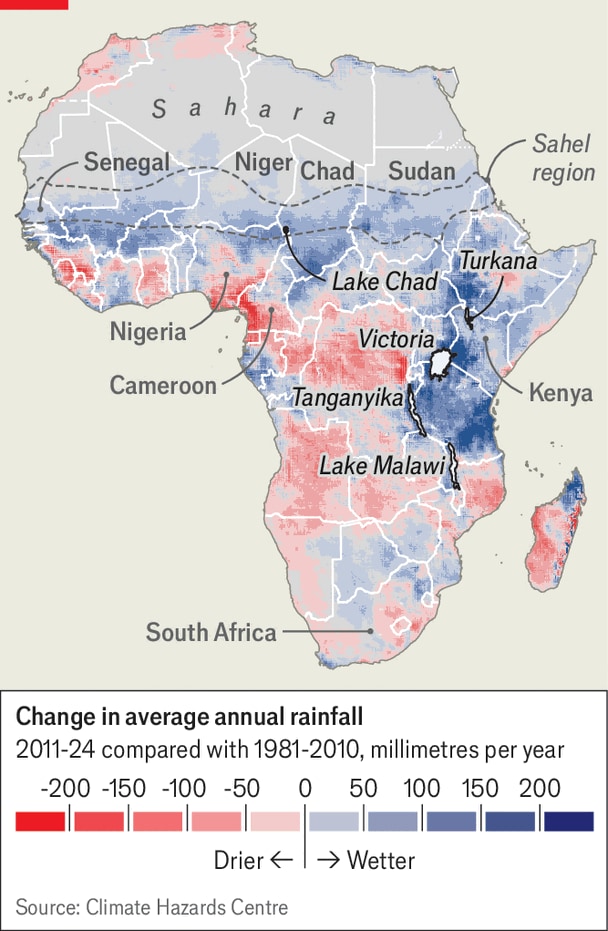
Parts of eastern and southern Africa appear to be drying. But in the Sahel, a vast semi-arid belt stretching from Senegal to Sudan, rainfall has for years been increasing (see map). The clearest sign is Lake Chad, which acts like a “giant rain gauge,” says Richard Washington of Oxford University. Another is the Sahel’s storms, which bring most of its rain. Extreme ones have become roughly three times as frequent since the early 1980s. Many climate scientists expect these trends to continue, as warming in the Sahara and the North Atlantic fuels the west African monsoon and draws more moisture into the Sahel.
In some places, that change brings the promise of better harvests. Satellite imagery shows that much of the Sahel is turning greener as once-parched lands revive. Richard Taylor of the University of Toronto says that a recent expansion in groundwater storage could, in theory, expand access to drinking water and one day even feed irrigated farms.
But more rain also means more floods. Rainfall in the Sahel in mid-2024 was between 120% to 600% above the seasonal average for the previous three decades, sweeping away villages, forcing hundreds of thousands from their homes and leaving parts of Niamey, Niger’s capital, underwater. In 2025, more than 230 people were killed in flash floods in Nigeria.
All this challenges a long and widely held belief in Africa’s relentless “desertification”. The idea of the Sahara, the world’s largest hot desert, pushing southwards into the Sahelian savannah dates back to the colonial era. A study commissioned by the UN in the 1970s claimed it was expanding in Sudan by as many as six kilometres each year. “At that stage it did indeed look as though the Sahel and west Africa as a whole was getting drier and drier in some kind of inexorable process,” says Camilla Toulmin, a British drylands expert. Based on that premise, the African Union launched the “Great Green Wall”, an initiative involving at least 22 countries in tackling soil degradation and desertification, in part by planting trees.
In future, successful adaptation may have to look very different. It will require closer attention to what Stella Shumba, a Zimbabwean climate scientist at the United Nations University Institute for Environment and Human Security, calls the “local expressions” of climate change in Africa. By some estimates the continent will need $30bn-50bn a year for adaptation by 2030. Preparing for a future that is at once wetter and drier raises both the cost and the difficulty.
In the first place, adapting means gathering more and better data, so that “we understand what is changing, how it is changing, where and when,” says Joyce Kimutai of Imperial College London and Kenya’s meteorological agency. Rainfall projections are especially tricky. In east Africa the “long rains” of March to May dwindled from the mid-1980s to around 2010, even as climate models predicted a wetter region in the future—a mismatch scientists dubbed the “eastern African paradox”.
More recently the rains have recovered somewhat, and the short rains between October and December have increased, which helps explain the dramatic rise of Lake Victoria and the lakes of Kenya’s Rift Valley. But projections for the region remain unusually unsettled, particularly for the long rains, says Caroline Wainwright of the University of Leeds. “It’s not just that we don’t know the magnitude of the future change; the direction of change is also uncertain.”
Tropical weather, especially rain, is generally much harder to simulate than the mid-latitude kind. A dearth of observations makes it harder still to test existing climate models and build better ones. Africa covers about a fifth of the world’s land, yet is estimated to host only about a tenth of its weather-monitoring stations, and perhaps half of those fail to record reliable data. The networks have thinned in recent decades. Cuts to Western aid budgets, which have long helped pay for African climate research, could hasten their decline.
The perils and promise can be seen on the shores of Lake Baringo in Kenya’s Rift Valley. The lake’s waters (pictured above) have been rising since 2010, engulfing schools, churches, homes and hotels. Nearby, some farmers are growing tomatoes on newly irrigated fields. The last rains failed. But in the coming weeks El Niño, a recurring climatic pattern that disrupts global weather, is expected to bring floods. Nobody knows for sure if the lake will continue to rise. But locals are preparing as though it will.


